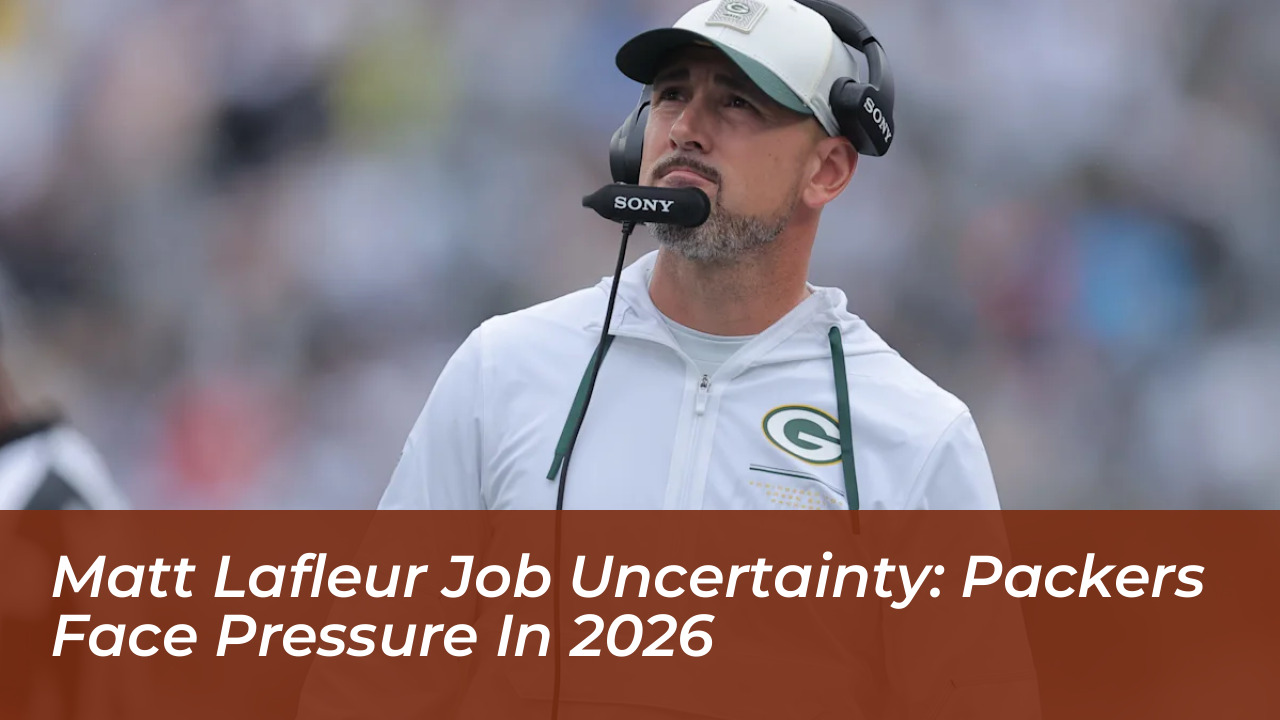
Green Bay Packers head coach Matt LaFleur enters a critical juncture in his tenure as the team navigates a challenging 2026 NFL season. Holding a volatile 1-1 record following a late-game collapse against the Minnesota Vikings in Week 1 and a narrow overtime victory against the New York Jets in Week 2, the organization faces mounting scrutiny. Less than a year after signing a multi-year contract extension, questions regarding LaFleur’s long-term job security have resurfaced across sports media and analytical circles.
- Introduction to the Rising Pressure on Matt LaFleur
- The Anatomy of Green Bay’s Postseason Drought
- Regular Season Excellence Versus January Realities
- Historical Trends in Late-Game Collapses
- Front Office Dynamics and Win-Now Mandates
- President Ed Policy and GM Brian Gutekunst Perspectives
- Financial and Cap Impact of Coaching Changes
- Tactical Regressions and Offensive Coordinator Adjustments
- Red-Zone Inefficiencies Against Disguised Defenses
- Jordan Love and Quarterback Development Under Duress
- Historical Parallels in Green Bay Coaching History
- Comparing Modern Pressure to the Mike McCarthy Era
- Frequently Asked Questions
- Is Matt LaFleur’s Job in Immediate Danger During the 2026 Season?
- How Does Matt LaFleur’s Regular-Season Record Compare to His Postseason Record?
- What Factors Contributed to the Packers Late-Game Struggles?
- What Is the Ultimate Expectation from Green Bay’s Front Office?
The core of the issue stems from a persistent disconnect between regular-season excellence and postseason execution. Since franchise quarterback Aaron Rodgers departed in 2023, the Packers have produced only one double-digit win season and failed to secure a single playoff victory. This performance trajectory has placed immense pressure on both LaFleur and general manager Brian Gutekunst to deliver immediate results, particularly after aggressive roster acquisitions signaled a strict win-now mandate.
Introduction to the Rising Pressure on Matt LaFleur
Every decision made at Lambeau Field undergoes intense examination as the Green Bay Packers try to regain their footing in a fiercely competitive NFC North. Matt LaFleur remains one of the winningest coaches in franchise history on paper, but the current climate demands more than regular-season competence. Fan expectations and front office investments have raised the bar significantly for the coaching staff.
- LaFleur guided the Packers to a stellar 76-40-1 record through his first seven seasons, establishing early offensive dominance.
- Despite multi-year contract security, consecutive postseason disappointments create an undercurrent of urgency.
- The friction between standard regular-season success and January shortcomings defines the current organizational narrative.
- Front office patience wears thin as executive leadership demands cleaner execution in high-leverage moments.
Evaluating this dynamic requires looking past the surface numbers. The transition from a legendary quarterback era to a young roster brought predictable bumps, but the recurring nature of late-game execution failures points to deeper structural concerns.
The Anatomy of Green Bay’s Postseason Drought
Regular Season Excellence Versus January Realities
LaFleur boasts an impressive regular-season resume, ranking among the top coaches in NFL history through his first seven campaigns with that 76-40-1 record. However, January football reveals a starkly different narrative. Green Bay owns a 3-6 postseason record under his leadership and has not appeared in an NFC Championship Game since the 2020 season. Recent playoff exits highlight recurring vulnerabilities in closing out games against elite competition.
Statistical tracking shows a troubling trend where offensive efficiency drops significantly once the calendar turns to the postseason. Opposing coordinators utilize extra film study to neutralize LaFleur’s scripted opening drives, forcing the Packers into predictable offensive patterns. Without explosive plays to bail out stalled drives, Green Bay often squanders leads built during the first three quarters.
Historical Trends in Late-Game Collapses
The Packers suffered a devastating wild-card defeat against the Chicago Bears after blowing a substantial second-half lead. Statistical tracking from NFL.com highlighted a troubling historical trend: Green Bay became the first team since the 1970 merger to lose three games in a single season, including playoffs, after holding a lead of at least 10 points in the final five minutes. These recurring late-game struggles forced a radical offseason evaluation.
LaFleur openly admitted that closing out tight contests remained a primary point of emphasis, leading him to strip down his offensive scheme and review foundational details as if starting over from Year One. Despite these internal adjustments, the early weeks of the 2026 season suggest that execution ghosts from previous years continue to haunt the squad.
Front Office Dynamics and Win-Now Mandates
President Ed Policy and GM Brian Gutekunst Perspectives
Team president Ed Policy and general manager Brian Gutekunst face critical decisions regarding organizational direction. When Policy assumed his role, he emphasized stability and a desire to avoid lame-duck coaching situations. While Policy expressed unwavering confidence in LaFleur during contract discussions, he also publicly acknowledged the collective disappointment of failing to capture a Super Bowl title over seven seasons.
Gutekunst mirrored this sentiment during summer shareholder meetings, stressing that the roster must master the art of finishing games and maintaining composure during high-leverage moments. The front office reinforced this win-now philosophy by trading valuable draft capital for star defender Micah Parsons, signaling zero tolerance for a rebuilding phase and raising the baseline expectations for the coaching staff.
Financial and Cap Impact of Coaching Changes
Modern NFL revenue structures dictate that coaching staff buyouts carry substantial financial weight. While Green Bay operates under a unique publicly owned business model with a healthy financial reserve, firing a recently extended head coach triggers complex salary cap and cash flow considerations. These fiscal realities influence executive decision-making, ensuring that mid-season terminations remain an absolute last resort.
However, if the team spirals out of contention by November, financial penalties take a backseat to the preservation of ticket sales, season-ticket holder satisfaction, and overall franchise valuation. Front office patience directly correlates with the trajectory of on-field performance.
Tactical Regressions and Offensive Coordinator Adjustments
Red-Zone Inefficiencies Against Disguised Defenses
Play-calling tendencies during fourth-quarter offensive regressions reveal a noticeable drop in rhythm. Opposing defenses increasingly exploit Green Bay formations using Cover-2 shells and complex zone schemes that neutralize intermediate crossing routes. When the field shrinks in the red zone, LaFleur’s play-calling sometimes relies on horizontal concepts rather than vertical shots or power running.
This conservative shift invites defenders to jump routes and blow up blocking assignments in the backfield. Fixing these red-zone inefficiencies requires a willingness to trust the passing game outside the numbers and establish a physical presence on early downs.
Jordan Love and Quarterback Development Under Duress
Jordan Love experiences erratic performance metrics in high-pressure defensive scenarios. Distinguishing between play-calling conservatism and quarterback progression milestones is essential for evaluating the offense. When blitzed heavily, Love occasionally holds the ball too long, leading to avoidable sacks and stalled drives.
The coaching staff must design quicker hot reads and simpler pre-snap answers to help their young signal-caller process complex coverages efficiently. Growth depends heavily on how quickly Love adapts to disguised coverages in crunch time.
Historical Parallels in Green Bay Coaching History
Comparing Modern Pressure to the Mike McCarthy Era
Examining past Packers regimes reveals clear patterns in how leadership handles transitional phases post-dynasty. The final seasons of the Mike McCarthy era offer a striking parallel to the current pressure metrics surrounding LaFleur. When championship windows narrow and the roster features star talent, front office tolerance thresholds shift rapidly from developmental patience to demanding immediate championship contention.
Franchise history shows that Green Bay leadership rarely hesitates to make sweeping changes when stagnant postseason performances threaten the prime years of elite rosters. Understanding this historical precedent helps contextualize why every single loss in the 2026 season carries amplified weight for the coaching staff.
Frequently Asked Questions
Is Matt LaFleur’s Job in Immediate Danger During the 2026 Season?
While LaFleur signed a multi-year contract extension, the Packers slow start to the 2026 campaign and history of late-game collapses have intensified scrutiny. Front office patience depends heavily on whether the team secures a decisive playoff berth and executes effectively in critical moments.
How Does Matt LaFleur’s Regular-Season Record Compare to His Postseason Record?
LaFleur maintains an elite regular-season winning percentage, compiling a 76-40-1 record through his first seven seasons. However, his postseason record stands at 3-6, with no conference championship game appearances since the 2020 season.
What Factors Contributed to the Packers Late-Game Struggles?
Green Bay struggles with execution in the final minutes of close contests, including historical losses after holding double-digit leads. Injuries to key personnel, red-zone inefficiencies, and turnovers further exacerbate these late-game vulnerabilities.
What Is the Ultimate Expectation from Green Bay’s Front Office?
Team president Ed Policy and general manager Brian Gutekunst demand consistent execution, improved composure in high-leverage situations, and deep postseason runs, especially after making aggressive roster moves to acquire elite talent like Micah Parsons.