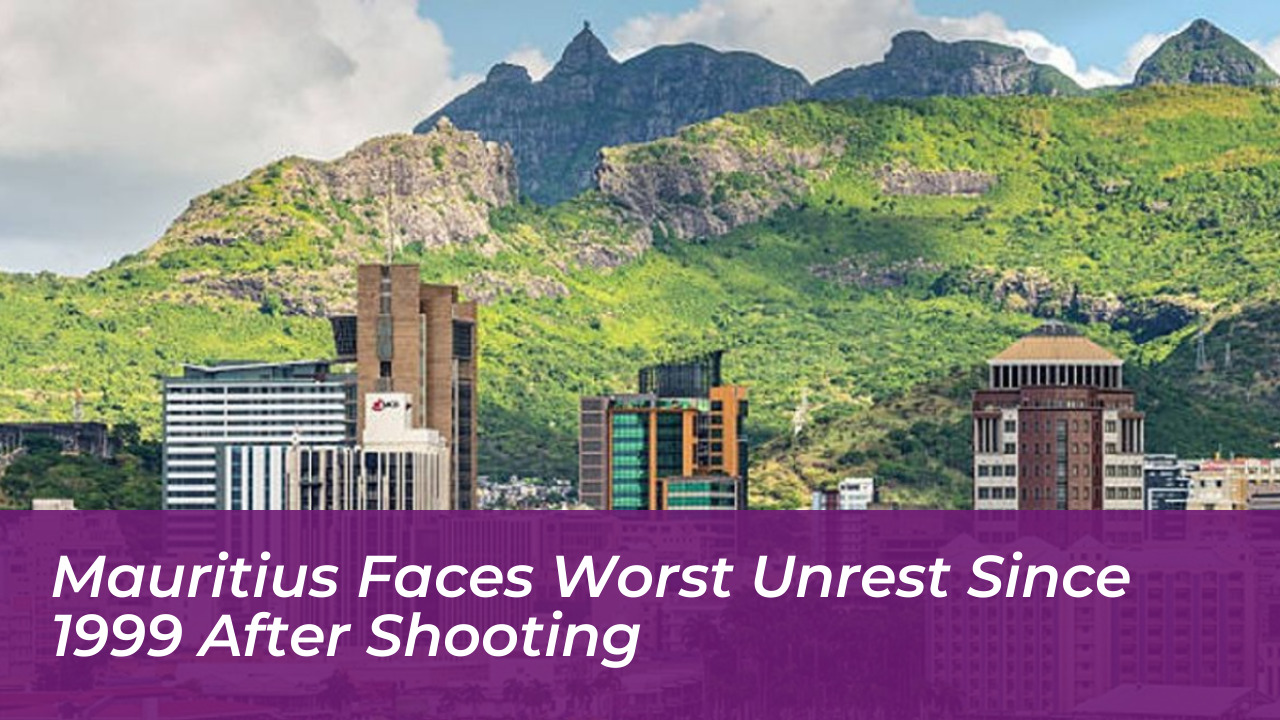

Mauritius has experienced its most severe public unrest in more than two decades. Widespread demonstrations over utility shortages and living costs intensified following the police shooting of a 27-year-old woman.
The unrest began on October 7 in the central region of the main island. Residents took to the streets to protest severe water shortages and mounting living expenses. Demonstrations escalated sharply after police shot and injured Élodie Thomas on October 9. The incident sparked public outrage across the Indian Ocean island nation, prompting clashes with security forces and widespread disruptions.
Escalation and Clashes in Rose Hill
Following the shooting, demonstrators set up roadblocks across major transport routes. They used burning tyres, broken furniture, and discarded mattresses. Tensions culminated on October 12 in Rose Hill, a major town located south of the capital, Port Louis. Protesters attacked and set fire to a local police station.
The government ordered schools closed. Business groups advised private sector employers to transition staff to remote work arrangements. To treat Thomas, specialised surgeons were flown in from India to perform an emergency operation to remove a bullet.
Prime Minister Navinchandra Ramgoolam confirmed that the police officer responsible for the shooting has been arrested and charged. In a public address on October 11, Ramgoolam appealed for national restraint.
“I have insisted that the investigation proceed as quickly as possible to establish the exact circumstances of this tragedy and determine where responsibility lies,” Ramgoolam said. “In these painful moments, anger is understandable. However, it must not lead to further tragedies.”
Ramgoolam convened an emergency Cabinet meeting to address the security situation and review public infrastructure demands.
Parallels to the 1999 Riots
The unrest marks the island’s most widespread civil disturbance since February 1999. At that time, mass riots broke out following the death of popular seggae musician Joseph Reginald Topize, known as Kaya, while in police custody. The 1999 violence resulted in several deaths, widespread looting, and property damage before order was restored.
Historian and political analyst Jocelyn Chan Low noted striking structural similarities between the two crises. He pointed out that public frustration with law enforcement acted as a catalyst for deeper grievances.
“This time again, as in 1999, the police are the main target,” Chan Low said. “The scale of the violence has multiplied, with police stations and vehicles set ablaze. The root cause for the unrest is almost similar.”
Economic Pressures and Drought
While street violence is rare in Mauritius, underlying economic pressures have built up over recent months. Mauritius ranks as Africa’s second-richest country per capita behind Seychelles. However, the island nation has been heavily exposed to international commodity fluctuations.
A prolonged drought across the archipelago has severely depleted municipal reservoirs. This prompted authorities to impose strict water-use restrictions in several residential zones. At the same time, regional conflicts in the Middle East have driven up imported fuel and food prices, placing pressure on household budgets.
Return to Order and Market Stability
By mid-October, security forces reported that the situation had stabilized. The Mauritius Police Force confirmed that public roads were cleared and normal transit had resumed. Local banks and the Stock Exchange of Mauritius operated without interruption.
Market analysts expect the country’s core tourism and financial services industries to withstand the shock, provided order is maintained.
“Unless the unrest persists, tourism and investor confidence are unlikely to be affected,” said Zoë McCathie, country risk analyst at Signal Risk. “Mauritius is still seen to have a business-friendly environment.”
Authorities continue to monitor sensitive districts while judicial proceedings against the detained officer move forward.