
Sitting still for ten minutes sounds easy until you try it. The first minute feels fine, the second minute your shoulders itch, and by the third minute you are planning dinner, replaying a conversation from yesterday, and wondering whether the washing machine has finished. That restless feeling is not a sign that meditation is not for you. It is the reason a log helps, because the only way to know whether sitting is getting easier is to write down what happened each day.
This free printable meditation log gives you two monthly pages and a practice guide in one short PDF. Each day gets one line: how many minutes you sat, which technique you used, and a calm rating from 1 to 5. After a few weeks the pattern shows itself. Maybe mornings work better than evenings, or maybe guided sessions calm you faster than silent sitting. The log does not judge the numbers, it just keeps them, so you can see a habit forming instead of guessing. If you already track other daily habits, the free printable monthly habit tracker pairs well with this log. You can also browse the full Health, Habits & Wellness collection for more.
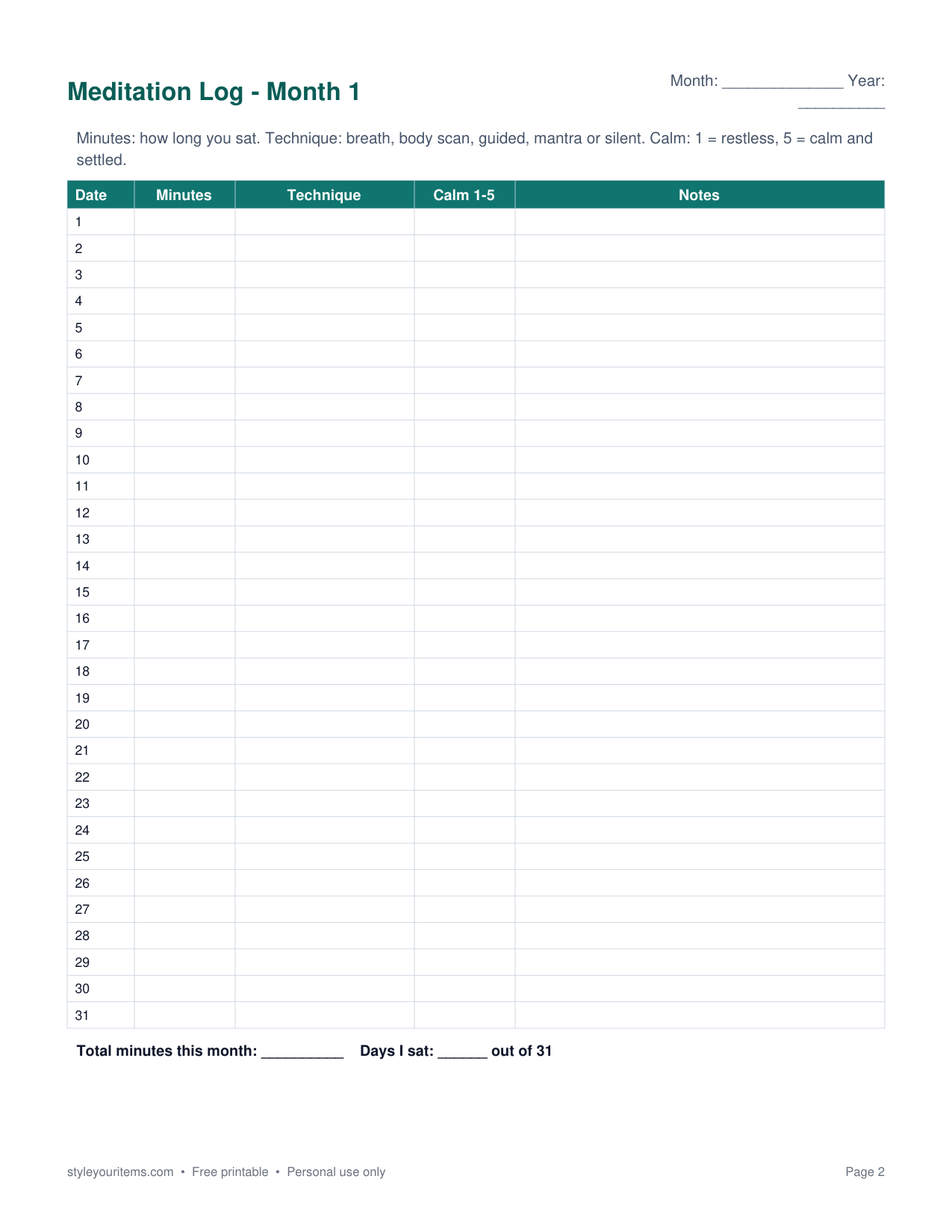
What the log records each day
The PDF has four pages: a cover, two monthly log pages, and a practice page with technique ideas and a calm scale. Every day on the log has the same five columns, so filling it in takes less than a minute after you sit.
| Column | What to write |
|---|---|
| Date | The day of the month, 1 to 31 |
| Minutes | How long you sat, even if it was only 3 minutes |
| Technique | Breath counting, body scan, guided, mantra, or silent sitting |
| Calm 1-5 | 1 means restless, 5 means calm and settled |
| Notes | One short line: what helped, or what got in the way |
At the bottom of each monthly page there is a line for your total minutes and the number of days you sat. Those two numbers are the whole point of the log. A month with 200 minutes across 20 days tells you far more than a vague feeling that you “meditated a bit”. The practice page at the back explains the five techniques and what each calm rating feels like, so a 3 means the same thing in week one and week four.
A filled-in week, so you can see it working
Here is what one ordinary week in the log might look like. Nothing dramatic, just a person sitting for a few minutes a day and writing it down honestly.
| Day | Minutes | Technique | Calm | Notes |
|---|---|---|---|---|
| Monday | 5 | Breath counting | 2 | Mind kept wandering to work emails |
| Tuesday | 10 | Guided | 3 | A voice to follow made it easier |
| Wednesday | 10 | Breath counting | 3 | Counted to 10 three times without losing track |
| Thursday | 5 | Body scan | 4 | Shoulders relaxed for the first time |
| Friday | 15 | Guided | 4 | Longest sit so far, felt steady |
| Saturday | 10 | Silent sitting | 3 | Noisy morning, but stayed the full 10 minutes |
| Sunday | 15 | Mantra | 5 | Quiet house, calmest sit of the week |
That week adds up to 70 minutes across 7 days. The calm ratings climb from 2 to 5, not because the person got good at meditating in a week, but because the log showed them what worked: guided sessions on busy days, a quieter spot on Sunday, and short sits on days when time was tight. Your week will look different, and that is fine. The log is a mirror, not a scoreboard, and a 2 written honestly is worth more than a 5 written to impress yourself.
Small rules that keep the streak alive
- Start at five minutes, not twenty. Five minutes you actually do beats twenty minutes you keep putting off. Add a minute or two each week, only when five feels easy.
- Sit at the same time every day. Right after waking up works for most people, because the day has not started arguing with you yet. A fixed time turns sitting into a habit instead of a decision.
- Fill the log in straight after sitting. If you wait until bedtime, the minutes blur and the calm rating becomes a guess. The log lives next to your cushion or chair, not in a drawer.
- Count a short sit as a win. Three minutes on a bad day still counts. The streak that matters is days sat, not minutes sat, and a short sit keeps the streak alive.
- Change the technique, not the habit. If breath counting feels stale, try a body scan or a guided session. A new technique is a fresh start, and the log will show you which one suits you. The free printable sleep tracker is a good next log if evening sitting starts improving your sleep.
How to print and start
- Print the PDF single-sided on Letter or A4 at 100 percent scale, so the columns stay wide enough to write in.
- Pick your sitting spot and time before the first session. A quiet corner and a fixed time matter more than a cushion or an app.
- Write the month at the top of Month 1 and sit for five minutes. Any technique from the practice page will do for day one.
- Fill in the line straight after sitting: minutes, technique, calm rating, and one short note. That is the whole job.
- At the end of the month, add up the totals at the bottom of the page, then start Month 2 on a fresh sheet. Compare the two months and keep whatever worked.
Questions people ask
How long should I meditate each day?
Start with five minutes. Most people settle somewhere between ten and twenty minutes after a month or two, but there is no target to hit. The log works at any length, because it tracks what you did, not what you should have done.
What if I miss a day?
Leave the line blank and sit again tomorrow. A blank line is information, not failure: it shows you which days are hardest, usually the busiest ones. Two blank days in a row is the moment to shrink the sit back to five minutes and restart the streak.
Which technique should a beginner pick?
Guided meditation is the easiest first step, because a voice gives your attention somewhere to rest. Breath counting is the simplest once you are comfortable sitting alone. Try each technique on the practice page for a week and let the calm ratings decide.