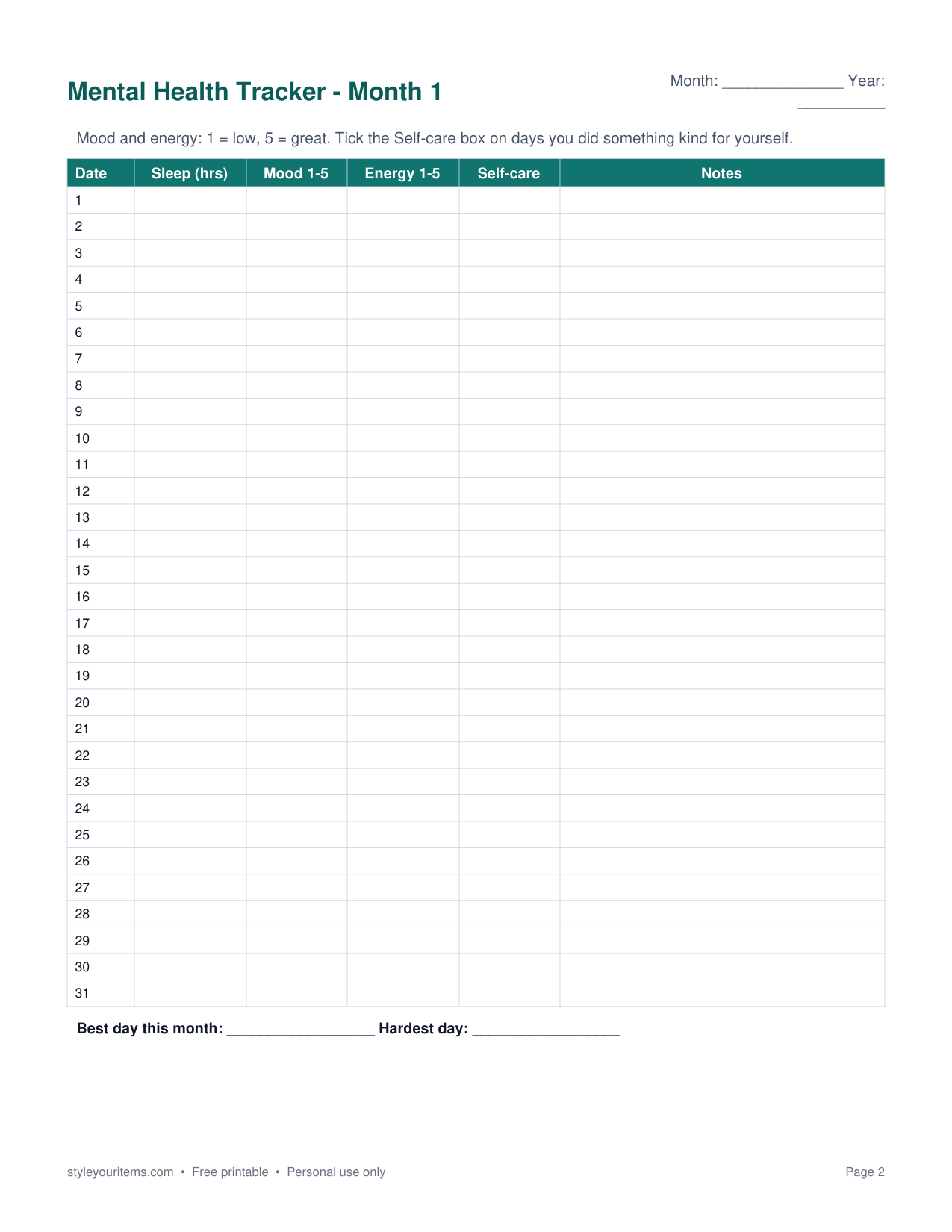
Most of us can say whether we had a good day or a bad day, but very few of us can say why. Was it the short night, the skipped lunch, the argument at work, or the walk we did not take? A mood on its own tells you almost nothing. A mood next to sleep, energy and self-care tells you a story. This free printable mental health tracker is built for that story. It is a simple daily log: how long you slept, how your mood felt on a scale of one to five, how much energy you had, whether you did something kind for yourself, and a line for notes.
The PDF has four pages: a cover and two monthly logs, each with thirty-one dated rows, plus a patterns page at the end. Each monthly page holds a full month, so one print covers you from the first to the last day, and the second page carries you into the next month. The patterns page is where the tracking pays off: what lifted your mood, what drained your energy, the sleep pattern you noticed, one small thing to try next month, and space for notes to share with a clinician. Print it, keep it somewhere you will see it at night, and fill it in before bed. It takes less than a minute, and that minute is the whole point.
One week, filled in, so you can see the pattern
Here is a week from a filled-in tracker, so you can see how little it takes to spot something useful. The numbers are small, one to five, and the notes are short. Nothing here needs a paragraph. The pattern does the talking.
| Date | Sleep | Mood | Energy | Self-care | Notes |
|---|---|---|---|---|---|
| Mon 5 | 7 hrs | 4 | 4 | Yes | Walk after lunch, felt steady |
| Tue 6 | 5.5 hrs | 2 | 2 | No | Late night, woke up tired |
| Wed 7 | 6 hrs | 3 | 3 | Yes | Ten minutes reading before bed |
| Thu 8 | 8 hrs | 5 | 5 | Yes | Early night, best day of the week |
| Fri 9 | 6.5 hrs | 3 | 2 | No | Long meeting day, skipped lunch |
| Sat 10 | 7.5 hrs | 4 | 4 | Yes | Cooked a proper dinner |
| Sun 11 | 7 hrs | 4 | 3 | Yes | Phone off after 9 pm |
Read that week as a whole and the lesson is plain: the two best days follow the two longest nights, and the worst day follows the shortest one. Nobody needed a lecture about sleep to see it. The numbers showed it. That is why the tracker asks for sleep first, before mood. When a low day arrives, the first question is not “what is wrong with me”, it is “what did yesterday look like”. The sleep tracker goes deeper on nights alone, with bedtimes and wake times, if sleep turns out to be the thread worth pulling.
Five small habits that make the tracker work
- Fill it in at night, not in the morning. Mood and energy are guesses by morning. At night they are fresh. Keep the sheet by the bed and make it the last thing you do, next to plugging in the phone.
- Score fast, and do not argue with the number. One to five, first instinct, move on. A tracker you agonise over is a tracker you abandon. The pattern across thirty days matters, not whether Tuesday was a three or a four.
- Count small self-care, not grand gestures. A ten-minute walk, a proper lunch, a chapter of a book, a phone call to a friend. If it only counts when it is a spa day, the box stays empty, and an empty box teaches you nothing.
- Write the note in five words or fewer. “Late night, woke up tired” is enough. Long diary entries belong in a journal, and our gratitude journal is the sheet for those. The tracker note is a label, not a story.
- Read it back at the end of the month. Sit with the patterns page and answer its four prompts honestly. One page of looking back is worth more than thirty days of filling in, because it turns data into a decision: earlier nights, a walk at lunch, or a conversation with your doctor. The monthly habit tracker pairs well here if the decision becomes a habit you want to keep.
Two honest notes about this sheet. First, it is a self-help tool, not a diagnosis. If low mood or low energy lasts for weeks, or gets worse, please talk to a doctor or a mental health professional, and take the filled-in pages with you. A clinician learns more from a month of numbers than from a single “I have been feeling low”. Second, the sheet is private. There is no name line and no account, and nothing leaves your home. It is paper, and paper keeps secrets well. You will find it in the Health, Habits and Wellness collection, alongside trackers for sleep, water and weight.
Frequently asked questions
How long should I track before I see a pattern?
About two weeks is enough to see the first links, usually between sleep and mood. A full month is better, because it covers workdays, weekends and at least one bad week. Print both monthly pages and commit to one month first.
What counts as self-care on this sheet?
Anything you did for yourself on purpose: a walk, a bath, a proper meal, time with a friend, an early night, ten quiet minutes. It does not need to cost money or take an hour. If it made the day kinder, tick the box. Our monthly budget planner can help if cost is the thing stopping you.
Can I share this tracker with my doctor or therapist?
Yes, and that is one of the reasons the patterns page exists. Bring the two monthly pages and the patterns page to your appointment. The notes are yours, so share only what you are comfortable sharing.
Is this a replacement for treatment?
No. Tracking helps you notice and helps a professional understand, but it does not treat depression, anxiety or any other condition. If you are struggling, please reach out to a professional, a helpline in your country, or someone you trust.