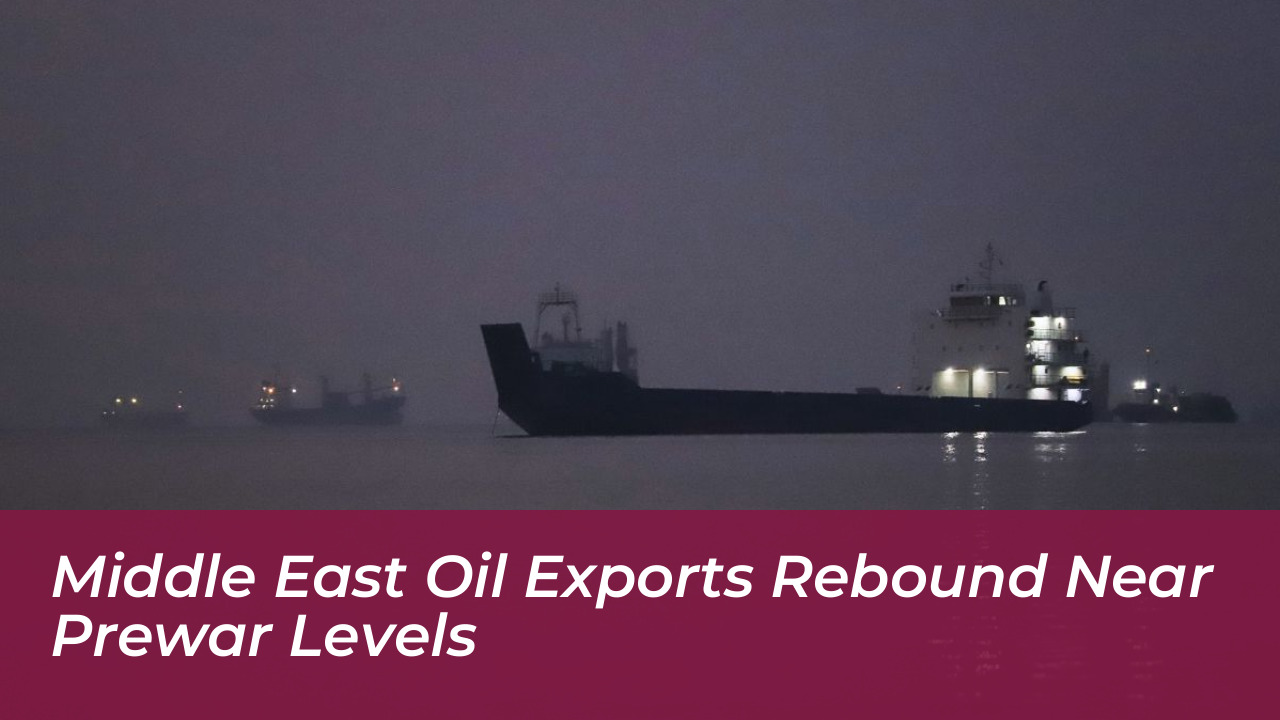
Middle Eastern crude oil exports have recovered to nearly 98 percent of prewar levels. Military-escorted shuttles and alternative pipeline routes now bypass ongoing war risks in the Strait of Hormuz. Data tracking firm Kpler reports that crude and petroleum product shipments through the crucial waterway averaged 13.1 million barrels daily. This represents nearly 80 percent of its prewar volume, while broader regional figures have climbed significantly.
- Naval Operations and Rerouting Strategies
- Diverging Energy Sectors and LNG Disruptions
- Market Response and Future Outlook
- Frequently Asked Questions
- What percentage have Middle Eastern oil exports recovered to?
- How are tankers bypassing Strait of Hormuz risks?
- Why are Qatari LNG exports still disrupted?
- How has Saudi Arabia contributed to the export recovery?
- What role does the US Navy play in maintaining oil flows?
Data compiled by JPMorgan Chase & Co. indicates that overall Middle Eastern oil exports reached 17.5 million barrels per day in September 2026. Goldman Sachs Group Inc. provided even higher estimates, calculating that total Gulf exports-including clandestine dark flows-rebounded to 23.3 million barrels per day. This matches typical 2025 averages as the regional conflict entered its eighth month.
Naval Operations and Rerouting Strategies
The resilience of the global energy market relies heavily on complex naval operations, stealthy dark transits, and flexible rerouting strategies. Saudi Arabia drove this recovery by more than doubling its monthly exports from 2.45 million barrels per day in August to roughly 5.4 million barrels per day in September.
To sustain these volumes, Saudi Arabia initially diverted shipments to the Red Sea via its East-West pipeline. However, an attack on the cross-country conduit forced flows back through the Strait of Hormuz, with Western ports later resuming full operations. The US Navy has actively assisted commercial transits by other nations’ vessels through the contested maritime corridor while maintaining a strict blockade on Iranian ports.
Diverging Energy Sectors and LNG Disruptions
While crude oil flows have largely stabilized, the broader energy sector faces an uneven recovery, particularly regarding liquefied natural gas (LNG). QatarEnergy continues to experience major logistics hurdles because every LNG tanker leaving Qatar must pass directly through the Strait of Hormuz.
Several Qatar-linked LNG tankers resumed crossings in September, including vessels heading to India, Pakistan, and China. However, normal export schedules have not resumed. QatarEnergy extended force majeure delivery suspensions for various European and Asian customers through November and early December. Italian energy firm Edison reported that six additional LNG cargoes destined for its Adriatic terminal would not be delivered. This brings its total missed cargoes since April to 35.
Qatar’s Energy Minister Saad Sherida Al-Kaabi noted that building an alternative pipeline to bypass the strait makes no economic sense. Such a project would require constructing an entirely new liquefaction plant outside the country. Meanwhile, attacks on Ras Laffan damaged two LNG production units, reducing Qatar’s total production capacity by approximately 17 percent.
Market Response and Future Outlook
Despite the successful workaround of regional shipping choke points, global energy markets remain highly sensitive. International benchmark Brent crude remains on track for a notable third consecutive monthly gain. It currently trades around $103.43 a barrel amid lingering fears of renewed military escalation that could damage vital regional infrastructure.
Analysts emphasize that higher crossing counts reflect the oil shipping industry’s tactical ability to operate under sustained risk. They do not signal an actual improvement in regional security. As diplomatic channels and indirect talks via Qatari and Pakistani mediators continue, energy traders closely monitor whether naval escorts can maintain these supply lines indefinitely.
Frequently Asked Questions
What percentage have Middle Eastern oil exports recovered to?
Crude oil exports have recovered to nearly 98 percent of prewar levels, reaching 17.5 million barrels per day according to JPMorgan estimates. Overall regional flows through alternative routes and Hormuz sit at roughly 80 percent of prewar volume.
How are tankers bypassing Strait of Hormuz risks?
Exporters are utilizing military-escorted shuttles, alternative pipeline systems like Saudi Arabia’s East-West conduit, and clandestine dark transits where ships temporarily disable tracking systems.
Why are Qatari LNG exports still disrupted?
All Qatari LNG shipments must transit the Strait of Hormuz. Despite some recent crossings, force majeure suspensions remain in effect for several European and Asian buyers following infrastructure damage at Ras Laffan.
How has Saudi Arabia contributed to the export recovery?
Saudi Arabia more than doubled its monthly exports from 2.45 million barrels per day in August to about 5.4 million barrels per day in September, leading the volume rebound through the Gulf terminals.
What role does the US Navy play in maintaining oil flows?
The US Navy enforces a blockade on Iranian ports while providing direct operational assistance and escort services to commercial vessels navigating the contested waters of the Strait of Hormuz.