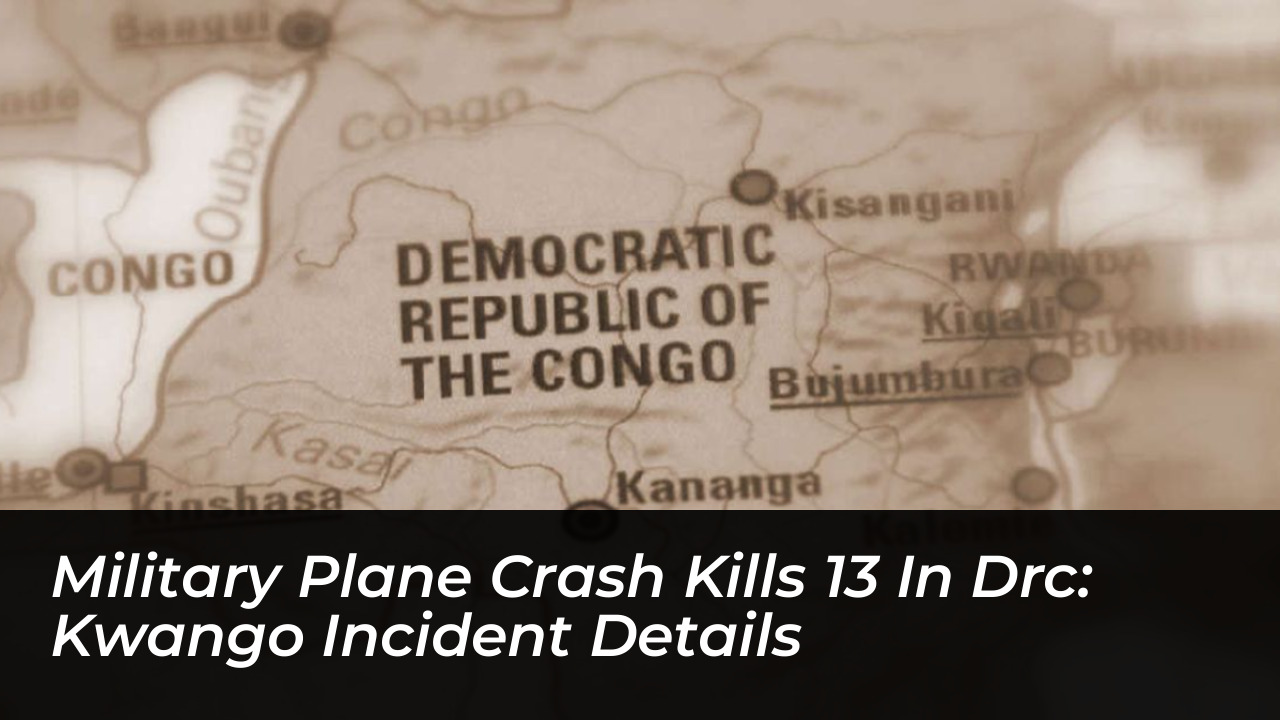
A fatal aviation accident occurred in the western region of the Democratic Republic of Congo on Friday, September 25, 2026. A twin-engine turboprop aircraft carrying 13 individuals suffered catastrophic mechanical issues mid-flight, resulting in a crash with zero survivors. The disaster took place during an attempted forced landing in Kwango province as the crew tried to reach a safe landing area after departing from Kikwit Aerodrome.
- Overview of the Democratic Republic of Congo Aviation Tragedy
- Flight Route and Operational Profile
- Departure From Kikwit
- Intended Destination Kinshasa N’Dolo
- Aircraft and Operator Background
- Let L-410 Specifications and Registration 9S-GUC
- Tracep Congo Aviation Operations
- The Emergency Diversion and Crash at Kenge
- Mid-Flight Mechanical Distress
- Ground Impact in the Manzaw Neighborhood
- Emergency Response and Local Governance
- First Responder Actions and Site Security
- Regional and Federal Coordination
- Infrastructure Challenges in Interior DRC Provinces
- Deficit of Operational Landing Strips
- Risks of Abandoned Aerodromes
- Frequently Asked Questions
- What caused the plane crash in Kwango province?
- How many people were on board the flight?
- Which airline operated the aircraft?
- What type of aircraft was involved in the incident?
- Why did the plane try to land in Kenge?
Overview of the Democratic Republic of Congo Aviation Tragedy
The tragic event sent shockwaves through both local communities and the broader aviation sector in Central Africa. Initial assessments confirm that all 13 passengers and crew members aboard the aircraft perished in the high-velocity ground impact. Emergency responders and local municipal authorities reached the site shortly after the collision, securing the perimeter and beginning the grim task of recovery.
The incident underscores the extreme operational hazards facing regional carriers in developing aviation markets. Transport safety advocates point to aging fleets and deficient ground infrastructure as persistent challenges that amplify the risks of routine regional transit across the interior provinces.
Families and colleagues of the victims are awaiting formal identification processes handled by national forensic teams. Aviation authorities have promised a transparent investigation to determine accountability and prevent future operational failures.
Flight Route and Operational Profile
Departure From Kikwit
The flight departed from Kikwit, a major commercial hub located in Kwilu province. Kikwit Aerodrome serves as a vital air transport link for passengers and goods moving west toward the capital. Flights along this regional transit corridor routinely carry local commuters, regional commerce items, and technical staff across western provinces.
Operations at Kikwit require careful scheduling and reliance on visual flight rules for many smaller carriers. Because ground support equipment is limited, pilots carry the primary burden for pre-flight inspections and weather evaluations before lifting off toward urban centers.
Local weather patterns around Kikwit often shift rapidly during seasonal transitions, adding extra pressure on flight crews. Dispatchers maintain communication with pilots through basic radio channels as long-range radar coverage remains limited.

Intended Destination Kinshasa N’Dolo
The aircraft was routed directly to Kinshasa N’Dolo Airport, an urban airfield situated near the center of the capital city. N’Dolo Airport manages regional, cargo, and domestic general aviation traffic, operating independently from the larger N’Djili International Airport.
As the flight neared the final stages of its journey, the crew encountered critical technical anomalies that disrupted their flight plan. Air traffic controllers received distress signals indicating severe system degradation just minutes before the diversion was initiated.
Air traffic controllers at N’Dolo cleared surrounding airspace immediately upon receiving the emergency call. Unfortunately, the rapid deterioration of flight control systems made reaching the capital impossible for the struggling aircraft.
Aircraft and Operator Background
Let L-410 Specifications and Registration 9S-GUC
The aircraft involved was a Let L-410, a widely utilized short-range twin-engine turboprop designed for regional passenger and freight operations. Manufactured for unpaved and short-takeoff-and-landing operations, the airframe carries up to 19 passengers with rugged landing gear systems suited for remote territories.
The specific aircraft carried civil registration designation 9S-GUC, which civil aviation databases track under regional transport registries. Investigators from the transport ministry are actively examining historical maintenance logs, airframe flight hours, and component overhaul records associated with this specific tail number.
Technical inspectors are paying close attention to engine performance records and fuel system maintenance. Parts availability for Soviet-era design airframes remains a chronic hurdle for regional operators striving to maintain strict safety standards.
Tracep Congo Aviation Operations
Tracep Congo Aviation operated the fatal flight, running charter services and regional transport routes within the country. The airline connects regional provincial capitals with primary logistics centers in Kinshasa, providing a lifeline for remote areas lacking reliable road networks.
Regulatory oversight for regional operators remains a subject of intense scrutiny following the accident. Federal transport authorities are reviewing compliance records across similar domestic carriers to ensure adherence to mandatory maintenance schedules and pilot training protocols.
Company representatives have expressed full cooperation with government investigators and civil aviation regulators. Management teams are currently auditing internal safety practices across all active routes to restore public confidence.
The Emergency Diversion and Crash at Kenge
Mid-Flight Mechanical Distress
While en route between Kwilu and Kinshasa, the aircraft encountered sudden technical failures that prompted the flight crew to alert regional air traffic controls. Facing severe system degradation, the pilots selected an immediate diversion point rather than continuing toward Kinshasa.
Choosing an emergency diversion requires split-second calculations regarding altitude, fuel reserves, and the distance to alternative landing sites. With no major fully equipped airports nearby, the crew targeted Kenge as the most viable option within gliding distance.
Cockpit voice recorders and flight data monitors will provide exact timelines regarding the mechanical failure. Investigators aim to reconstruct the final minutes to understand how the crew managed the failing flight systems.

Ground Impact in the Manzaw Neighborhood
Unable to reach an active runway, the aircraft struck a residential plot within the Manzaw area of Kenge, a zone adjacent to a former municipal aerodrome. Kwango Vice Governor Remy Saki Bokinda confirmed that the lack of active aviation infrastructure in Kenge directly hindered the pilots’ emergency landing attempt.
Ground observers reported significant structural damage to private properties within the residential plot. Local emergency personnel conducted immediate ground searches to verify whether any residents on the ground suffered injuries during the destructive impact.
Engineers are analyzing the impact angle and final velocity vectors to map the aircraft trajectory. Structural analysis of the debris field confirms a high-speed vertical descent into the populated sector.
Emergency Response and Local Governance
First Responder Actions and Site Security
Local police units, military personnel, and municipal emergency teams established a security cordon around the crash site immediately following impact. Response teams focused on suppressing localized fires, securing the wreckage, and beginning the recovery of victim remains.
Crowd control proved challenging as curious onlookers gathered near the impact zone. Security forces maintained a strict perimeter to preserve forensic evidence required by federal accident investigators.
Medical teams set up temporary triage stations near the perimeter to support distressed family members and local residents. Local hospitals prepared mortuary facilities to receive the victims recovered from the site.
Regional and Federal Coordination
Provincial administrators in Kwango initiated immediate coordination with federal transport ministry authorities in Kinshasa to facilitate access for accident investigators. Officials organized logistics to transport technical experts directly to the crash scene.
Kwango Vice Governor Remy Saki Bokinda issued formal briefings to update regional news organizations on recovery operations. Provincial leadership pledged full support to the families of the victims while assisting federal teams in piecing together the sequence of events.
Inter-agency task forces are reviewing emergency response times to identify areas for improvement in rural disaster management. Future planning will prioritize better communication equipment for regional municipal authorities.
Infrastructure Challenges in Interior DRC Provinces
Deficit of Operational Landing Strips
The tragic outcome highlights systemic infrastructure deficits across interior provinces where operational landing fields remain sparse. Former airstrips suffer from years of neglect, erosion, and residential encroachment, making forced landings exceptionally hazardous.
Without functional instrument landing systems or emergency runway lighting in rural districts, pilots facing catastrophic failures have virtually no margin for error when executing emergency maneuvers.
National development plans must address regional airport modernization to support growing domestic commercial traffic safely. Upgrading rural aviation facilities is essential for economic integration and emergency medical evacuation.
Risks of Abandoned Aerodromes
Abandoned or inactive aerodromes frequently attract residential settlement due to flat terrain layouts, leading pilots in distress toward populated neighborhoods instead of open runways. Urban expansion in towns like Kenge has systematically swallowed buffer zones around historical aviation sites.
Transport safety experts emphasize that reclaiming or properly fencing disused airstrips is essential to prevent future ground collisions. Clear regulatory policies regarding land use around aviation facilities remain urgent priorities for municipal planners across the country.
Zoning enforcements need urgent strengthening to prevent housing developments on designated aviation safety corridors. Protecting these open spaces ensures that future pilots in distress retain viable emergency landing zones.
Frequently Asked Questions
What caused the plane crash in Kwango province?
The aircraft suffered severe mid-flight mechanical issues, forcing the crew to attempt an emergency landing.
How many people were on board the flight?
A total of 13 individuals, including passengers and crew members, were on board the twin-engine turboprop.
Which airline operated the aircraft?
The flight was operated by Tracep Congo Aviation as part of its regional transport network.
What type of aircraft was involved in the incident?
The aircraft was a Let L-410 short-range twin-engine turboprop with civil registration 9S-GUC.
Why did the plane try to land in Kenge?
The flight crew initiated an emergency diversion toward Kenge after experiencing critical system failures en route to Kinshasa.