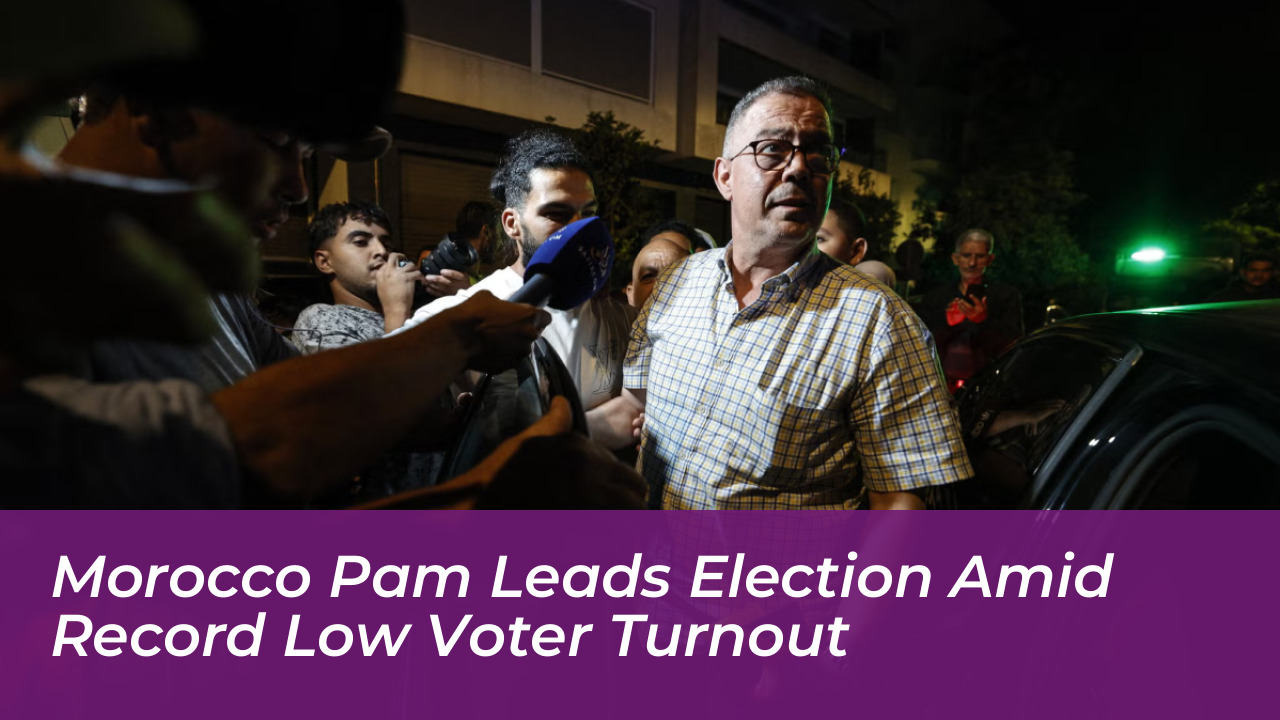
Morocco’s parliamentary elections have delivered a transformative political shift, establishing the Authenticity and Modernity Party (PAM) as the largest political force in the 395-seat House of Representatives. Provisional results released by Interior Minister Abdelouafi Laftit show that PAM secured 97 seats, improving upon its 87 seats from the previous election. This victory places the monarchy-aligned party at the center of upcoming coalition talks under Article 47 of Morocco’s Constitution.
- The New Parliamentary Landscape and Seat Distribution
- Shifting Power Among Established Parties
- The Resurgence of the Islamist Justice and Development Party
- Voter Turnout Hits a Two-Decade Low
- Analyzing the 38.02 Percent Turnout Rate
- Socioeconomic Grievances and Youth Disengagement
- Regional Disparities in Voter Participation
- Coalition Dynamics and Government Formation Under Article 47
- The Path to the 198-Seat Majority Threshold
- Overcoming Inter-Party Friction
- Key Contenders for the Premiership
- Fatima Ezzahra El Mansouri and Leadership Profiles
- Fouzi Lekjaa and Technocratic Integration
- Economic Pressure Points and the 2030 World Cup
- The 37-Billion-Dollar Campaign Agenda
- Balancing Mega-Projects With Domestic Needs
- Constitutional Boundaries and the Royal Prerogative
- The Division of Power in the Moroccan Monarchy
- The Primary Mandate of the New Administration
- Frequently Asked Questions
- Who won the 2026 Moroccan parliamentary elections?
- Why was voter turnout exceptionally low in this election?
- Who appoints the prime minister of Morocco?
- What role does Fouzi Lekjaa play in Morocco’s political scene?
- Can the previous ruling coalition form the next government?
Despite the high-stakes political transition, the electoral process unfolded against a backdrop of severe voter apathy. National turnout plummeted to 38.02 percent of registered voters, dropping sharply from 50 percent in 2021 and marking the lowest participation rate in nearly two decades. This disconnect highlights deep socioeconomic grievances, mounting youth disengagement, and broader questions regarding the efficacy of traditional political parties in the North African kingdom.
The New Parliamentary Landscape and Seat Distribution
Shifting Power Among Established Parties
The legislative race reshaped the distribution of power among Morocco’s established political parties. Twenty-seven parties competed for the 395 available seats in the lower house, resulting in a fractured legislature where no single party secured the 198 seats required for an absolute majority. Building effective coalitions remains the only path forward for legislative stability.
The National Rally of Independents (RNI), which headed the outgoing coalition government under Prime Minister Aziz Akhannouch, experienced a sharp decline. RNI dropped from 102 seats to 66 seats. Similarly, the right-wing Istiqlal Party fell from 81 seats to 65 seats, reflecting voter dissatisfaction with incumbent governance.
The Resurgence of the Islamist Justice and Development Party
Conversely, the centrist Islamist Justice and Development Party (PJD) staged a remarkable recovery. After suffering a crushing defeat in 2021 that reduced its footprint from 125 seats in 2016 down to just 13 seats, the PJD rebounded strongly by capturing 54 seats. This resurgence re-establishes the PJD as a major parliamentary player.
This political comeback shifts the ideological balance within the Moroccan parliament. While secular and monarchy-aligned parties maintain dominance, the return of a vocal Islamist opposition ensures lively parliamentary debates on social policy, governance, and public ethics during the upcoming legislative term.
Voter Turnout Hits a Two-Decade Low
Analyzing the 38.02 Percent Turnout Rate
The defining narrative of the election cycle is widespread voter disengagement. Official figures indicate that turnout fell to 38.02 percent among the approximately 15.8 million registered voters. When calculated against the broader base of all eligible citizens of voting age, total participation drops to approximately 22 percent.
This declining participation mirrors the 36.8 percent turnout recorded in 2007. Analysts attribute the low turnout to a mixture of economic uncertainty, high inflation, and youth disillusionment with the political class. Traditional party messaging failed to resonate with a populace facing daily financial strain.
Socioeconomic Grievances and Youth Disengagement
Recent months featured significant social friction, including youth-led protests addressing inadequate healthcare, educational disparities, and high unemployment. Young voters increasingly view the political establishment as disconnected from their lived realities. This structural disconnect fosters widespread apathy at the ballot box.
Migration pressures, such as the crossing of young individuals into the Spanish enclave of Ceuta, underscored the acute socioeconomic strains facing the population. Without tangible job creation and better social safety nets, political engagement is likely to remain subdued among working-class demographics.
Regional Disparities in Voter Participation
Regional turnout figures revealed stark contrasts across the country. While major urban centers experienced heavy apathy and low physical turnout, southern provinces recorded significantly higher participation rates due to distinct local engagement strategies and tribal governance structures.
For instance, voter turnout reached 77 percent in the Laayoune-Sakia El Hamra region and 61 percent in Dakhla-Oued Ed-Dahab. These figures contrast sharply with single-digit or low double-digit turnouts in dense commercial hubs like Casablanca and Rabat.
Coalition Dynamics and Government Formation Under Article 47
The Path to the 198-Seat Majority Threshold
Under Morocco’s 2011 constitution, King Mohammed VI appoints the prime minister from the political party that secures the most seats in the House of Representatives. Because PAM captured 97 seats, the party holds the initial mandate to lead government formation discussions.
Forming a stable government requires building a coalition that reaches the 198-seat threshold. Mathematically, the three members of the outgoing government, PAM, RNI, and Istiqlal, could renew their alliance, as their combined seat count totals 228 seats in the lower chamber.
Overcoming Inter-Party Friction
However, political friction makes a straightforward renewal unlikely. During the campaign, PAM and RNI engaged in sharp public disputes despite governing together for five years. Senior PAM figures, including national coordinator Fatima Ezzahra El Mansouri and party leader Mohamed Mehdi Bensaid, publicly ruled out smooth partnerships without concessions.
With PAM now holding the premier position, coalition negotiations will navigate these entrenched political tensions. Party leadership must weigh the stability of a familiar tripartite alliance against the risks of internal gridlock and continued public dissatisfaction.
Key Contenders for the Premiership
Fatima Ezzahra El Mansouri and Leadership Profiles
PAM’s victory brings several prominent personalities into focus as potential candidates for the prime minister’s office. Fatima Ezzahra El Mansouri stands out as a primary candidate for the premiership given her strong organizational standing within the party hierarchy.
If appointed, she would make history as the second female head of government in the Arab region, following Tunisia’s Najla Bouden. Her leadership style emphasizes administrative efficiency and municipal management, drawing from her experience as the mayor of Marrakech.
Fouzi Lekjaa and Technocratic Integration
Fouzi Lekjaa represents another powerful figure within the political bureau. Serving as minister delegate in charge of the budget and heading the Royal Moroccan Football Federation since 2014, his integration into party ranks bridges sports governance and national fiscal policy.
Lekjaa brings technical expertise that appeals to investors and international financial institutions. His involvement ensures that economic policy and major public spending initiatives remain closely aligned with royal development objectives.
Economic Pressure Points and the 2030 World Cup
The 37-Billion-Dollar Campaign Agenda
The incoming government faces immediate pressure to deliver on economic reforms. PAM campaigned on an ambitious 37-billion-dollar platform centered on creating one million jobs, improving public wages, and expanding healthcare coverage and social protections across all regions.
Immediate public expectations focus on tangible economic relief. Citizens want lower commodity prices, effective job placement programs, and reliable public services. Failure to meet these basic benchmarks could trigger further social unrest and deepen voter cynicism.
Balancing Mega-Projects With Domestic Needs
At the same time, the administration must oversee massive infrastructure investments as Morocco prepares to co-host the 2030 FIFA World Cup alongside Spain and Portugal. Stadium construction, rail expansions, and hospitality upgrades require billions in public and private capital.
While the tournament presents substantial economic opportunities and international visibility, critics argue that heavy capital allocation toward transit projects risks sidelining immediate domestic needs. The new government must carefully balance prestige projects with localized poverty alleviation.
Constitutional Boundaries and the Royal Prerogative
The Division of Power in the Moroccan Monarchy
While the elected parliament and the designated prime minister manage domestic legislation and administrative policy, the core architecture of Moroccan governance remains anchored in the monarchy. King Mohammed VI retains ultimate authority over strategic state affairs.
Sovereign portfolios such as national defense, religious oversight, and foreign policy fall directly under royal purview. This division of power ensures continuity in state strategy regardless of legislative shifts or changes in parliamentary coalitions.
The Primary Mandate of the New Administration
Consequently, the new government’s primary mandate centers on execution. Ministers must focus on managing the economy, pacifying social discontent, and addressing structural unemployment without altering the fundamental balance of the kingdom’s governance model.
Working within these constitutional boundaries allows elected officials to focus strictly on public administration and socio-economic development, leaving geopolitical and religious leadership securely with the crown.
Frequently Asked Questions
Who won the 2026 Moroccan parliamentary elections?
The Authenticity and Modernity Party (PAM), a center-right, monarchy-aligned party, won the most seats, capturing 97 out of 395 available positions in the House of Representatives.
Why was voter turnout exceptionally low in this election?
Voter turnout fell to 38.02 percent due to growing voter apathy, widespread dissatisfaction with established political parties, high inflation, and deep-seated youth disillusionment with the political process.
Who appoints the prime minister of Morocco?
Under Article 47 of the Moroccan Constitution, King Mohammed VI appoints the prime minister from the political party that secures the highest number of seats in the House of Representatives.
What role does Fouzi Lekjaa play in Morocco’s political scene?
Fouzi Lekjaa serves as a senior political figure within PAM, a minister delegate in charge of the budget, and the head of the Royal Moroccan Football Federation, bridging national finance and sports administration.
Can the previous ruling coalition form the next government?
Mathematically, the previous coalition of PAM, RNI, and Istiqlal holds 228 seats, which exceeds the 198-seat majority threshold, though political friction between parties complicates a straightforward renewal.