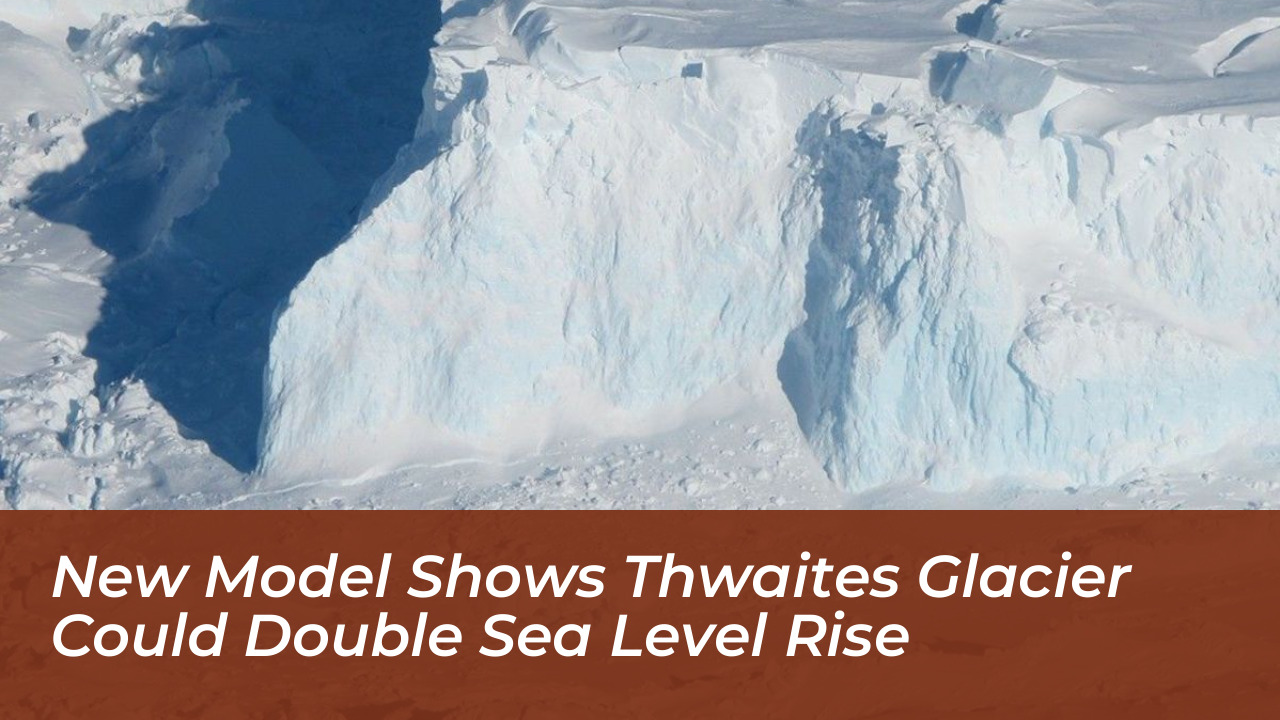

A sophisticated new ice sheet model has revealed that the “Doomsday Glacier,” West Antarctica’s Thwaites Glacier, poses a significantly higher risk to global sea levels than previously estimated. Research published in Nature Communications suggests that the glacier could contribute up to 1.2 inches (30 mm) of sea level rise by 2100, a figure that effectively doubles earlier projections.
Scientists from the University of California, Irvine, and NASA’s Jet Propulsion Laboratory developed this model to address a critical gap in climate science: the role of seawater movement beneath the glacier. Unlike previous models that treated the transition between grounded and floating ice as a sharp, static boundary, the new research accounts for “grounding zones”-areas where seawater intrudes several kilometers beneath the ice base.
The Role of Grounding Zones
The study highlights that tidal movements act as a pump, forcing relatively warm, modified Circumpolar Deep Water (mCDW) deep under the glacier’s underside. This process accelerates ice loss by melting the ice from below, which in turn destabilizes the glacier’s connection to the seafloor.
The research team utilized the Ice-sheet and Sea-level System Model (ISSM) to reconstruct the glacier’s behavior over the last three decades. By calibrating the model against satellite observations of ice velocity, thickness, and grounding-line migration, they found that simulations incorporating these actively melting grounding zones were four times more accurate at reproducing historical trends than traditional models.
Why Thwaites is a “Doomsday” Concern
Thwaites Glacier is roughly the size of Florida and is already responsible for approximately 4% of global sea level rise. Its current retreat is driven by its position on a retrograde slope, meaning the bedrock deepens as the glacier moves inland. The new model indicates that the glacier’s detachment from stabilizing seafloor ridges-such as the Mouginot Ridge-could occur as early as 2038.
Key Findings of the Research:
- Increased Projections: The model projects up to 30 mm of global mean sea-level rise by 2100, doubling previous estimates under similar climate conditions.
- Unpinning Risks: Grounding-zone processes are expected to govern the glacier’s detachment from stabilizing ridges, with a high probability of unpinning before the end of the century.
- Model Precision: Explicitly resolving 2-5 km wide grounding zones is essential for accurately simulating historical glacier thinning and acceleration.
Implications for Coastal Communities
The findings underscore the urgency of integrating grounding-zone dynamics into global climate models. While the research provides a more precise look at the future of the Amundsen Sea Embayment, it also highlights the limitations of current projections that do not account for these complex sub-ice interactions. As the glacier continues to retreat, the researchers emphasize that narrowing these uncertainties is vital for coastal communities preparing for the impacts of rising oceans.
The study concludes that while moderate changes in ocean temperature will influence future melting, the physical extent of these seawater intrusions is the primary driver of the glacier’s long-term instability. Future efforts will focus on expanding in-situ observations to further constrain how heat is delivered to these sub-ice cavities.