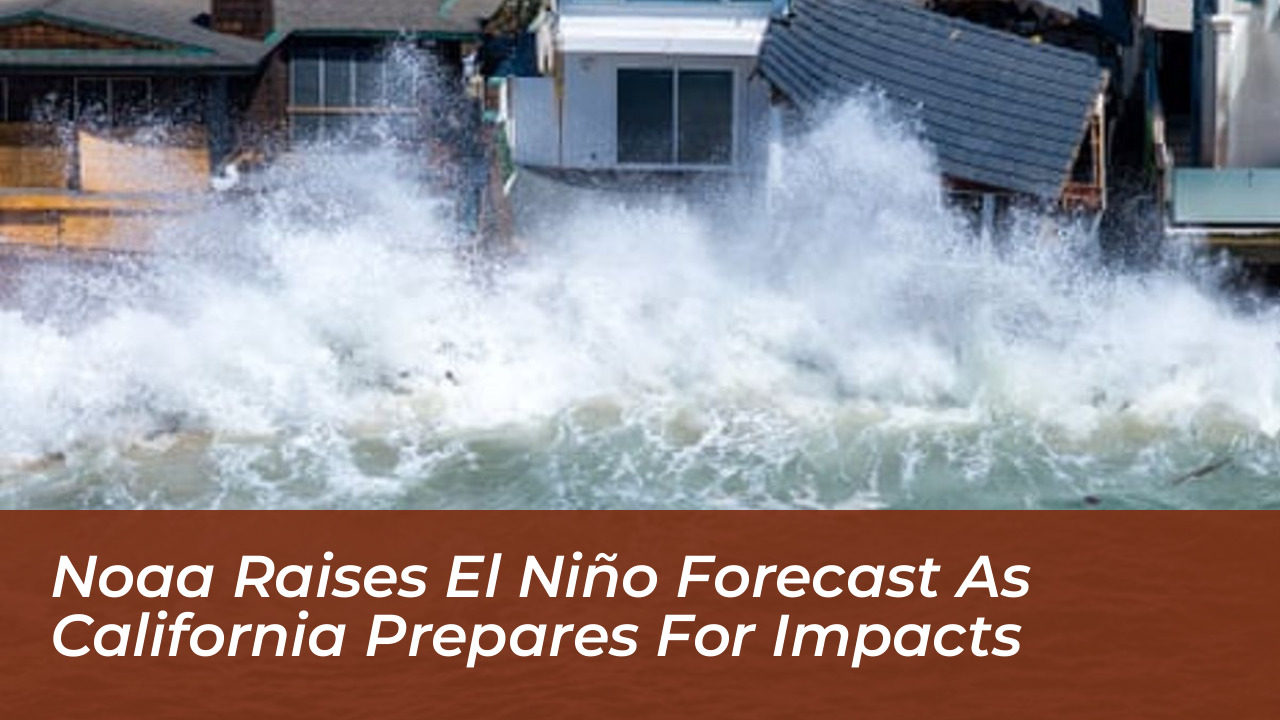


California is aggressively preparing for a potentially historic El Niño winter after the National Oceanic and Atmospheric Administration (NOAA) officially classified the climate pattern as “very strong.” According to an updated outlook published by NOAA’s Climate Prediction Center, there is an 83% chance that this developing El Niño could surpass the strength of all recorded events since 1950 by the time it peaks.
Forecasters report that tropical Pacific waters in the key monitoring region have reached 2.1 degrees Celsius above normal, crossing the vital 2-degree threshold required for a very strong classification. While this reading remains shy of the historic 1982-1983 record-which peaked at approximately 2.5 degrees Celsius-scientists warn that the ongoing phenomenon is tracking as an exceptionally powerful and volatile weather maker.
The Mechanics of a “Very Strong” El Niño
El Niño represents the warm phase of the El Niño-Southern Oscillation (ENSO), a natural climate cycle that alternates between warm phases, La Niña, and neutral conditions. During an El Niño event, weak trade winds allow warm water accumulated in the western tropical Pacific to shift eastward toward the Americas.
Josh Willis, a senior research scientist at NASA’s Jet Propulsion Laboratory, characterized the current system as exceptionally potent. “It’s El Niño macho, as I call it,” Willis told researchers. “This is a big event, it’s still growing in size, and its impact is just starting to reach out of the tropics.”
To track these shifts accurately, NOAA recently adopted the Relative Oceanic Niño Index (RONI). Unlike the traditional Oceanic Niño Index (ONI) that relies on a static 30-year historical baseline, RONI evolves monthly, providing a more reliable gauge of sea surface temperature anomalies in a rapidly warming global climate.
California Mobilizes for Severe Weather and Coastal Flooding
State and local authorities are taking defensive action ahead of winter. In September, California Governor Gavin Newsom declared a state of emergency, directing regional agencies to fortify infrastructure against potential multi-hazard threats.
Meteorologists note that the ongoing El Niño is layering on top of pre-existing environmental stressors, including long-standing marine heatwaves and a steady rise in baseline sea levels driven by climate change. In San Francisco Bay and across Southern California, high tides have already begun running unusually high.
- Coastal Flooding and Erosion: High tides combined with storm surges and El Niño-driven Kelvin waves dramatically elevate erosion risks along vulnerable beaches.
- Above-Normal Precipitation: Climate models show a high probability of a wet winter, with the Pacific jet stream shifting southward to direct heavy storm tracks toward the state.
- Ecosystem Pressures: Prolonged warm water retention threatens marine habitats, raising concerns over harmful algal blooms and shifts in local fisheries.
Historical Parallels and Ecosystem Risks
Marine scientists and ecologists are closely monitoring how the incoming El Niño will interact with lingering marine heatwaves, such as the regional anomaly known as NEP25A. Past sequences-such as the infamous “Blob” of 2014-2015 followed by the 2015-2016 El Niño-demonstrated how back-to-back thermal stress can profoundly disrupt marine food webs.
Researchers with the California Current Integrated Ecosystem Assessment (CCIEA) team warn that upcoming impacts could include longitudinal habitat compression, reduced availability of lipid-rich zooplankton, and altered migration patterns for commercial species like market squid, salmon, and groundfish. , compressed nearshore prey habitats increase the risk of whale entanglements in commercial fishing gear.
Despite these ecological challenges, state agencies, academic partners, and NOAA fleets are maintaining rigorous monitoring protocols. Officials encourage commercial fishermen and coastal observers to submit real-time marine observations to help refine ecosystem management models as California navigates the unfolding winter.
Frequently Asked Questions About the 2026-2027 El Niño
What is an El Niño event?
El Niño is a recurring climate pattern characterized by warmer-than-average ocean surface temperatures in the central and eastern tropical Pacific Ocean, which significantly alters global weather patterns and jet streams.
Why is this specific El Niño considered historic?
NOAA forecasters have given an 83% chance that this event will reach peak intensities surpassing all recorded El Niño episodes since 1950, driven by tropical Pacific temperatures exceeding 2.1 degrees Celsius above normal.
How will El Niño affect California’s winter weather?
El Niño typically pushes the Pacific jet stream southward, resulting in a higher probability of above-normal precipitation, severe coastal storms, high-tide flooding, and accelerated beach erosion across California.
Are marine heatwaves linked to El Niño?
While current marine heatwaves off the U.S. West Coast developed independently of El Niño, the arrival of El Niño-driven Kelvin waves is expected to reinforce coastal warming and lengthen the duration of environmental stress for marine life.
What actions is California taking to prepare?
State leaders, led by Governor Gavin Newsom’s emergency declaration, are actively funding flood defenses, shoring up vulnerable coastal infrastructure, and coordinating emergency response agencies ahead of severe winter storms.