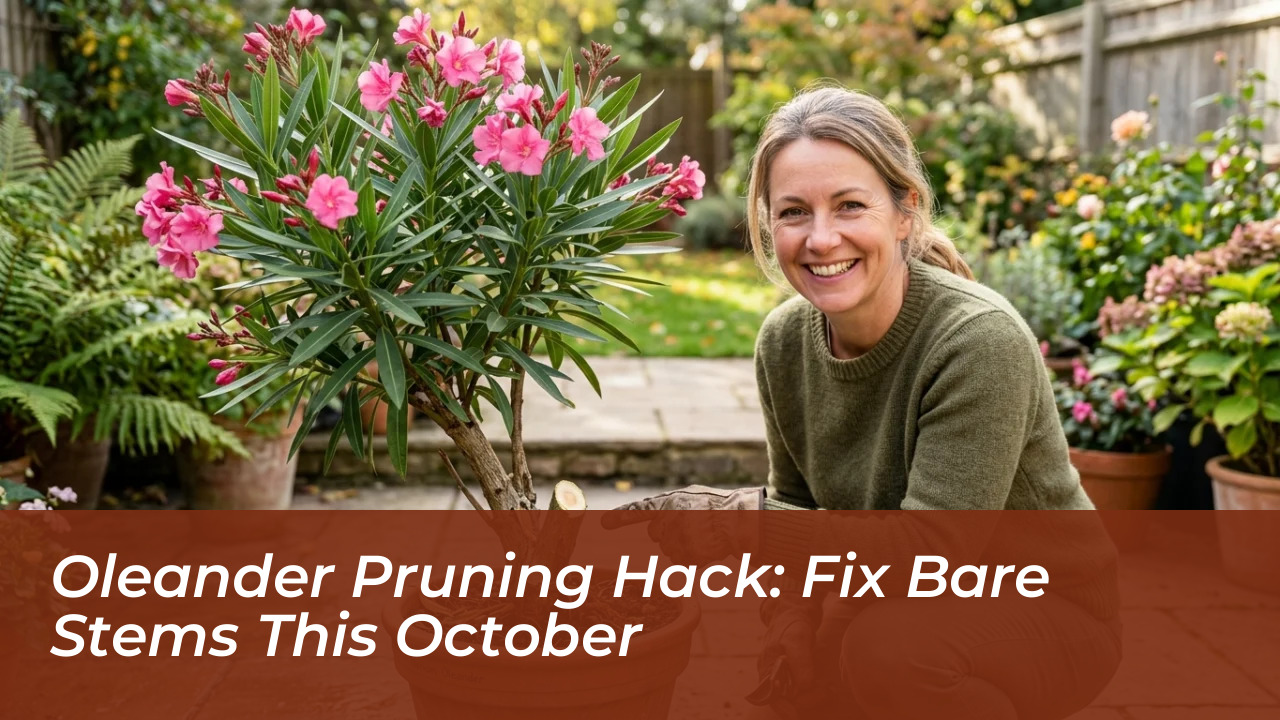

Cutting just one to three of the thickest, oldest stems down to two inches from the ground in early October stimulates dense basal regrowth on leggy oleanders without stripping away next year’s blooms. While mature specimens of Nerium oleander can reach heights between 5 and 20 feet, their natural growth habit often leaves the bottom completely bare while flowers cluster strictly at the top.
A heavy, all-over trim in the fall strips away developing flower buds and leaves the shrub barren for months. By switching to an ultra-targeted structural thinning method at the root crown during the first half of October, home gardeners trigger vigorous new shoots directly from the stump while preserving the current canopy.
Why Oleanders Lose Their Lower Leaves
Oleanders develop flower clusters on established stems. Over time, as the shrub channels energy upward toward the sun, the lowest branches naturally shed foliage, leaving thick, cracked gray bark exposed near the soil. This results in an unbalanced, top-heavy silhouette. Standard shearing cuts the tips of all branches indiscriminately, destroying next season’s buds.
Specialist care for Nerium oleander focuses instead on selective renewal. Pruning all stems short in the autumn removes the majority of future flower buds, leaving the shrub barren of blossoms for long stretches of the upcoming season. By strictly avoiding top shearing in autumn and addressing only the foundation of the plant, you retain existing green flowering wood while forcing dormant basal nodes to break open in the spring.
The One-Third Thinning Rule Explained
A common misconception is that a bare-bottomed shrub requires severe hard cutting back across the entire crown to force low growth. In reality, hacking the entire plant down shocks the root system and eliminates flowering entirely for an extended period. Instead, arborists rely on the classic one-third rule: never eliminate more than one out of every three branches during a single season.
Applying this guideline in autumn targets only the oldest structural wood with faded, severely cracked gray bark, leaving healthy green shoots completely untouched.
Pruning Strategy Impact Comparison
- Top Shearing: Removes upcoming flower buds; maintains a hollow, bare lower base.
- Selective Basal Cut: Stimulates new ground shoots; preserves next season’s canopy blooms.
Focusing these cuts at the ground level allows light and air to penetrate the center of the shrub, sparking low lateral shoots that fill out the base within two growing seasons.
Step-by-Step: The 15-Minute Base Restoration Cut
Completing this restorative cut takes less than a quarter of an hour and provides long-lasting structural renewal when performed during early autumn.
- Inspect the Crown: Gently pull aside exterior foliage to inspect the central root crown. Identify one to three of the thickest, most aged stems displaying cracked, weathered bark.
- Sterilize Your Tools: Use clean, sharpened loppers or bypass pruners to ensure smooth cuts that heal quickly without tearing plant tissue.
- Make the Slanted Cut: Sever the selected branches roughly two inches (5 cm) above ground level. Angle the blade outward toward the exterior of the bush so water runs off the wound rather than pooling on top.
- Clear Weak Interior Growth: Snip away dead, spindly twigs congesting the interior core to maximize airflow through the remaining branches.
A targeted thinning cut made at a clean outward angle prevents standing moisture on the wound, protecting the cut stem while new growth forms. This disciplined, partial reduction allows established specimens to regenerate a bushy, eye-level profile without losing their summer flower show.
Handling Cold Temperatures and Plant Toxicity
Climate dictates your autumn pruning schedule. Standard oleander plants begin showing freeze injury around 18°F (-8°C), though certain cold-hardy varieties survive down to 5°F (-15°C). In cooler regions prone to early frost, perform this renewal prune strictly during the first two weeks of October while soil and air temperatures remain mild. Late-season cuts leave tender, open wounds vulnerable to sudden freeze snaps. For container-grown oleanders, execute this light thinning immediately after blooms fade before moving containers into protected winter quarters.
Every part of Nerium oleander produces toxic sap that causes severe irritation upon contact and poisoning if ingested. Always wear heavy protective gloves and long sleeves during pruning. Immediately bag and dispose of cut trimmings far away from pastures and outdoor pets, as dried branches retain full toxicity and pose serious risks to livestock, horses, and dogs.
Inspect your oleander’s root crown this week to spot thick, aging structural stems ready for an early-autumn renewal. Keep your cuts limited to one out of three branches to protect next summer’s flowers while fixing bare lower growth.
Frequently Asked Questions About Oleander Pruning
When is the best time to fix leggy oleanders?
Early October is the ideal window. Pruning during the first half of the month stimulates basal regrowth before winter dormancy without sacrificing next summer’s flower buds.
Can I cut my oleander all the way to the ground?
While a radical hard cutback (clipping all stems to 8-12 inches) will force new growth, it will strip away your blooms for the following one to two years. The one-third thinning rule is preferred to maintain flowers while encouraging lower foliage.
Why are the bottom leaves of my oleander turning brown and dropping?
This is a natural growth habit as the shrub matures and channels energy upward toward the sun. However, it can also indicate a lack of light reaching the interior core, which selective basal thinning successfully corrects.
How do I protect myself from oleander toxicity while pruning?
Every part of the plant contains cardiac glycosides like oleandrin. Always wear heavy waterproof gloves, long sleeves, and protective eyewear. Never burn the trimmings, and immediately bag them for municipal waste disposal.
Should I fertilize my oleander right after autumn pruning?
No, avoid fertilizing in autumn. Feeding the plant late in the season stimulates tender new growth that can easily be damaged by oncoming frost. Save fertilization for early spring.