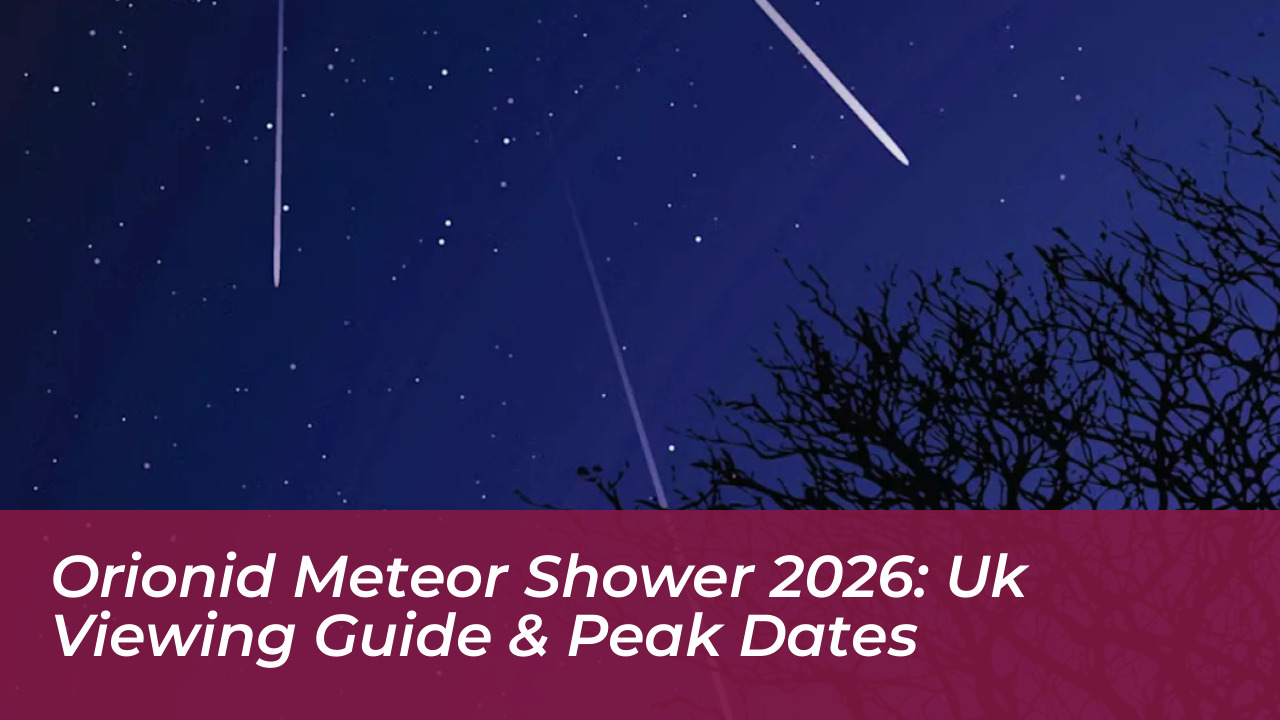
Stargazers across the United Kingdom can observe the annual Orionid meteor shower as cosmic debris illuminates the night sky. The celestial event is active from October 2 through November 7, with activity reaching its peak intensity overnight, offering skywatchers a reliable opportunity to catch shooting stars.
The display occurs at approximately the same time each year as Earth passes through a vast trail of dust, gas, and microparticles left behind by Halley’s Comet, officially designated 1P/Halley. As Earth moves through this particle field at high speeds, the fragments collide with the atmosphere and vaporize, producing brilliant streaks of light visible across the country.
What Are the Orionids and Halley’s Comet?
Halley’s Comet is one of the most famous comets in our Solar System, taking roughly 76 years to complete one orbit of the Sun. It was last seen from Earth in 1986 and is not expected to return to our skies until 2061. However, the debris field left in its wake continues to intersect with Earth’s orbit twice a year, resulting in the Eta Aquariid meteor shower in May and the Orionids in October.
Orionid meteors are known for being fast, entering Earth’s atmosphere at approximately 41 miles per second, or roughly 66 kilometres per second. Due to this high velocity, they frequently leave glowing persistent trails that remain visible in the sky for several seconds. Under ideal viewing conditions, observers can typically spot between 10 and 20 meteors every hour during the peak.
How and When to Watch the Orionid Meteor Shower in the UK
The meteors get their name because they appear to radiate outward from the constellation of Orion the Hunter, though they can streak across any part of the night sky. To maximize your chances of spotting a shooting star, experts recommend following several practical guidelines:
- Timing: The best time to view the meteors is between midnight and dawn when the night sky is at its darkest and clearest.
- Location: Head away from urban areas and street lights to a location with minimal light pollution, such as a local park, country lane, or designated Dark Sky Reserve.
- Equipment: You do not need binoculars or a telescope. The meteor shower is best viewed with the naked eye.
- Preparation: Give your eyes roughly 15 to 20 minutes to adapt completely to the darkness by avoiding smartphones, bright screens, and artificial lights. Dress warmly and bring a camping chair or blanket for comfort.
Weather and Lunar Conditions
Viewing prospects across the United Kingdom depend heavily on regional weather forecasts. Southern and eastern parts of England often experience clear spells, while other regions like Wales, the Midlands, Northern England, Scotland, and Northern Ireland may encounter alternating periods of clear skies, patchy cloud cover, and occasional light showers.
Stargazers should also account for lunar illumination. A brighter Moon can wash out fainter meteors, though brighter shooting stars remain visible to patient observers positioned away from artificial light sources.