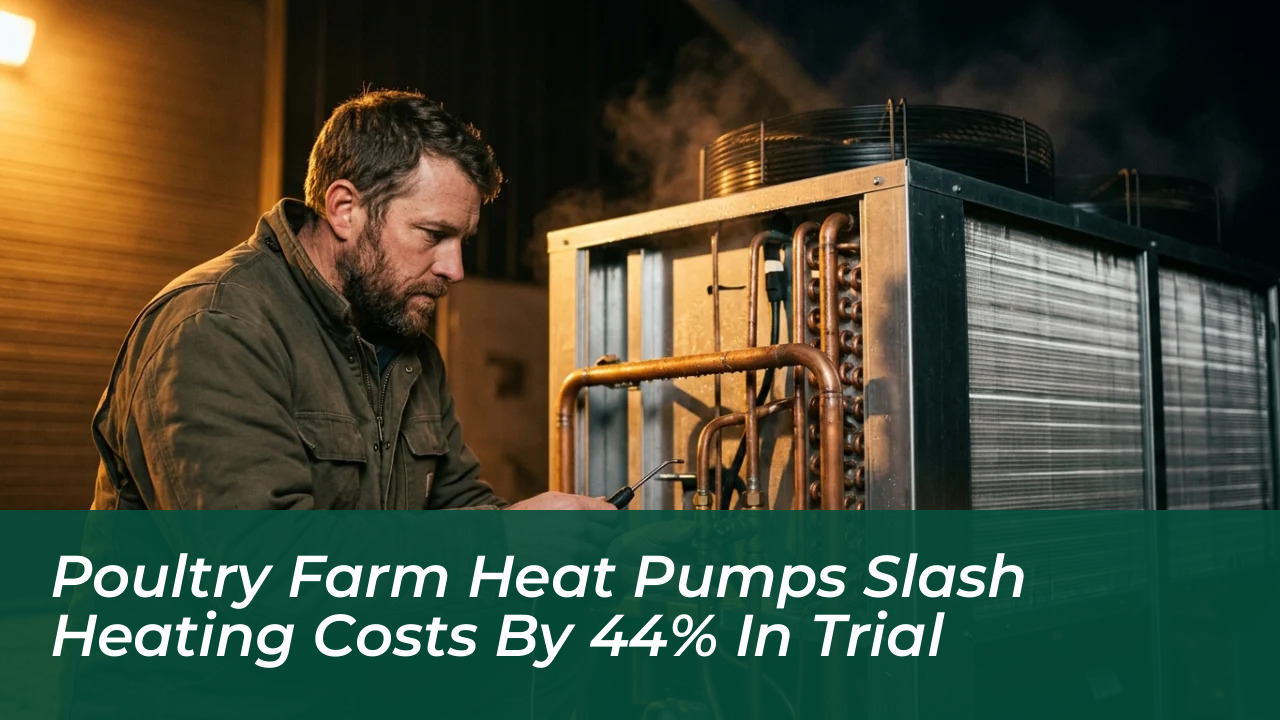

Switching commercial poultry broiler houses from traditional fossil fuels to an air-source heat pump system slashes annual heating costs by 44%. This reduces yearly expenses from $15,506.26 to $8,692.48. Engineering researchers from Sakarya University and ETA4 Engineering in Turkey validated this performance across identical commercial broiler sheds. Their findings demonstrate that clean thermal technology delivers significant economic savings and steady indoor temperatures for livestock rearing.
Agricultural operations traditionally depend on combustion heaters to keep livestock warm, burning massive quantities of coal, oil, and gas during winter cycles. The trial proves that extracting heat from ambient outdoor air produces reliable baseline temperatures across industrial-scale facilities. It also insulates farmers from volatile energy markets.
The Physics Behind Agricultural Heat Exchange
How does thermal technology originally designed for residential living scale up to handle commercial farming? The system relies on thermodynamic refrigerant cycles operating through a measurable coefficient of performance (COP). Standard electric resistance heating produces a strict 1:1 ratio, converting one kilowatt-hour of electricity into one unit of usable heat. In contrast, an industrial air-source heat pump moves existing thermal energy from outdoor air, generating multiple units of heat for every electrical unit consumed.
A widespread misconception suggests that ambient heat pumps cannot maintain operational output once outside temperatures plummet. In reality, modern heat exchangers draw thermal energy even from frigid air, transferring that energy directly into a closed water circuit rather than relying on direct fuel combustion. To distribute warmth without exposing birds to harsh drafts, the experimental system routes warmed water into an insulated buffer tank. This tank acts as a thermal battery, pumping heated water continuously into designated fan coil units across the shed floor.
CFD Modeling Solves the Cold-Spot Problem
Young broiler chickens require strictly regulated thermal environments to thrive. Cold spots cause birds to cluster together in self-defensive huddles that stunt physical development and harm animal welfare. To establish completely uniform conditions, the engineering team applied computational fluid dynamics (CFD) modeling using Ansys Fluent to map indoor air currents before installing physical hardware.
The research team tested the system at a commercial poultry farm featuring three identical broiler facilities. Each structure measured 90.3 metres (296 feet) in length by 15 metres (49 feet) in width, with a wall height of 2.1 meters, encompassing 1,355 square metres (14,585 square feet) and housing approximately 21,000 birds. Two control houses retained their standard baseline coal-fired boilers. The third shed received the experimental heat pump network paired with internal fan coil units.
CFD aerodynamic simulations identified that running all seven fan coil units simultaneously in heating mode delivered the most uniform airflow and temperature profile. The analytical approach successfully forecast coal consumption with just 0.14% error and heat pump electricity consumption with 2.21% error relative to measured figures.
Evaluating Heating Performance Across Fuel Types
The detailed findings, published in the peer-reviewed journal Case Studies in Thermal Engineering, highlight how alternative energy systems reshape livestock production overheads across multiple fuel categories. Comparative thermodynamic analyses revealed dramatic operational savings:
- Baseline Coal-Fired Heating: 44% annual cost reduction ($8,692.48 down from $15,506.26)
- Direct Electric Resistance: 65% cost savings under equivalent conditions
- Standard Fuel Oil System: 48% cost savings
- Mains Natural Gas Setup: 42% cost savings
Future Outlook for Renewable Agriculture
Decarbonising agricultural heating offers producers an actionable pathway to protect livestock welfare while trimming operational margins. The research team is currently developing upgrades that combine the facility’s air-source heat pump infrastructure with rooftop solar photovoltaic panels, dedicated battery storage, and advanced heat recovery ventilation. These integrated technologies aim to push operating overheads even lower. They also establish a comprehensive calculation methodology for determining suitable heat pump capacities in cold climates.
Upgrading rural infrastructure with data-backed fluid dynamics models removes the guesswork from clean energy installations. This proves that sustainable modernization makes sound financial sense for large-scale agricultural enterprises.