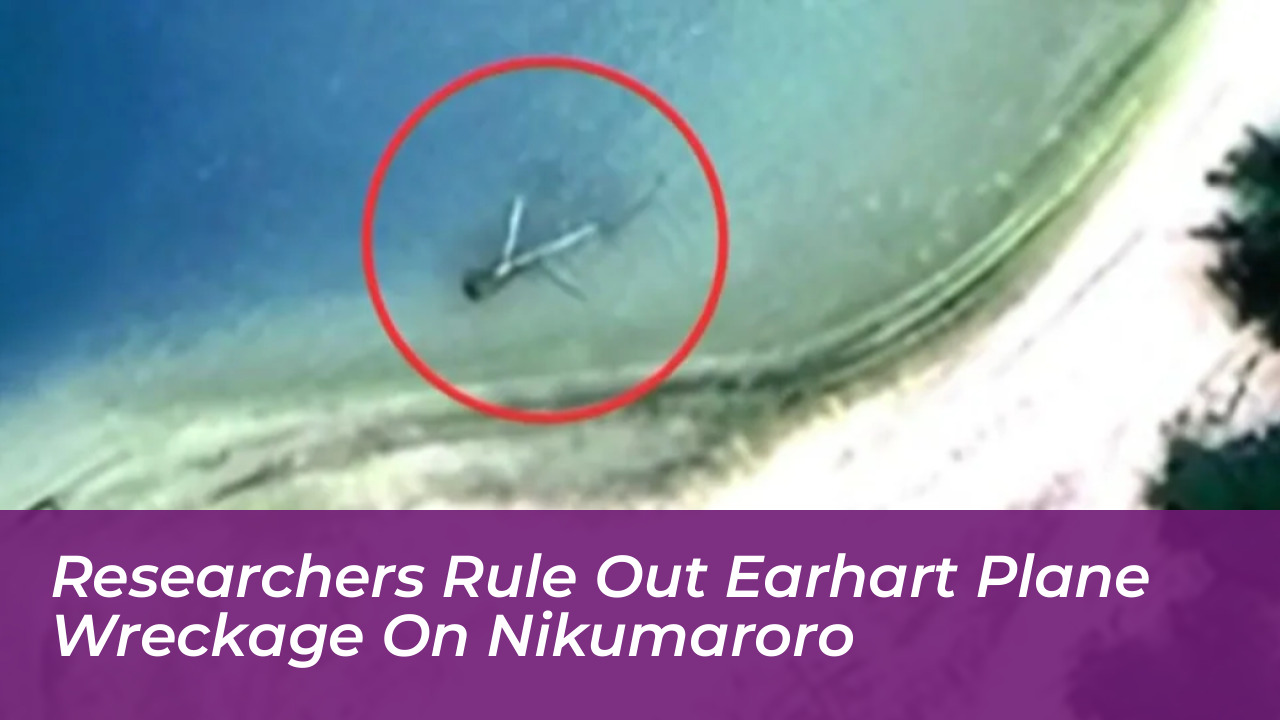

An international research expedition to a remote Pacific island has ruled out a mysterious object as the missing aircraft of pioneering aviator Amelia Earhart, dealing a fresh setback to one of aviation’s most enduring historical mysteries. On October 14, a 17-member research team led by Steve Schultz of Purdue University and Richard Pettigrew of the Archaeological Legacy Institute began investigating the Taraia Object on Nikumaroro Island, part of the Republic of Kiribati. The investigation followed satellite imagery analysis from 2020 suggesting the visual anomaly might be wreckage from Earhart’s Lockheed Electra 10-E.
Investigation Results Point to Natural Debris
Following a multi-day voyage from Tarawa and subsequent delays due to severe weather, the team conducted four days of on-site operations using metal detectors and archaeological surveying. Researchers ultimately concluded that the anomaly was not an aircraft, but rather a collection of large trees deposited along a sandy spit on the Taraia Peninsula.
By the time researchers reached the site, a significant portion of the material had fragmented and washed away, leaving only a single Y-shaped section. While this fragment initially appeared consistent with potential aircraft structure, closer inspection revealed that its reflective surface was actually a carbonate veneer that had previously triggered speculation of metal. Expeditions noted that other items recovered nearby were similarly coated with a shiny concretized amalgam of coral sand.
“We set out to test a hypothesis, not to guarantee a particular result, and we followed the evidence to the end,” said Steve Schultz, Purdue general counsel and expedition member. “While the Taraia Object did not prove to be what we hoped, the journey produced new discoveries, added to the world’s knowledge of Nikumaroro, and wrote another extraordinary chapter in a story of discovery and exploration.”
Historical Context of the Disappearance
Amelia Earhart and her navigator, Fred Noonan, vanished on July 2, 1937, while attempting to circumnavigate the globe at the equator. Departing Lae, Papua New Guinea, the pair headed toward Howland Island before radio contact was lost, prompting one of the largest air and sea searches in history. Earhart’s twin-engine Lockheed Electra 10-E had been purchased with funds from the Purdue Research Foundation, with the intention of returning it to the university following the flight.
For decades, researchers and private organizations-most notably The International Group for Historic Aircraft Recovery (TIGHAR)-have investigated the “castaway hypothesis.” This theory suggests that Earhart and Noonan did not crash into the deep open ocean, but instead successfully landed the aircraft on the reef flat of uninhabited Nikumaroro Island, where they survived temporarily as castaways.
Supporting Evidence Cited by Castaway Theorists
- Radio bearings recorded during the 1937 disappearance by the U.S. Navy, U.S. Coast Guard, and Pan American World Airways that converged on the atoll.
- A 2018 forensic re-analysis of human bones discovered on the island in 1940, indicating they belonged to a woman of Earhart’s stature.
- Historical artifacts recovered from the island, including a 1930s-era woman’s shoe, a compact case, a freckle cream jar, and a medicine vial.
- The Bevington Object, a photographic anomaly captured on the Nikumaroro reef three months after the disappearance, which proponents believe resembles the Electra’s landing gear.
Future Prospects in the Search for Earhart
Although the Taraia Object expedition did not find conclusive proof of the missing plane, researchers successfully recovered other items, including a 30-inch steel tube found in the lagoon. The team plans to study how objects enter the lagoon via the Tatiman Passage and accumulate along the Taraia Peninsula catchment area.
Purdue University and the Archaeological Legacy Institute reaffirmed their commitment to ongoing historical research and exploration, noting that the mission deepens their resolve to solve the nearly 90-year-old mystery.
“Amelia Earhart never gave up – she kept pushing boundaries and flying into the unknown,” Schultz said. “That same fire fuels our search. She kept flying, and we will keep searching.”