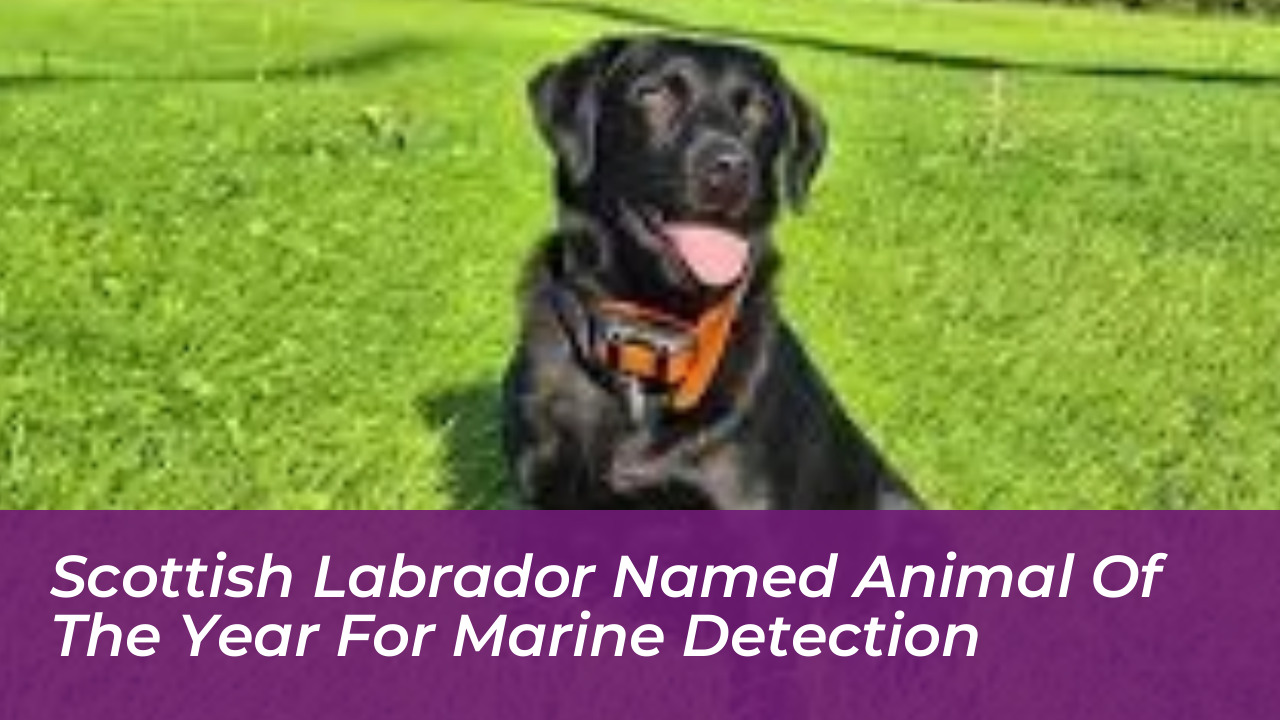

A six-year-old black Labrador from the Scottish Highlands has been named Animal of the Year for 2026. She earned this honor for her groundbreaking role in helping researchers locate an invasive marine species known as the carpet sea squirt, or colloquially as “sea vomit.” Sgiath (pronounced Skee-ah) works alongside her owner, marine ecologist Dr. Texa Sim. Together, they identify hidden colonies that threaten fragile marine ecosystems, local economies, and critical aquaculture infrastructure.
The International Fund for Animal Welfare (IFAW) honored Sgiath at its 26th Annual Animal Action Awards ceremony held at BAFTA London. According to conservation reports, she is believed to be the first dog in the United Kingdom-and potentially the world-specifically trained to detect the carpet sea squirt by its unique scent.
From Mountain Rescue to Marine Biosecurity
Sgiath’s journey to becoming an award-winning conservation dog began on land. Originally trained as a mountain rescue dog near Glencoe, the talented Labrador excelled at tracking missing hikers across rugged terrain. However, Dr. Texa Sim soon wondered if the dog’s exceptional scent-detection abilities could be redirected to address urgent aquatic environmental challenges.
The proof-of-concept project took shape during a native conservation initiative on Scotland’s west coast. The carpet sea squirt, formally cataloged as Didemnum vexillum, is a non-native organism originating from Japan. It first arrived on the shores of southern England and Wales in 2008. Since then, the invasive colonial tunicate has spread to numerous coastal locations across the UK.
The Threat of the Carpet Sea Squirt
Marine biologists warn that the invasive organism poses severe ecological and financial risks. Key impacts include:
- Smothering Native Species: The mat-forming organism can completely cover and choke out native marine life, destroying biodiversity.
- Infrastructure Damage: It aggressively clogs aquaculture pens, boat propellers, pontoons, and essential coastal machinery.
- Economic Burden: Control and clean-up efforts cost millions of pounds annually across Europe. Rising sea temperatures driven by climate change further exacerbate this problem.
How Canine Scent Detection Outperforms Traditional Methods
Traditionally, identifying and tracking the spread of Didemnum vexillum requires slow, labor-intensive laboratory analysis and DNA testing. Visual identification is equally challenging because the organism often resembles ordinary slime or sponge growth. It can hide beneath seaweed, on boat hulls, or attached to oyster cages.
Operating during low tide, Sgiath cuts straight through these obstacles by relying entirely on her sense of smell. During her mountain rescue days, she was trained to bark and bound around to signal a found hiker. For marine conservation work, however, Sgiath employs a “passive indication.” When she detects the target scent, she freezes, offering a quiet stare or a fixed sit to guide Dr. Sim directly to the infestation.
“When I first started this project, I genuinely didn’t know whether it would work,” said Dr. Texa Sim. “No one had really explored whether dogs could help tackle this problem in the marine environment. It began as a proof-of-concept project and has exceeded every expectation I had.”
A Trailblazing Milestone for Animal Welfare
Sharon Livermore, IFAW’s director of marine conservation, praised the canine’s historic contribution during the London ceremony. She noted that Sgiath’s achievements open entirely new doors for employing working dogs in complex environmental biosecurity frameworks.
Conservationists emphasize that dogs cannot completely eradicate invasive species on their own. However, early detection provides a critical window for site managers and environmental scientists to intervene before infestations spiral out of control. Younger working dogs, like Sgiath’s companion Uisge-whose name translates to “water” in Scottish Gaelic-are also entering training programs. As a result, canine marine scent detection is rapidly establishing itself as a vital tool for safeguarding European coastlines.