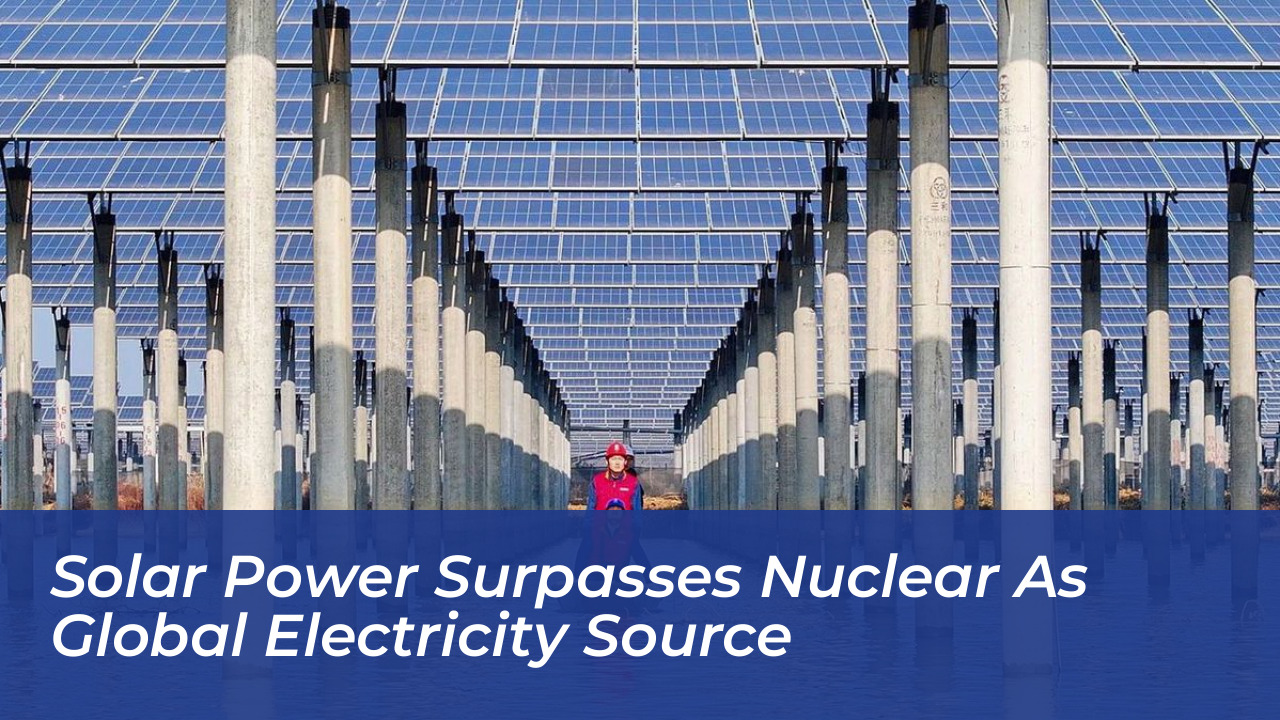

Solar power has officially overtaken nuclear energy as a major global electricity source. This marks a historic turning point in the worldwide energy transition. Plummeting equipment prices, aggressive manufacturing scale, and rapid advancements in battery storage drove global solar generation past nuclear output in 2025. This lead widened further through September 2026.
Data from the UK-based energy think tank Ember shows that solar electricity generation produced 13% more power than the world’s entire nuclear fleet over the 12-month period ending in September 2026. Just a decade ago, solar accounted for barely 1% of global electricity. This unprecedented scale-up continues to defy conventional industry projections.
The Driving Forces Behind the Solar Surge
Experts attribute this seismic shift to several compounding economic and technological factors. Dave Jones, co-founder of Ember, described solar’s rapid ascent as a remarkable milestone. He noted that current photovoltaic modules have become exceptionally cost-effective due to massive production capacity, particularly in China. Jan Rosenow, a professor of energy and climate policy at the University of Oxford, pointed out that solar is the fastest-growing source of new electricity in human history. It met three-quarters of the global demand growth for electricity in 2025.
Mainstream institutions like the International Energy Agency (IEA) previously underestimated the pace of solar expansion. They assumed linear growth and only slowly falling costs. Instead, mass industrial scaling drove panel costs down to very low levels. This allows households and utility providers alike to generate electricity at a fraction of historical costs without ongoing fuel inputs.
Global Adoption and Off-Grid Independence
China remains the world’s undisputed leader in total solar capacity. However, the revolution is happening across diverse geographic regions driven by vastly different local challenges:
- United States: Despite federal policy fluctuations and tariffs, solar installations continue to surge across various states. Current capacity is capable of powering over one-third of American households.
- India: New solar projects have met 60% of the country’s surging power demand increase over the past two years, outpacing fossil fuel transitions.
- Pakistan and African Nations: Nations plagued by unreliable grid infrastructure and expensive diesel generators have adopted rooftop solar at breakneck speeds. In Pakistan, solar’s share of electricity jumped from under 2% in 2019 to 24% following consumer-driven purchases of cheap imported panels.
- Australia: Over four million residential rooftops now feature solar arrays, covering well over a third of all households.
The Role of the Battery Storage Revolution
A critical barrier to intermittent renewable energy has historically been the challenge of matching variable generation with round-the-clock demand. However, a parallel revolution in battery energy storage systems (BESS) has transformed grid stability. In 2025 alone, global grid-scale deployment accelerated sharply, connecting 104 GW and 257 GWh of storage capacity.
In regions like California, combined solar and battery infrastructure regularly supplied over a quarter of total electricity demand during evening peak hours in the first half of 2026. This pairing has made solar-plus-storage routinely cheaper than new fossil fuel or nuclear plants in sun-belt regions.
Contrasting Realities: Nuclear’s Slow Expansion
In stark contrast to the explosive trajectory of solar and wind power, the global nuclear sector faces prolonged stagnation, escalating construction timelines, and financial headwinds. Findings from the World Nuclear Industry Status Report (WNISR) 2026 indicate that global nuclear capacity has remained essentially flat for over 25 years. While operating nuclear capacity stood at 368.6 GW with 411 active reactors as of mid-2026, nuclear’s share of global electricity generation slipped to 8.8%, marking its lowest level in over four decades.
High capital costs, complex supply chains, and extensive delays continue to plague traditional nuclear projects and small modular reactors (SMRs). According to the WNISR report, none of the 16 nuclear reactors connected to the grid between 2023 and 2025 met their original completion schedules. These projects averaged a construction period of nearly 11 years, and market uncertainty has forced several prominent nuclear firms to restructure.
Looking Ahead: The Future of Global Energy
As the energy sector moves toward deep electrification-spanning electric vehicles, industrial heating, and data centers-solar power is positioned to transition from simply leading the electricity sector to dominating total energy consumption. While regional grid constraints, long-term seasonal storage challenges, and supply chain dependencies remain hurdles, the fundamental economics of solar energy continue to pull markets worldwide toward rapid, decentralized expansion.