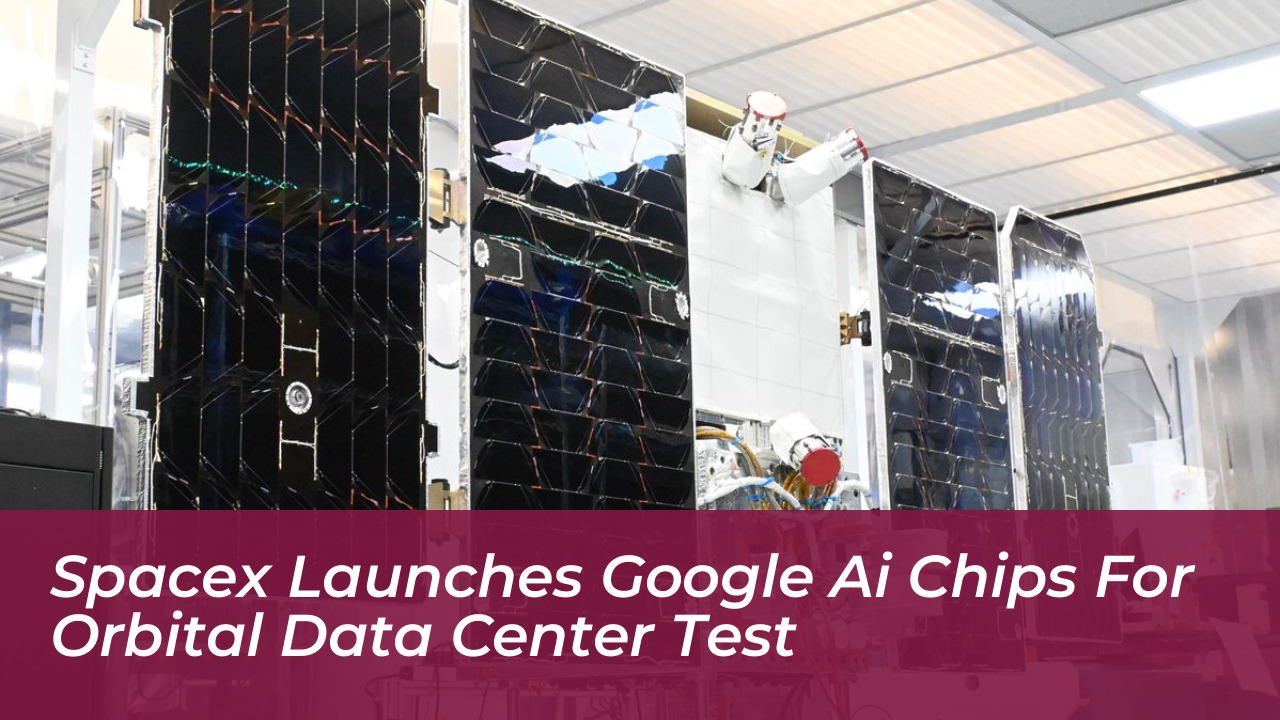
SpaceX successfully launched Google’s custom artificial intelligence chips into low Earth orbit from Vandenberg Space Force Base in California on a Thursday. This marked the first spaceflight test for Alphabet’s Project Suncatcher orbital data center initiative. The prototype satellite, manufactured by Planet Labs PBC, lifted off aboard a Falcon 9 rocket during the Transporter-18 rideshare mission. Its goal is to evaluate how Tensor Processing Units (TPUs) withstand cosmic radiation and thermal extremes in space.
- The Vision Behind Project Suncatcher
- Inside the Minimum Viable Product Satellite
- Overcoming Technical Hurdles in Orbit
- Future Roadmap and Next Steps
- Frequently Asked Questions
- What is Google Project Suncatcher?
- When did the first Project Suncatcher satellite launch?
- How many TPUs are on the test satellite?
- Why does Google want to run AI in space?
- Is Project Suncatcher a fully functioning orbital data center?
- What are the future plans for the project?
Alphabet launched these chips into orbit to see if solar-powered satellites can handle complex machine learning workloads without relying on terrestrial power grids. The launch window opened at 11:15 a.m. PT from California’s Santa Barbara County. Liftoff occurred without incident, and all onboard payloads were successfully deployed by 1 p.m. local time.
The Vision Behind Project Suncatcher
Alphabet revealed Project Suncatcher as a long-term research initiative to develop reliable AI computing infrastructure in space. Earth-bound data centers face backlash, grid capacity constraints, and community opposition due to massive electricity demands. Because of this, tech companies are exploring alternative locations for energy-hungry infrastructure.
In low Earth orbit, satellites can access near-constant sunlight by using a dawn-dusk, sun-synchronous orbit. According to Alphabet’s research, solar panels in space can generate up to eight times more solar power than equivalent panels on the ground. They achieve this by bypassing the atmosphere, weather patterns, and standard day-night cycles.
“We’ve done testing on the ground, but you know, there’s no test that’s completely as good as the real thing,” said Travis Beals, the Google executive managing Project Suncatcher.
Inside the Minimum Viable Product Satellite
The prototype satellite, designated as a Minimum Viable Product (MVP), is modest by design. Built in partnership with small-satellite manufacturing veteran Planet Labs, the spacecraft carries four Google TPUs. It also features solar arrays capable of generating about one kilowatt of continuous power.
Thermal management in the vacuum of space is difficult. It relies entirely on specialized radiators rather than air convection or liquid cooling loops. To manage this, the satellite’s onboard chips will fire up in controlled 15-minute bursts. This strategy prevents overheating and protects power distribution systems while researchers gather telemetry data over the satellite’s expected one-year operational lifespan.
Overcoming Technical Hurdles in Orbit
Before launching hardware into space, Google subjected its equipment to extensive terrestrial testing. This included particle accelerator proton-beam bombardments to simulate cosmic radiation and thermal vacuum chamber evaluations. However, engineering an orbital data center presents unique physics and logistical challenges:
- Radiation Exposure: High-energy cosmic rays can flip bits in logic circuitry, requiring robust error-detection and correction methods.
- Thermal Dissipation: The vacuum of space lacks atmosphere, making the rejection of waste heat a primary hurdle for dense compute clusters.
- Data Bandwidth and Latency: Transmitting massive AI datasets and model outputs between space and ground stations remains capacity-constrained and expensive.
- Orbital Debris: Constellations must navigate space junk and micrometeoroids over multi-year missions.
Google’s economic modeling suggests that for space-based compute to compete directly with terrestrial data centers, launch costs must fall to about $200 per kilogram. Achieving this threshold relies heavily on reusable rocket platforms, such as SpaceX’s Starship program.
Future Roadmap and Next Steps
While the four-TPU test satellite is a small fraction of a terrestrial data center, it serves as a critical proof-of-concept. Alphabet holds an investment stake worth more than $82 billion in SpaceX, cementing a close partnership as both companies explore space-based supercomputing. Elon Musk’s SpaceX has also announced plans to build its own orbital data centers using swarms of satellites equipped with graphics processing units and custom solar arrays.
If the MVP satellite validates power generation and chip survivability, Google plans to launch two additional satellites in 2027. Those future spacecraft will test high-bandwidth free-space optical laser interconnects. These links are essential for allowing dozens of independent satellites to operate in close formation as a single AI computing cluster.
Frequently Asked Questions
What is Google Project Suncatcher?
Project Suncatcher is a Google research initiative exploring whether artificial intelligence compute, specifically Google Tensor Processing Units (TPUs), can operate on solar-powered satellites in low Earth orbit.
When did the first Project Suncatcher satellite launch?
The MVP prototype satellite launched on Thursday aboard a SpaceX Falcon 9 rocket during the Transporter-18 rideshare mission from Vandenberg Space Force Base.
How many TPUs are on the test satellite?
The prototype satellite carries four Google TPUs, providing computing capacity comparable to a single terrestrial server.
Why does Google want to run AI in space?
Satellites in low Earth orbit can access near-constant solar energy, generating up to eight times more usable solar power than ground-based panels while bypassing terrestrial grid limitations.
Is Project Suncatcher a fully functioning orbital data center?
No. The initial launch is a technology demonstrator designed to test chip survivability, radiation tolerance, and thermal management in space before larger constellation phases begin.
What are the future plans for the project?
Following telemetry evaluation of the MVP satellite, Google plans to launch two purpose-built satellites in 2027 to test high-bandwidth optical laser links between spacecraft.