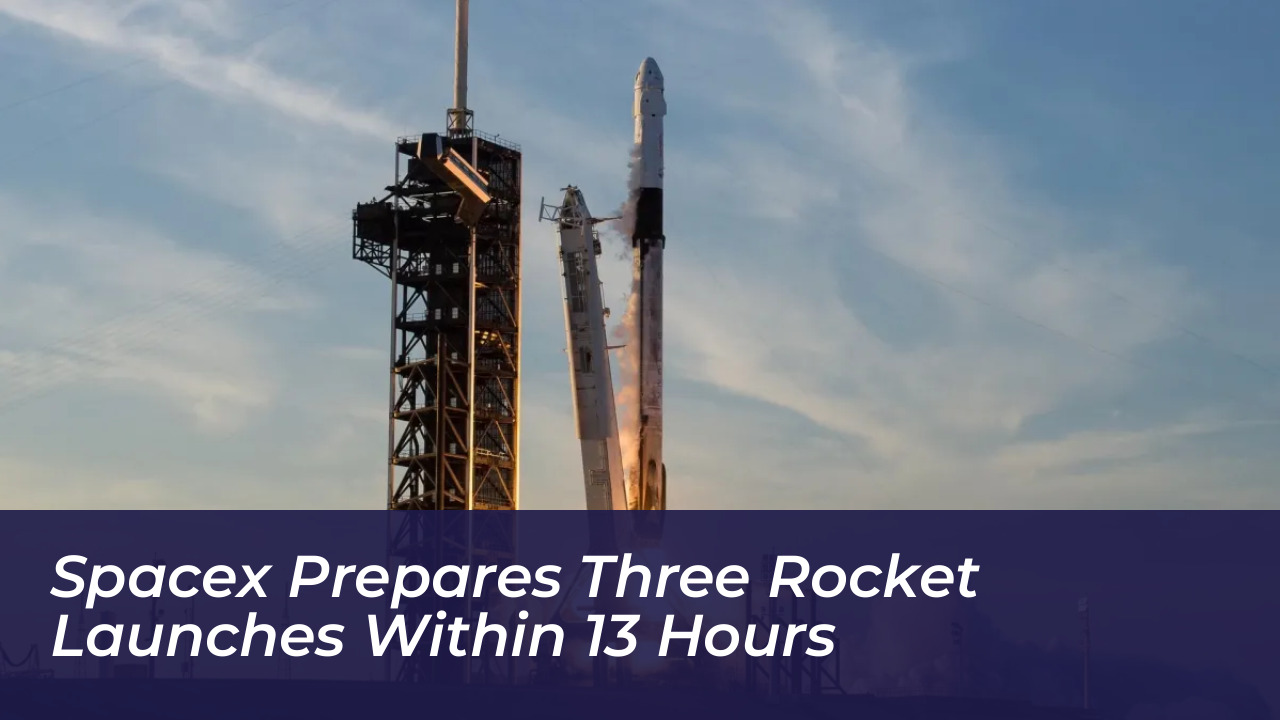
SpaceX scheduled an intensive launch tripleheader on Thursday, October 1, 2026. The company aimed to deploy three separate orbital missions within a 13-hour window. These launches used two coastal launch sites in the United States. This rare operational lineup showed the rapid cadence and industrial scale of modern commercial spaceflight. The missions included human spaceflight, commercial rideshare services, and classified national security operations.
The sequence began on the East Coast at Cape Canaveral Space Force Station in Florida. It then shifted across the country to California. Finally, it returned to Florida for a late-night heavy-lift finale. Each flight used a distinct vehicle configuration and served a completely different customer segment.
Crew-13 Astronaut Mission Kicks Off the Day
The high-stakes opening launch took place at 11:10 a.m. EDT. It sent a four-person crew toward the International Space Station (ISS). Operating under NASA’s Commercial Crew Program, the mission used a two-stage Falcon 9 rocket topped with a SpaceX Dragon spacecraft.
The flight carried NASA astronauts Jessica Watkins and Luke Delaney, Canadian Space Agency astronaut Joshua Kutryk, and Russian cosmonaut Sergey Teteryatnikov. The rocket lifted off from Space Launch Complex 40. About eight minutes later, the first-stage booster completed a Return-to-Launch-Site (RTLS) landing at the Florida station. The crewed capsule separated successfully and targeted an orbital rendezvous for later that evening.
Transporter-18 Delivers 130 Payloads from California
Activity immediately shifted to the West Coast for the second leg of the tripleheader. A second Falcon 9 rocket lifted off from Space Launch Complex 4 West at Vandenberg Space Force Base in California. The launch window opened at 2:18 p.m. EDT.
This dedicated rideshare mission was known as Transporter-18. It carried 130 payloads into a sun-synchronous orbit for many commercial and civil customers. The manifest included CubeSats, microsatellites, and hosted payloads. It also featured two spacecraft equipped with reentry vehicles and four orbital transfer vehicles. These transfer vehicles were designed to deploy an additional 41 payloads at later dates. The West Coast booster also executed a successful ground landing after deployment.
Falcon Heavy Closes Out the Tripleheader With NROL-97
The final mission of the day brought operations back to Florida. It featured a late-night liftoff from NASA’s historic Pad 39A at the Kennedy Space Center. Unlike the earlier Falcon 9 flights, this mission used SpaceX’s heavy-lift vehicle, the Falcon Heavy.
Scheduled for 11:53 p.m. EDT, the Falcon Heavy carried a classified national-security payload. Designated as NROL-97, it flew for the National Reconnaissance Office (NRO) and the U.S. Space Force. The powerful rocket was built from three reusable Falcon 9 first-stage cores strapped together. It closed out the day with dual sonic booms as both side boosters returned to landing zones on the Space Coast.
Industrialized Orbital Launch Cadence
The October 1 operations marked only the second time in history that SpaceX managed three orbital missions within a single 13-hour window. By preparing three pads in two states at the same time, the aerospace manufacturer showed how routine multi-launch days have become in the modern commercial space industry.