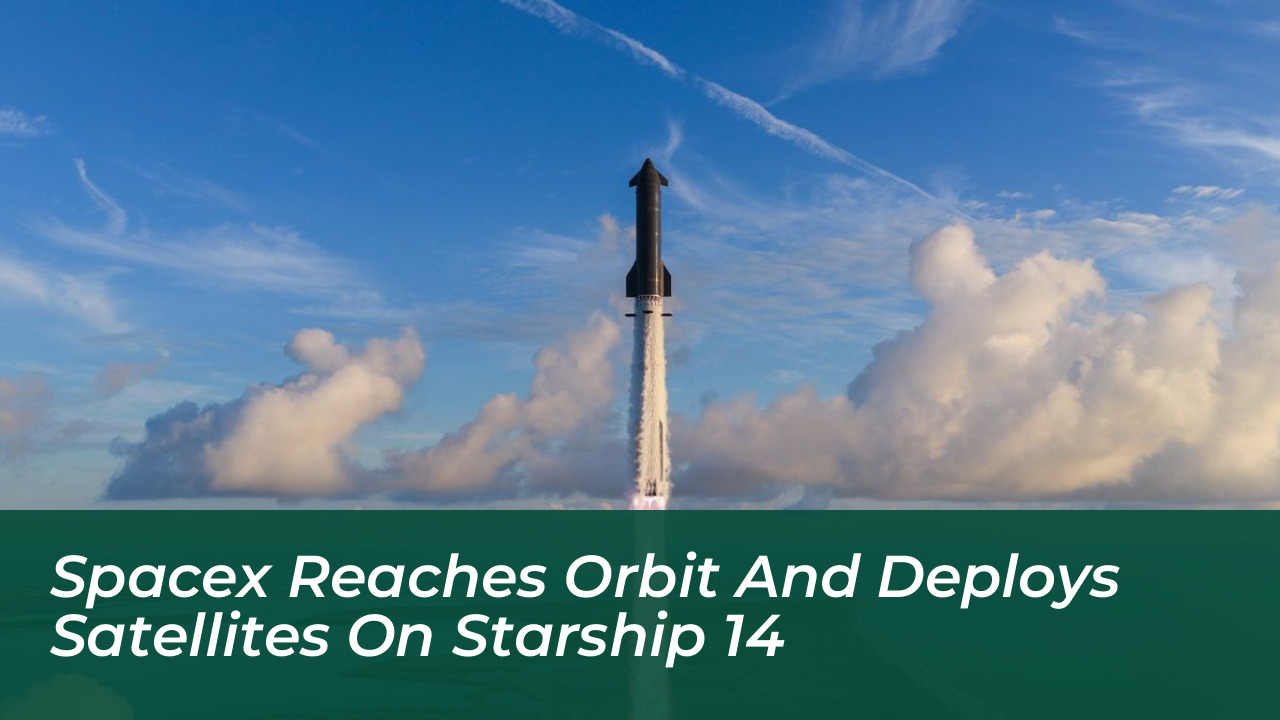
SpaceX successfully reached low-Earth orbit and deployed its first commercial batch of next-generation Starlink satellites during the 14th test flight of its Starship rocket, launching from Starbase, Texas, on Monday morning at 8:49 a.m. EDT. The milestone marked a major technological step forward for the world’s most powerful launch vehicle, which had previously completed 13 integrated flight tests following strictly suborbital trajectories.
The 407-foot-tall launch vehicle lifted off powered by 33 Raptor engines generating 18 million pounds of thrust. Following stage separation, the Super Heavy booster executed a controlled splashdown in the Gulf of Mexico. Meanwhile, the upper-stage Starship spacecraft continued its ascent into space, overcoming early technical anomalies to achieve a critical operational breakthrough for the company.
Overcoming Engine Anomalies During Ascent
The historic flight did not proceed entirely without incident. During the initial ascent phase, one of the six Raptor engines on the upper-stage Starship shut down prematurely. For several minutes, mission controllers and SpaceX spokespersons indicated that the vehicle might not commit to orbital insertion.
SpaceX spokesman Dan Huot noted during the live broadcast that the team initially evaluated whether to abort the orbital burn. However, after running extensive diagnostic checks and evaluating core flight safety systems, mission controllers reversed course approximately 22 minutes into the flight. They determined the spacecraft was clear to proceed with an orbital insertion burn, igniting a Raptor engine to send the ship into low-Earth orbit.
Deploying High-Capacity Starlink V3 Satellites
Approximately 12 minutes after achieving orbit, Starship’s innovative slot-like payload door opened to deploy 26 next-generation “V3” Starlink broadband satellites. SpaceX confirmed shortly after deployment that ground teams had successfully established contact with all 26 spacecraft.
These high-capacity V3 satellites represent a massive capacity upgrade for the Starlink constellation:
- Each satellite supports roughly 1 terabit per second of downlink capacity.
- Uplink capacity reaches approximately 160 gigabits per second.
- This delivers roughly a 10x downlink and 22x uplink improvement compared to legacy Starlink V2 spacecraft.
Following separation, the satellites were programmed to unfold their solar arrays and antennas, subsequently using onboard thrusters to raise their operational orbits. SpaceX expects these units to begin serving residential and business customers within a few weeks.
Controlled Shortened Mission and Pacific Splashdown
Out of an abundance of caution regarding the earlier engine anomaly during ascent, mission managers elected to shorten the planned duration of the flight. Instead of continuing a nearly 10-hour orbital mission, controllers commanded a deorbit burn after roughly three hours in space.
Starship concluded its test flight with a controlled, fiery splashdown in a pre-coordinated target zone in the northern Pacific Ocean that had been cleared of maritime and air traffic. SpaceX opted not to attempt a structural catch of the upper stage during this mission, focusing instead on validating orbital insertion, payload deployment, and spacecraft communications.
The successful demonstration of orbital payload delivery moves SpaceX one step closer to realizing its broader vision for rapid reusability. Beyond scaling the Starlink constellation, the orbital Starship platform is slated to support future demanding architectures, including orbital AI data centers and human landing systems designed for NASA’s upcoming lunar exploration missions.