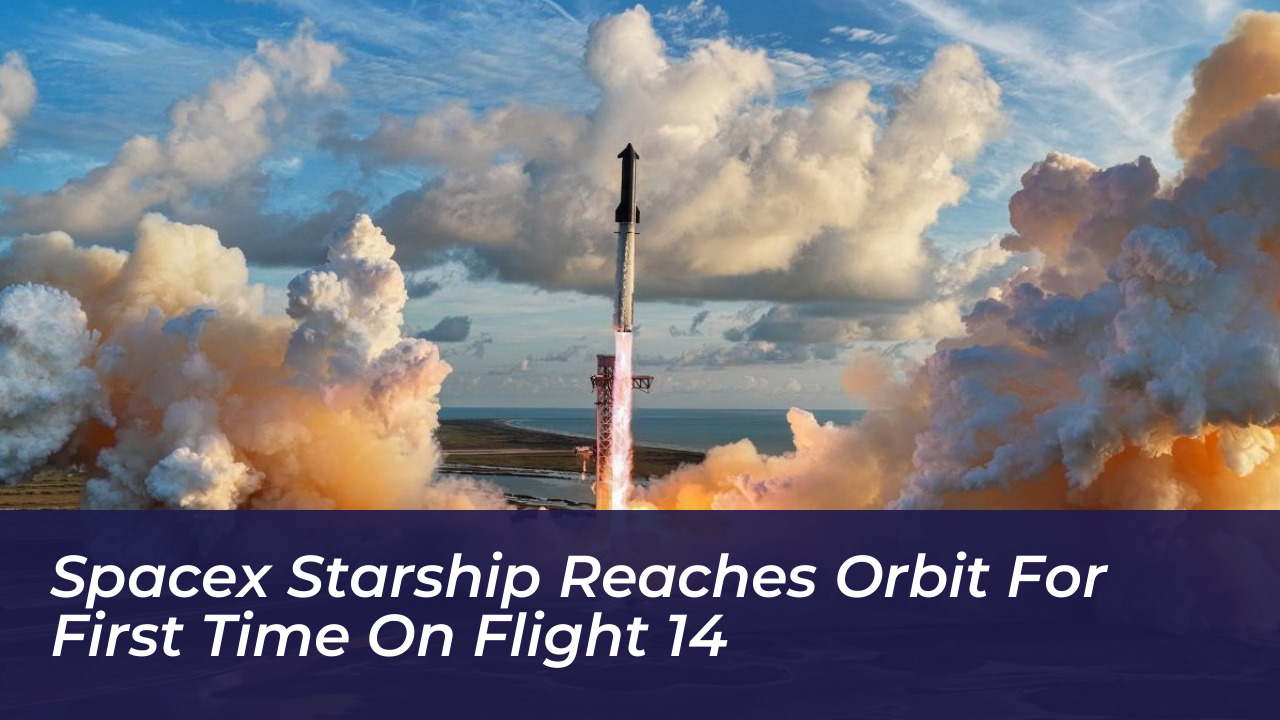
SpaceX’s Starship, the most powerful rocket ever built, reached Earth orbit for the first time on Monday, September 28, 2026. This milestone marks a turning point in commercial spaceflight and signals an eventual transition away from the Falcon 9 and Dragon era. Launching from the Starbase facility in Boca Chica, Texas, during the 14th integrated test flight (Flight 14), the stainless steel spacecraft successfully deployed 26 operational next-generation Starlink V3 satellites despite an in-flight engine anomaly.
Flight 14 Milestones and the Engine Anomaly
The mission lifted off at 8:49 a.m. EDT (7:48 a.m. CDT) as the 407-foot vehicle cleared the launch tower. Powered by 33 first-stage Raptor engines producing 16.7 million pounds of thrust, the Super Heavy booster separated successfully and performed a controlled splashdown in the Gulf of Mexico. Meanwhile, the upper-stage ship continued its ascent.
Shortly after stage separation, one of the ship’s six Raptor vacuum engines shut down unexpectedly. Mission controllers at SpaceX initially called off the orbital attempt before re-evaluating and deciding to continue. The remaining engines compensated for the missing thrust, allowing Ship 41 to complete its orbital insertion burn roughly 25 minutes after liftoff and enter a circular orbit 170 miles above Earth.
“Starship performs its orbital insertion burn and enters orbit of Earth for the first time,” SpaceX announced on X at 9:15 a.m. ET.
Due to the reduced propulsion margin from the engine shutdown, SpaceX controllers shortened the flight duration from its original 10-hour, six-orbit plan. The spacecraft completed two full orbits, successfully executing its payload deployment sequence before initiating a deorbit burn and a controlled splashdown in the Northern Pacific Ocean near Hawaii after approximately three hours of flight.
Deploying Next-Generation Starlink V3 Satellites
Flight 14 served as both a rigorous orbital test and an operational delivery mission. Using an internal payload deployment mechanism nicknamed the “Pez dispenser,” the Starship upper stage released all 26 V3 Starlink satellites into orbit.
These third-generation satellites are larger and more capable than earlier models. According to SpaceX specifications:
- Each V3 satellite provides roughly 1 Tbps of network capacity.
- A single full Starship payload capacity matches the network capacity of approximately 20 flights of Falcon 9 carrying V2 mini satellites.
- Three of the deployed V3 satellites carried specialized external cameras to inspect Starship’s thermal protection tiles during orbit and reentry.
The successful deployment underscores Starship’s vital role in expanding the Starlink constellation toward its long-term goals while validating operational payload handling in orbit.
Implications for Falcon 9, Dragon, and NASA’s Artemis Program
Reaching orbit marks a major milestone toward SpaceX’s long-term objective of achieving full reusability for both rocket stages. This success paves the way for the eventual retirement of the Falcon 9 rocket and Dragon spacecraft. For over a decade, Falcon 9 has dominated global commercial space launch services-accounting for 51% of global commercial launches and 85% of satellites in 2025-while Dragon has routinely supplied the International Space Station.
However, the anticipated phase-out of Falcon 9 has raised logistical concerns among commercial satellite operators who depend on this reliable workhorse. SpaceX plans to transition heavy cargo and large satellite constellations entirely to Starship to drastically cut launch costs per kilogram.
Additionally, Starship is central to NASA’s lunar exploration plans. Selected as the Human Landing System for the Artemis III mission, Starship must demonstrate several advanced capabilities before carrying astronauts to the Moon, including:
- Reliable atmospheric reentry and full vehicle recovery.
- Orbital propellant transfer, requiring multiple tanker flights to refuel a parking-orbit depot.
- Uncrewed lunar landing and liftoff demonstrations.
NASA Administrator Jared Isaacman congratulated SpaceX on X following the flight, noting that the agency is excited to see Starship missions progress toward routine operations. Although technical challenges remain before Elon Musk’s vision of frequent mega-rocket launches can be realized, Flight 14 represents an undeniable leap forward for heavy-lift orbital flight.