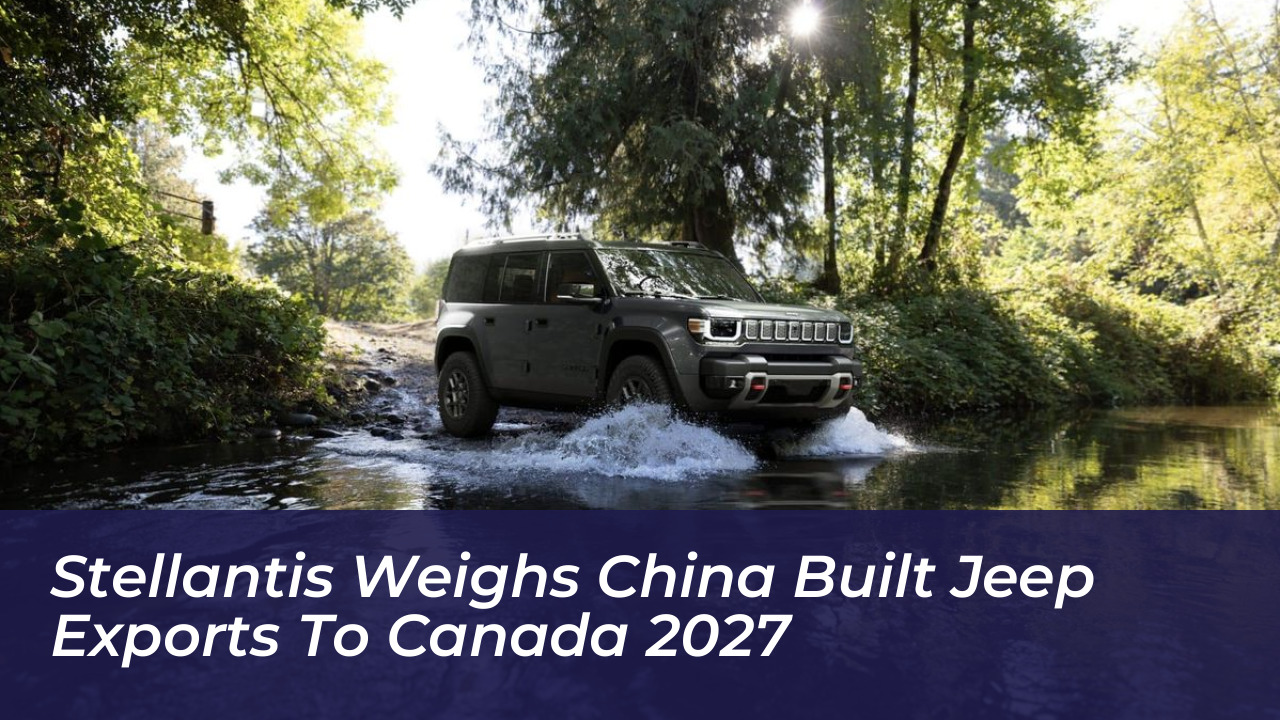

Stellantis is actively considering exporting China-built Jeep vehicles to Canada starting in 2027. This introduces a potential new trade route for its electrified lineup while its Brampton Assembly Plant in Ontario remains idle. The vehicles are slated for production through the automaker’s joint venture with Dongfeng in Wuhan, China. Canada and Mexico have both been identified as possible destination markets for these off-road models, according to reports from Automotive News Canada and several other industry outlets.
Two Electrified Models Eyed for Export
The proposed export initiative focuses on two electrified off-road Jeep models: one fully battery-electric vehicle and the other a plug-in hybrid. While production at the Wuhan facility is scheduled to begin in 2027, Stellantis has not formally confirmed that either vehicle will officially go on sale in the Canadian market. Company representatives emphasize that the global manufacturing strategy is still unfolding.
Stellantis Canada spokesperson LouAnn Gosselin stated that it would be premature to describe the Chinese-built Jeeps as officially planned for the Canadian market. She maintained that potential vehicle imports from China were not a factor in corporate decisions surrounding the future of the Brampton assembly facility.
Brampton Plant Uncertainty and Union Backlash
The prospect of importing Chinese-built Jeeps arrives amid ongoing anxiety regarding Stellantis’ Canadian manufacturing operations. Approximately 2,200 hourly workers represented by Unifor remain affected at the Brampton facility. Vehicle production at the plant stopped in late 2023 for extensive retooling, but the planned next-generation Jeep Compass program was abruptly paused in February 2025 and subsequently reassigned to the United States.
In response to the shifting production landscape and discussions regarding a potential sale of the Brampton site to Canadian armored vehicle manufacturer Roshel, Unifor leadership has expressed sharp opposition. Unifor President Lana Payne strongly criticized the import plans, describing the possibility of bringing in Chinese-built electric Jeeps while domestic production remains abandoned as entirely unacceptable and out of touch.
Regulatory Hurdles and Canadian Trade Policy
Canada’s revised import policy for Chinese electric vehicles could technically clear a path for the vehicles to enter the country. The federal government removed the previous 100% surtax for an initial annual quota of 49,000 Chinese electric vehicles, subjecting eligible imports to a standard 6.1% tariff. However, trade policy changes do not guarantee that the proposed Jeeps will automatically qualify for importation or regulatory approval.
Vehicles intended for Canadian sale must strictly comply with Canadian Motor Vehicle Safety Standards. Industry experts, such as Sam Fiorani of AutoForecast Solutions, note that China-developed Jeeps are engineered separately from Stellantis products built in other global regions, making North American certification a costly and time-consuming obstacle. As a result, the timeline for any potential Canadian launch remains subject to extensive technical, regulatory, and corporate decisions.