
Record-breaking sea surface temperatures across the central and eastern Pacific have confirmed an exceptionally powerful El Niño in 2026. This event has outstripped historical benchmarks months ahead of its projected December peak. Driven by a self-amplifying ocean-atmosphere feedback loop and amplified by long-term human-induced global warming, the climate phenomenon is already altering global weather patterns, stressing marine ecosystems, and raising urgent concerns for food security and humanitarian relief worldwide.
According to assessments from the World Meteorological Organization (WMO), Australia’s Bureau of Meteorology (BOM), and the US National Oceanic and Atmospheric Administration (NOAA), daily sea surface temperatures in the equatorial Pacific surpassed previous highs set during the historic 2015 El Niño. In parts of the tropical Pacific, temperatures have climbed above 30 degrees Celsius for the first time on record, accompanied by unprecedented ocean temperature anomalies and exceptional subsurface warmth.
The Mechanics: The Bjerknes Feedback Loop
The rapid intensification of the 2026 event stems from the breakdown of normal Pacific trade winds, which triggers the Bjerknes feedback loop. Under regular conditions, easterly trade winds push warm surface water toward Indonesia while cold, nutrient-rich water upwells along the coasts of Peru and Ecuador. When these winds weaken, warm water flows eastward, flattening the temperature gradient across the basin and further dismantling the Walker circulation.
This positive feedback loop has operated against a baseline ocean already significantly warmed by decades of greenhouse gas emissions. Tracking the event through the Niño 3.4 anomaly index, scientists noted that daily readings reached 3.11°C above average on September 21. This shattered the previous daily record of 3.08°C set on November 18, 2015-long before the typical late-year peak.
“Estamos presenciando actualmente un evento de El Niño que no tiene precedentes en el registro histórico,” said Dr. Zeke Hausfather, a climate scientist at Berkeley Earth.
Global Weather Disruptions and Regional Impacts
The vast thermal energy being released from the Pacific ocean into the atmosphere is reshaping seasonal forecasts globally. WMO forecasts indicate a near-100 percent likelihood that the El Niño will persist through February 2027, bringing severe extremes:
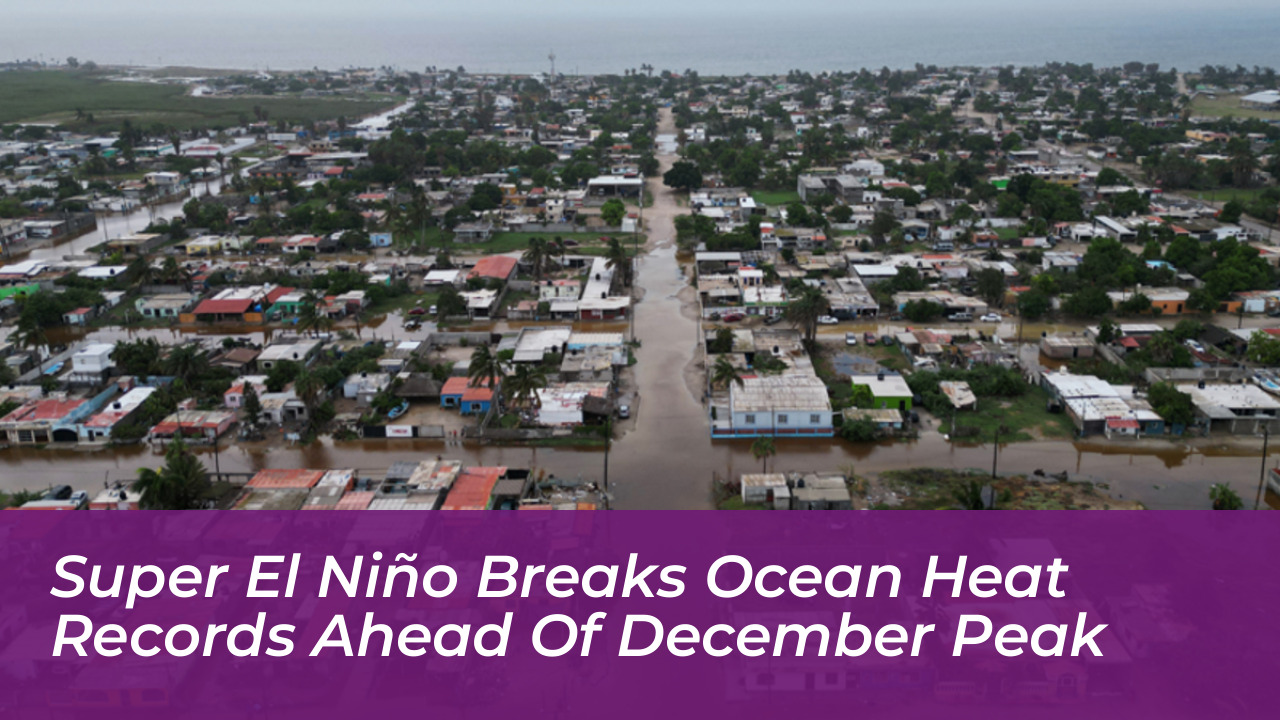
- Excessive Rainfall and Floods: Wetter-than-normal conditions are heavily favored across the central and eastern equatorial Pacific, the Greater Horn of Africa, parts of Central Asia, coastal East Asia, northern sections of the Arabian Peninsula, southern North America, and southeastern South America.
- Severe Droughts: Drier-than-normal conditions are projected across the western Pacific, the equatorial Atlantic, the Indian subcontinent, southern Central America, parts of the Caribbean, and northwestern South America.
- Suppressed Atlantic Hurricanes: High-altitude wind shear generated by El Niño over the Atlantic Basin has disrupted tropical storm formation, keeping the 2026 hurricane season well below historical averages.
Humanitarian Toll: Millions at Risk of Food Insecurity and Floods
The cascading effects of the super El Niño present acute risks to vulnerable populations. UNICEF reported that more than 347 million children across nearly 100 countries and territories face severe risks of flooding or drought between October and December 2026. Asia and the Pacific bear the highest exposure, with 190 million children at risk, followed by East and Southern Africa, and Latin America and the Caribbean.
Concurrently, the World Food Programme (WFP) projects that the ongoing climate shock could push at least 49 million additional people into acute food insecurity by the end of 2027 across 45 countries. This will drive the global total to approximately 274 million. Humanitarian agencies emphasize that funding constraints and reduced household surveys have hampered real-time monitoring just as crises begin to unfold.
Projections for 2027: Approaching Critical Thresholds
Because El Niño’s warming effect on global average temperatures typically lags Pacific sea surface peaks by three to five months, the primary thermal footprint of the 2026 event will materialize in 2027. Climate models analyzed by researchers suggest that 2026 will rank among the warmest years on record, while 2027 could approach or exceed 1.7°C above pre-industrial levels, pressing close to the critical 1.5°C threshold established by the Paris Agreement.
Experts highlight an urgent disconnect in international disaster response: less than one percent of global humanitarian funding currently targets anticipatory action-deploying resources before disasters peak based on reliable forecasts-despite evidence showing that proactive interventions vastly reduce both human suffering and long-term economic recovery costs.
Frequently Asked Questions
What makes the 2026 El Niño different from past events?
The 2026 event broke all-time daily sea-surface temperature records in the Niño 3.4 monitoring zone weeks before its typical peak in December. Operating on top of an already warmed global climate baseline, its early intensification and sheer magnitude outpace historical benchmarks like the 2015-16 and 1997-98 events.
How does El Niño influence North American winter weather?
Strong El Niño conditions typically drive a southern storm track across the United States, bringing wetter and cooler conditions-along with elevated flood risks-to the Gulf Coast, Florida, and the Southwest. Conversely, northern states generally experience warmer and drier winters.
Why is 2027 projected to be exceptionally warm?
Global temperatures lag behind peak Pacific ocean warming by several months. With the El Niño peaking in late 2026, the maximum release of heat into the atmosphere will occur through early and mid-2027, likely establishing new global temperature records.
What is anticipatory action in climate disaster management?
Anticipatory action involves deploying funds, food assistance, and protective measures before a predictable climate hazard peaks, utilizing advanced forecast data. Research demonstrates that every dollar invested prior to a disaster saves up to fifteen dollars in recovery expenses.
Which regions are most vulnerable to food insecurity during this event?
Southern Africa, South America, the Caribbean, and parts of East Africa face significant vulnerabilities. Changes in rainfall distribution and prolonged droughts directly threaten agricultural yields and exacerbate existing humanitarian crises.