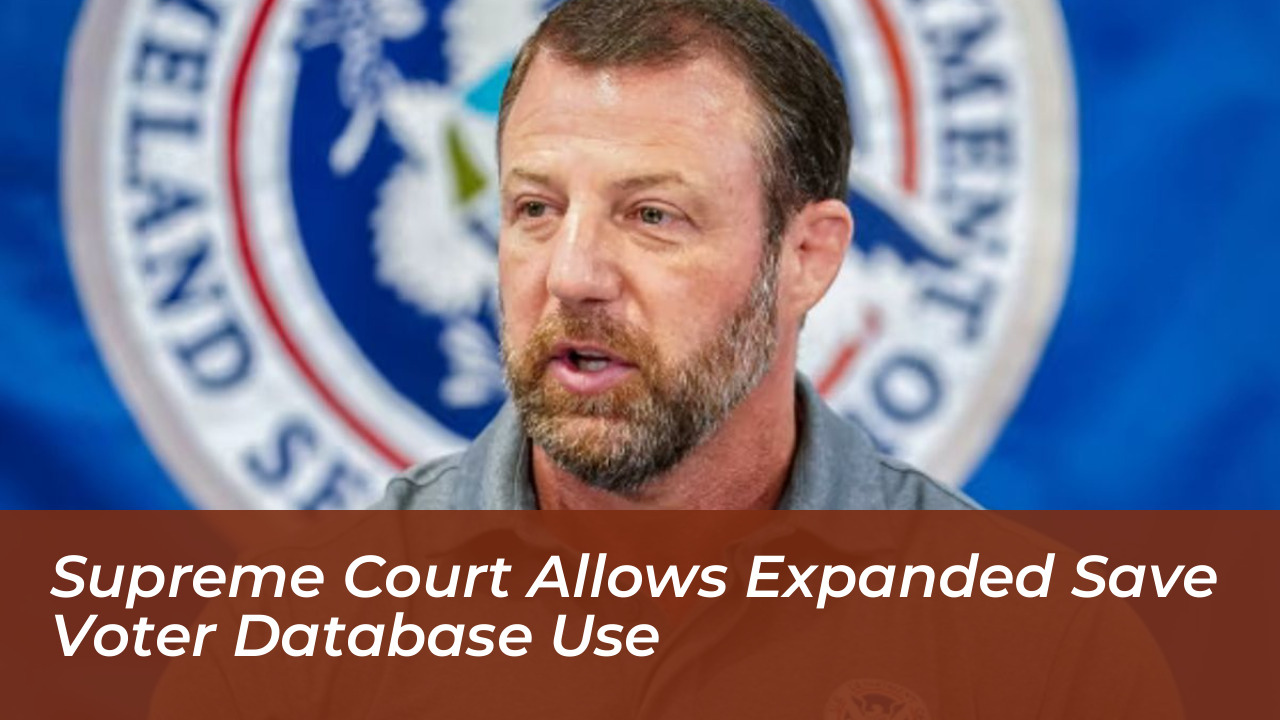
The United States Supreme Court delivered a pivotal 6-3 conservative majority decision on September 25, 2026, granting an emergency request by the federal government. This ruling allows the Trump administration to resume using an expanded federal citizenship database known as the Systematic Alien Verification for Entitlements program. The decision reverses lower court injunctions that previously halted modifications to the system, which critics argued violated federal privacy laws and risked disenfranchising eligible voters. The legal battle centers on how the federal government collects, merges, and shares sensitive citizen data with state election officials. While the administration champions the database as a necessary tool to secure election integrity and verify voter eligibility, voting rights organizations warn of widespread error rates and systemic data inaccuracies.
- Introduction to the Supreme Court SAVE Database Ruling
- The Structural Evolution of the SAVE Program
- Origins and Original Purpose
- Executive Overhaul and Scope Expansion
- Legal Battles and Lower Court Injunctions
- Supreme Court Reasoning and the 6-3 Decision
- The Dissenting Perspective
- Real-World Impacts on State Voter Rolls
- The Texas Case Study
- Unexplored Angles in Data Verification
- The Invisible Cost of Administrative Reverification Burdens
- Federal Interagency Data Integrity and Mismatch Mechanics
- Frequently Asked Questions
- Does the Supreme Court ruling allow mass voter purges right before the election?
- What is the SAVE database?
Understanding the mechanics of this ruling requires an examination of the SAVE system overhaul, the statutory limitations governing voter roll maintenance, and the real-world implications for the upcoming elections. The debate highlights the ongoing tension between modernization in government technology and the protection of individual privacy rights.
Introduction to the Supreme Court SAVE Database Ruling
The Supreme Court decision on September 25, 2026, marks a major turning point in federal oversight of state voter rolls. By a 6-3 margin, the conservative majority lifted emergency blocks that had kept the expanded database offline for months. This intervention immediately impacts how states interact with federal data repositories.
At the center of the dispute is the use of federal immigration and social security systems for election management. State election boards operate under strict guidelines, but the introduction of centralized federal data tools creates a new layer of complexity. Supporters argue that modern threats require modern tools, while opponents contend that merging administrative datasets invites widespread administrative errors.
The Structural Evolution of the SAVE Program
Origins and Original Purpose
Congress established the Systematic Alien Verification for Entitlements program in 1986. The original framework served as a verification mechanism for noncitizens applying for public benefits such as Medicaid, food assistance, or Social Security numbers. The design focused entirely on agency-specific checks rather than centralized mass voter list management.
For decades, the system operated quietly within narrow administrative boundaries. State and federal agencies used it to verify eligibility for welfare programs, ensuring that public resources went exclusively to qualified individuals. The database was never intended to cross-reference voter registries or track the citizenship status of the entire American electorate.
Executive Overhaul and Scope Expansion
The operational landscape shifted dramatically following an executive order signed by President Donald Trump in March 2025. This directive significantly expanded the mandate of the Department of Homeland Security regarding citizenship tracking. The restructured database introduced integration with Social Security Administration records to incorporate natural-born citizens into the tracking framework.
The overhaul implemented bulk search capabilities, allowing states to process entire voter databases simultaneously rather than checking individuals one by one. The system now utilizes Social Security numbers as primary query identifiers across multiple federal data silos. Solicitor General D. John Sauer reported to the high court that since May 2025, the updated framework verified more than 65 million voters across 26 states, flagging thousands of individuals as potential noncitizens.
Legal Battles and Lower Court Injunctions
Before the Supreme Court intervention, the database expansion faced severe judicial roadblocks. In June 2026, U.S. District Judge Sparkle Sooknanan in Washington, D.C., issued a sweeping injunction blocking the modified system. Judge Sooknanan ruled that the administration knowingly trampled on the privacy rights of American citizens by combining sensitive data in a manner that violated the Social Security Act, the Privacy Act, and the Administrative Procedure Act.
Litigation was spearheaded by organizations including the League of Women Voters and the Electronic Privacy Information Center. Plaintiffs argued that the federal government lacked statutory authority to construct a centralized master citizenship database. They presented evidence that the system produced erroneous flags, particularly impacting newly naturalized citizens who were subsequently forced to navigate bureaucratic hurdles to retain their voter registrations.
A federal appeals court panel refused to stay the lower court order in a 2-1 vote, leading the Justice Department to escalate the case to the high court. The administration contended that the lower court ruling directly threatened the integrity of federal elections by depriving state officials of the most efficient verification tool available.
Supreme Court Reasoning and the 6-3 Decision
In an unsigned opinion, the 6-3 conservative majority sided with the federal government, concluding that claims brought by voting rights groups against the modified database likely lacked legal merit. The justices emphasized that federal immigration law mandates the government to respond to state and local inquiries regarding citizenship status. The majority opinion stated that the lower court injunction effectively prevented the executive branch from utilizing the program it deemed best suited for the task.
The court noted that federal law under the National Voter Registration Act prohibits systematic, broad purges of voter rolls within 90 days of a federal election. Consequently, this statutory restriction limits the immediate impact of the Supreme Court ruling for the upcoming election, restricting the database use strictly to individualized voter inquiries rather than sweeping removals.
The Dissenting Perspective
Justice Ketanji Brown Jackson authored a sharp dissent joined by her liberal colleagues, Justices Sonia Sotomayor and Elena Kagan. The dissent criticized the majority for omitting any serious consideration of the harms inflicted upon lawful voters.
The harm caused by burdening or disenfranchising even a few lawful voters outweighs the nonexistent harm that the Government experiences when it is prevented from taking an action that it likely lacks the authority to take. – Justice Ketanji Brown Jackson
The minority warned that allowing the modified SAVE system to operate unchecked creates an unacceptable risk that states will cancel valid voter registrations or compel eligible citizens to endure burdensome reverification processes. The dissent emphasized that administrative friction often hits vulnerable populations the hardest.
Real-World Impacts on State Voter Rolls
The Texas Case Study
Practical application of the expanded database has already yielded documented administrative errors at the state level. Texas serves as a primary case study, having uploaded its entire voter registry of approximately 18 million records into the system.
| Metric Category | Recorded Figure | Context |
|---|---|---|
| Total Texas Records Processed | 18,000,000+ | Entire state voter list uploaded to SAVE |
| Initial Flags for Noncitizen Status | 2,724 | Voters given 30 days to prove citizenship |
| Confirmed Errors / Reinstatements | ~20% | Naturalized citizens wrongly flagged and later restored |
| Referred for Investigation | 117 | Cases representing 4.2% of initial flags |
Public disclosures from the Texas Secretary of State and independent journalistic investigations show that approximately 20 percent of voters initially flagged by the system were later proven to be lawful citizens who had to be reinstated. Local county officials had initially given flagged individuals a strict 30-day window to respond, resulting in the wrongful cancellation of registrations for citizens who failed to meet the deadline.
Unexplored Angles in Data Verification
The Invisible Cost of Administrative Reverification Burdens
Discussions surrounding voter roll management usually center on who gets removed entirely. However, the SAVE database expansion creates a secondary class of harm involving administrative friction. Eligible voters who are falsely flagged must navigate opaque municipal bureaucracy, take time off work, and submit physical documentation to prove their status.
This burden falls disproportionately on rural and working-class naturalized citizens lacking immediate access to legal aid. When a database error forces a citizen to spend hours on the phone or travel to a county office, the barrier to voting increases significantly.
Federal Interagency Data Integrity and Mismatch Mechanics
Technical architecture merging Department of Homeland Security immigration databases with Social Security Administration records introduces inherent matching flaws. Algorithmic approximations often fail for individuals who changed names after naturalization, hyphenated surnames, or possess common names.
Transparency failures regarding the database matching algorithm error rate leave the public in the dark about how many false positives occur behind the scenes. Without open audits, determining the true reliability of automated citizenship checks remains difficult for independent researchers.
Frequently Asked Questions
Does the Supreme Court ruling allow mass voter purges right before the election?
No. The National Voter Registration Act bars systematic mass removals within 90 days of a federal election. The Supreme Court ruling restricts the database use strictly to individualized voter inquiries rather than authorizing sweeping, automated roll purges close to election day.
What is the SAVE database?
The Systematic Alien Verification for Entitlements program is a federal database established in 1986 to help government agencies check the immigration status of noncitizens applying for public benefits. Recent executive overhauls expanded its scope to include natural-born citizens and bulk voter list cross-referencing.