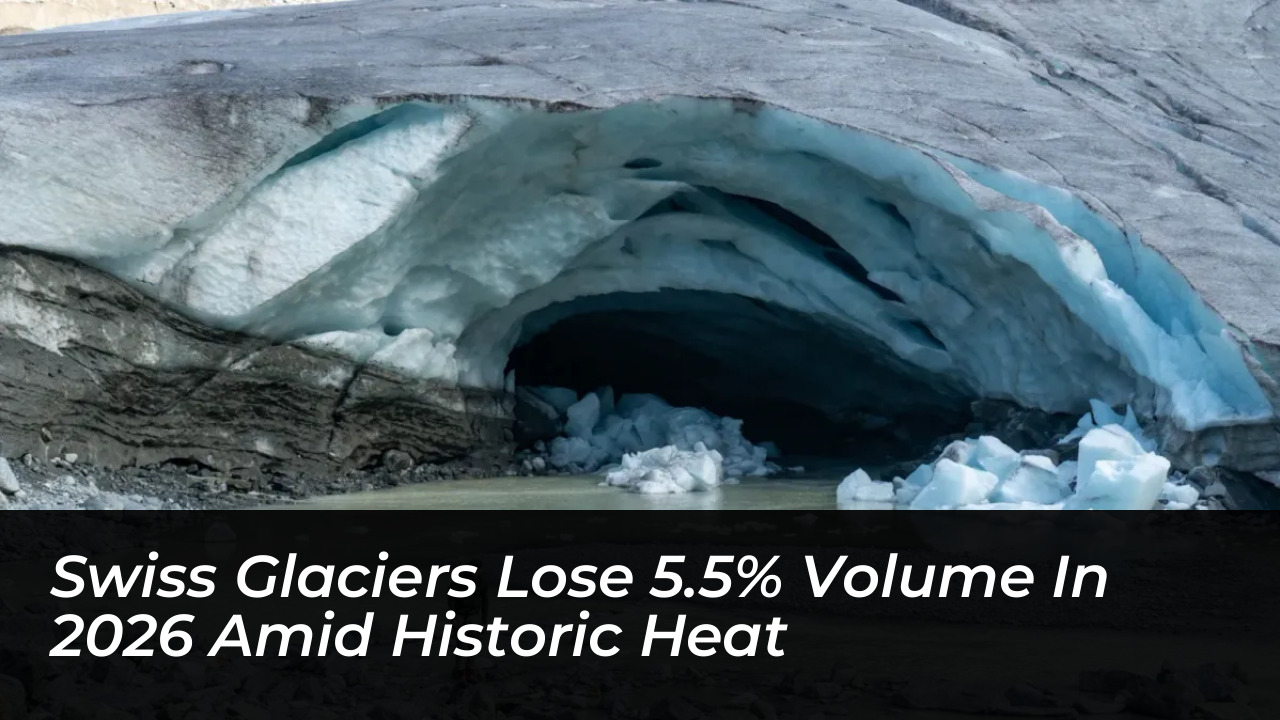
Switzerland’s glaciers suffered their second-largest ice volume reduction on record over the past 12 months, losing 5.5 percent of their total mass. According to a report released on October 1, 2026, by the Swiss Glacier Monitoring Network (GLAMOS) and the Swiss Commission for Cryosphere Observation of the Swiss Academy of Sciences, the dramatic melt was driven by an exceptionally snow-poor winter followed by unprecedented summer heatwaves across the Alpine region.
- Drivers of the 2026 Record Melt
- Impact on Water Supplies and Downstream Ecosystems
- Frequently Asked Questions
- How much ice did Swiss glaciers lose in 2026?
- How does the five-year ice loss compare historically?
- What caused the extreme melting in 2026?
- What role does GLAMOS play in monitoring these changes?
- Are some Swiss glaciers disappearing completely?
Data compiled by GLAMOS indicates that Alpine ice volume has dropped by nearly 20 percent since 2021. , the average melt rate recorded between 2022 and 2026 is more than double any previously documented five-year period in Swiss history, pointing to an accelerating structural retreat of Europe’s high-altitude ice fields.
Drivers of the 2026 Record Melt
The severity of the 2026 ice loss stems from a compounding sequence of extreme weather conditions throughout the hydrological year. The winter of 2025 to 2026 ranked among the ten least snowy winters since systematic monitoring began, leaving high-altitude peaks with a minimal natural snowpack.
Snow acts as a vital protective shield for glaciers, reflecting incoming solar radiation back into the atmosphere. Without this thick layer of reflective white cover, June, July, and August quickly stripped away remaining snowbanks. Summer temperatures-the hottest in Switzerland since records began in 1864-exposed dark, highly absorbent underlying ice surfaces much earlier in the ablation season than normal.
For a total of 76 days during the summer, freezing levels pushed above 4,000 meters, more than double the long-term average. This prolonged heat triggered severe ablation even in high-elevation firn basins. Iconic formations like the Aletsch Glacier and the Rhône Glacier experienced their largest single-season retreats on record, while smaller bodies of ice, such as the Bella Tola and Griessfirn glaciers, melted away completely and permanently.
Impact on Water Supplies and Downstream Ecosystems
As the glaciers retreated, they released an estimated 2.2 trillion liters of water between July and September 2026 alone-an amount equivalent to more than four times the annual drinking water consumption of all Swiss households. While this massive surge of meltwater temporarily cushioned drought conditions across downstream valleys and fed major European river systems like the Rhine and Danube during dry periods, researchers warn that this buffering function is a rapidly wasting asset.
Matthias Huss, director of GLAMOS, emphasized that the ongoing shrinkage diminishes the future capacity of these natural water towers. As ice volume shrinks, the late-summer contribution of glacier melt to Alpine streams will inevitably dwindle, creating long-term risks for agriculture, hydropower generation, and regional water security.
Frequently Asked Questions
How much ice did Swiss glaciers lose in 2026?
Swiss glaciers lost 5.5 percent of their total ice volume in 2026, marking the second-largest annual melt volume recorded since measurements began.
How does the five-year ice loss compare historically?
Between 2021 and 2026, Swiss glaciers shed nearly 20 percent of their total volume, with the five-year melt rate reaching more than double any previously recorded period.
What caused the extreme melting in 2026?
The severe melt was caused by a combination of a snow-poor winter that left minimal protective snowpack and record-breaking summer heatwaves that exposed dark, heat-absorbing ice surfaces.
What role does GLAMOS play in monitoring these changes?
GLAMOS (Glacier Monitoring Switzerland) conducts long-term, systematic tracking of Swiss glaciers using field stake readings, snow pit observations, and geodetic surveys to measure mass balance and volume changes.
Are some Swiss glaciers disappearing completely?
Yes. Smaller ice bodies, such as the Bella Tola glacier in Valais and the Griessfirn in Glarus, melted away entirely and permanently during the 2026 season.