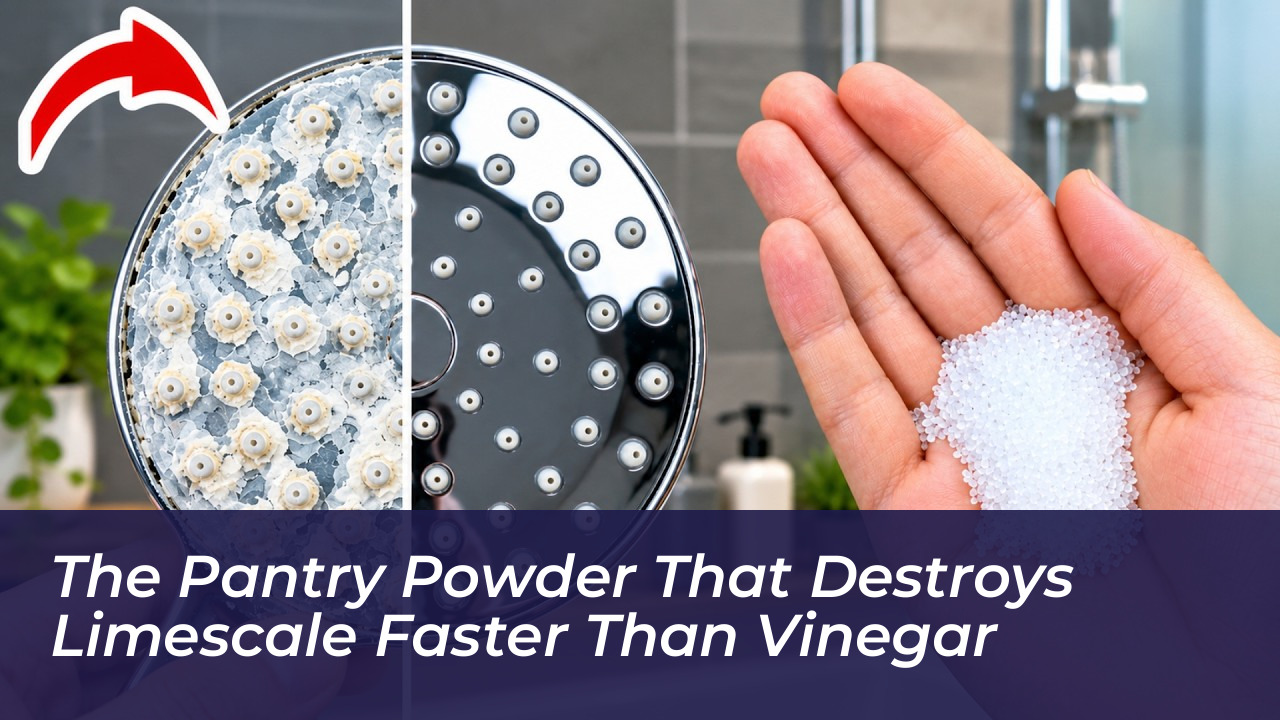

Millions of households battle hard water deposits that choke shower heads, dull chrome fixtures, and coat glass enclosures in stubborn white scale. While distilled vinegar remains the traditional go-to for clearing cloudy shower screens and chalky taps, concentrated food-grade citric powder serves as a far more potent household alternative. It dissolves dense calcium carbonate deposits in a fraction of the time without leaving behind a pungent, sour odor.
Commercial cleaners often rely on aggressive fumes and abrasive bleaches that degrade silicone seals and irritate the respiratory tract. By contrast, citric powder provides a natural, scent-free chemical reaction that safely strips away years of calcified mineral scale.
The Chemistry of Mineral Buildup: Why Vinegar Falls Short
Hard water carries elevated concentrations of dissolved calcium and magnesium ions. Every time water evaporates from taps, shower screens, or tiles, it leaves these minerals behind as solid calcium carbonate, commonly known as limescale.
Standard white vinegar typically contains only a 5% concentration of acetic diluted in 95% water. While mildly effective against light surface spots, its low acidity struggles against calcified rings and clogged shower nozzles, requiring hours of soaking alongside an overwhelming, vinegary stench.
Citric limescale treatments offer a vastly superior organic profile. As a tricarboxylic , citric binds directly with calcium ions through a process called chelation. This chemical bond converts insoluble calcium carbonate into highly water-soluble calcium citrate, allowing crusty deposits to rinse away effortlessly down the drain.
How to Mix and Apply Citric Powder for Instant Results
Pure, food-grade citric powder is readily available in the baking or canning aisle of most grocery stores, hardware shops, and online suppliers. Preparing an active descaling solution takes less than two minutes and requires no protective gas masks or harsh ventilation.
- The Heavy-Duty Spray: Dissolve two heaped tablespoons of citric powder into 500 milliliters of warm water inside a standard spray bottle. Shake vigorously until the crystals fully dissolve.
- The Rapid Paste: For vertical tap bases and thick rings around plugholes, mix equal parts citric powder and warm water with a drop of liquid dish soap to create an adhesive paste that clings to surfaces without sliding down.
- The Immersion Bath: For severely clogged shower heads where mineral blocks prevent normal water flow, submerge the detachable head directly into a warm bowl containing three tablespoons of dissolved citric powder.
Deep-Cleaning Clogged Shower Heads Step-by-Step
When hard water chokes a shower rose, water pressure drops dramatically and jets begin spraying in erratic directions. Restoring full pressure does not require replacing the hardware.
Unscrew the shower head from the hose or arm, ensuring you preserve the rubber washer seated inside the connector. Place the unit inside a deep bowl, cover it entirely with the warm citric solution, and leave it undisturbed for 30 to 45 minutes. The solution will gently fizz as the reacts with the alkaline calcium deposits. Once the effervescence stops, rinse the head thoroughly under cold running water, dislodge any loosened debris with an old soft-bristled toothbrush, and reattach it. The water channels will run completely clear.
Safety Precautions Across Different Bathroom Surfaces
Although citric is completely biodegradable and safe for household plumbing, its concentrated acidic nature means it must be kept away from specific materials. Knowing where to avoid it protects expensive bathroom investments from irreversible etching.
Never apply citric or any other -based descaler to natural stone surfaces, including marble, granite, limestone, or travertine. The will instantly dissolve the stone’s calcium-based matrix, leaving dull, rough patches that require professional polishing to repair.
Chrome, stainless steel, clear glass, ceramic tile, and porcelain handle citric exceptionally well. For delicate gold or matte-black finishes, test the solution on an incons**cuous spot first and avoid leaving acidic mixtures on coated metals for longer than ten minutes. Switching from vinegar to pure citric powder eliminates the most frustrating household cleaning battles while saving time, money, and your lungs.