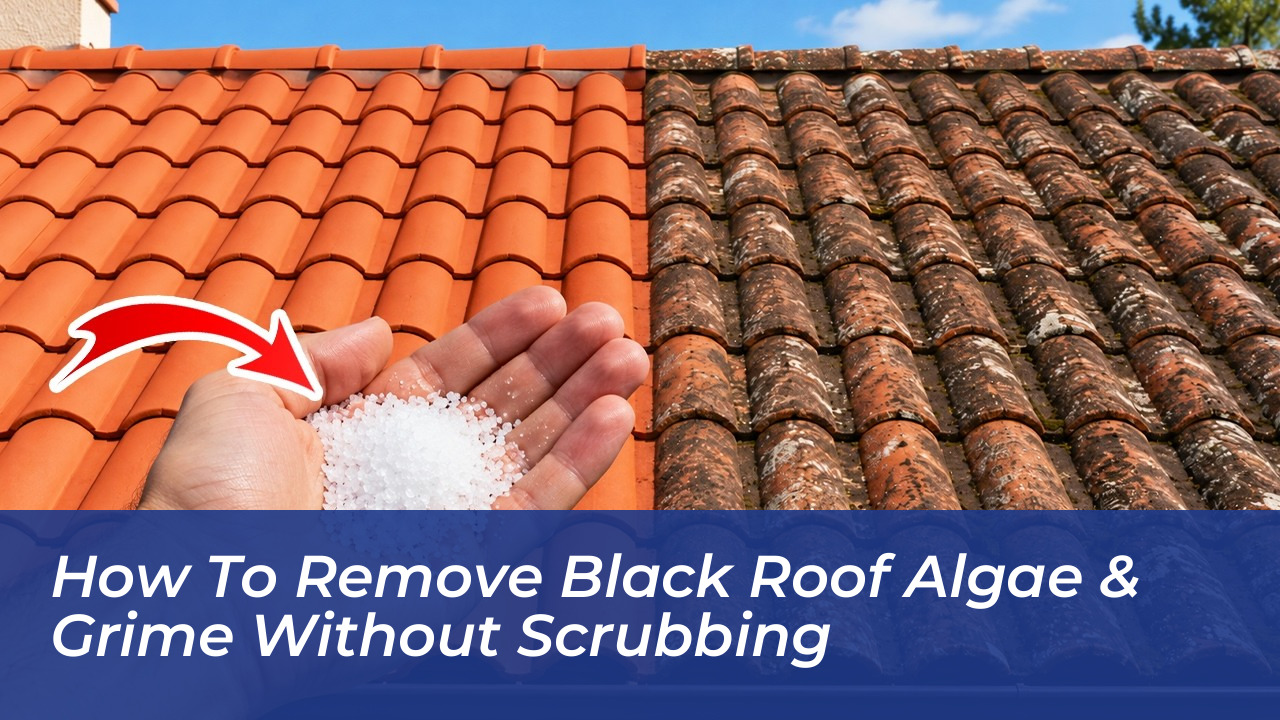

Restoring blackened, moss-covered roof tiles to their original shade requires neither abrasive wire brushes nor destructive pressure washers. Standard sodium hypochlorite-the active compound in ordinary household bleach-dissolves organic growth on contact through gentle chemical oxidation. Those dark streaks creeping down asphalt shingles and clay tiles are rarely simple dirt deposits. Instead, they are colonies of Gloeocapsa magma, an airborne, photosynthetic cyanobacteria that feeds on the limestone filler embedded within modern roofing materials.
The Science of Soft Washing: Why Friction Destroys Shingle Granules
Power washers exert upwards of 2,500 pounds per square inch of mechanical force against surfaces engineered only for vertical rainfall. That intense spray dislodges asphalt granules, leaving structural fiberglass mats vulnerable to ultraviolet degradation and leaks. Soft washing bypasses friction entirely by relying on chemical eradication rather than mechanical impact.
When diluted sodium hypochlorite settles over the roofline, it breaks down the cellular walls of moss, microalgae, and lichen clusters within ten to fifteen minutes. The chemical neutralises dark pigments instantly, shifting stubborn stains from pitch black to an inert, pale residue that washes away cleanly during the next rain.
Step-by-Step Application for Maximum Impact
Achieving professional-grade results without damaging surrounding property requires careful preparation and precise execution:
- Preparation: Thoroughly saturate surrounding foundation landscaping, flower beds, and shrubs with fresh water before and after application to prevent foliage burn from runoff.
- The Mixture: Blend standard 6% household bleach with equal parts tap water in an ordinary pump-action garden sprayer. Add one tablespoon of non-ammonia dish soap to help the liquid cling to angled pitches.
- Even Distribution: Mist the solution across dry shingles from the bottom edge upward to avoid uneven streaking, ensuring complete saturation across discoloured zones.
- Dwell Time: Allow the formulation to sit undisturbed for fifteen to twenty minutes while the active oxidiser dismantles the organic matter at root level.
- Gentle Rinse: Wash down the treatment using a standard garden hose equipped with a multi-pattern nozzle set to a broad, low-pressure shower setting.
Protecting Gutters, Metal Trim, and Garden Foliage
The single greatest hazard during chemical roof restoration is chemical runoff pooling in unintended areas. Bleach solutions accelerate oxidation across bare copper, aluminium flashings, and unpainted gutters if left unmonitored. Direct all downspout discharge into collection barrels or extend downspout tubes past sensitive landscaping into gravel driveways.
Pre-wetting delicate ornamental plants creates a protective moisture barrier on leaf surfaces, drastically diluting any incidental drift carried by the wind. Once the organic colonies die at root level, secondary treatments are rarely necessary for two to three years. Without living organisms securing moisture against the roofing substrate, structural materials dry out uniformly, resisting premature rot and ice damming throughout severe winter weather.
Frequently Asked Questions
Will household bleach damage my asphalt shingles?
When properly diluted with an equal part of water (yielding a roughly 3% sodium hypochlorite solution) and rinsed thoroughly after a brief dwell time, bleach safely kills algae without breaking down the asphalt or deteriorating structural fiberglass mats.
How long should the chemical mixture sit on the roof?
Allow the solution to dwell undisturbed for 15 to 20 minutes. This gives the active oxidiser enough time to break down the cellular walls of the algae and neutralise dark pigments before you rinse it away.
Can I use a pressure washer for the final rinse?
No. High-pressure streams will shear protective mineral granules off asphalt shingles, drastically shortening your roof’s functional lifespan. Always use a standard garden hose with a low-pressure nozzle setting.
How often will I need to repeat this cleaning process?
Because soft washing kills the organic growth down to the root level, secondary treatments are typically unnecessary for two to three years, depending on your local climate and tree coverage.
What safety precautions should I take before starting?
Always wear protective eyewear, rubber gloves, and old clothing. Pre-soak all surrounding plants and shrubs with clean water to prevent chemical burn from runoff, and avoid working on steep or wet roofs without proper fall protection equipment.