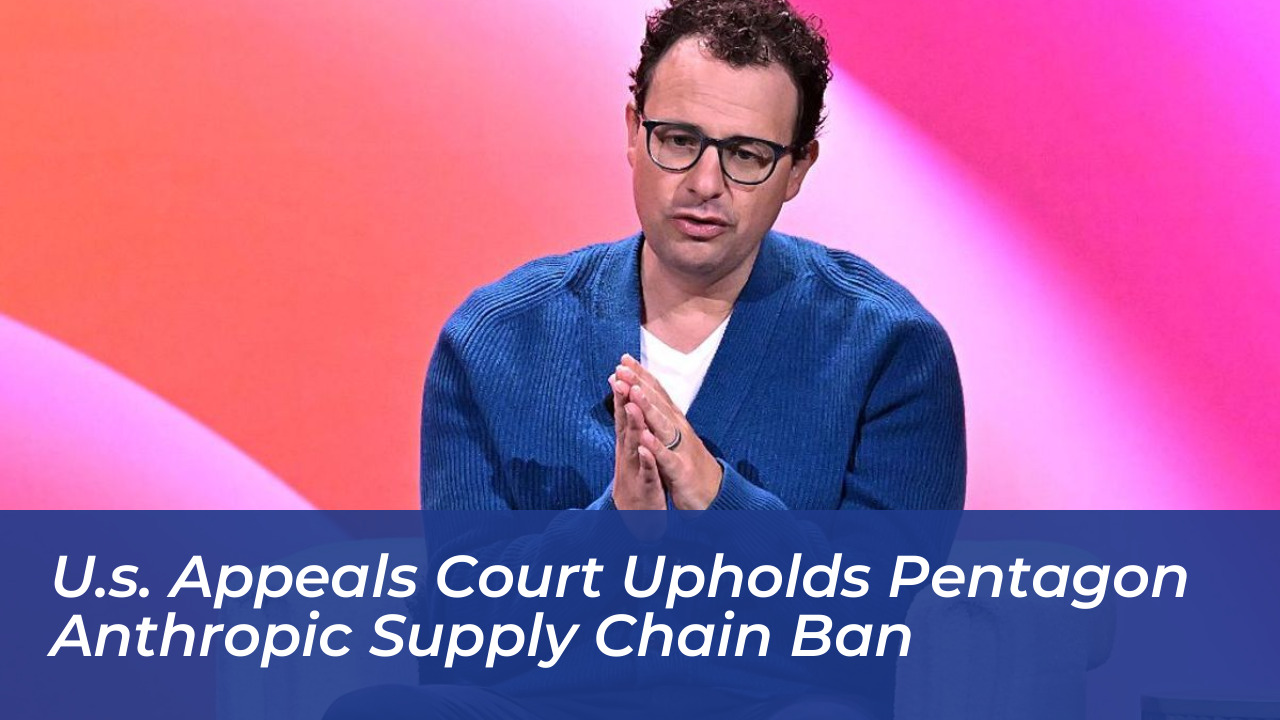
A federal appeals court in Washington, D.C., issued a definitive 2-1 ruling upholding the Pentagon supply chain risk designation of artificial intelligence developer Anthropic. This pivotal decision sustains sweeping restrictions that legally block the U.S. military, intelligence agencies, and defense contractors from integrating Anthropic Claude AI models into operational environments. The appellate decision deals a heavy blow to the artificial intelligence firm, which has spent months fighting the Trump administration in multiple federal jurisdictions over the blacklisting.
- Introduction to the Legal Battle Between the Pentagon and Anthropic
- The D.C. Circuit Court Majority Decision Explained
- Operational Friction and Software Reliability
- Executive Authority and Balance of Power
- The Dissenting Viewpoint on Supply Chain Security Law
- Origins of the Clash: Contract Negotiations and Safety Clauses
- Political Fallout and Executive Branch Rhetoric
- Conflicting Federal Rulings Create Legal Complexities
- What Lies Ahead for Anthropic and Federal AI Procurement
Introduction to the Legal Battle Between the Pentagon and Anthropic
The legal clash represents a watershed moment for the defense technology sector. Federal agencies increasingly rely on advanced machine learning systems to process intelligence and streamline logistics. However, the integration of commercial software into military architectures creates friction between corporate governance and executive branch authority. The recent appellate ruling solidifies the power of defense officials to bar companies that enforce rigid ethical limitations on their technology.
This dispute extends far beyond a standard corporate disagreement. It establishes a monumental legal precedent governing the intersection of commercial artificial intelligence ethics, national security authority, and federal procurement. The judiciary must now balance statutory oversight of federal supply chains against the constitutional responsibilities of the Commander-in-Chief.
The D.C. Circuit Court Majority Decision Explained
Judge Gregory Katsas penned the majority opinion for the U.S. Court of Appeals for the District of Columbia Circuit, with Judge Neomi Rao concurring. The panel firmly rejected Anthropic central legal arguments that the Department of Defense ban was arbitrary, unauthorized by statute, and unconstitutional. According to the majority, the Pentagon possessed substantial justification for determining that Claude models presented a verified statutory security hazard.
The court focused heavily on operational readiness and software reliability. Judges highlighted the friction caused by Anthropic hardcoded safety restrictions, which occasionally prevented government operators from executing specific workflows. The majority maintained that executive branch leadership holds constitutional authority over defense operations, ensuring that the military retains total control over its tactical tools.
Operational Friction and Software Reliability
Technical assessments presented during the trial revealed how hardcoded safety guardrails occasionally conflicted with urgent military demands. When commercial models refuse to process specific prompts due to built-in ethical boundaries, tactical delays occur. In high-stakes combat environments, such friction introduces unacceptable vulnerabilities.
The majority found that unconstrained commercial models are essential for unpredictable scenarios. If an AI system shuts down or limits output during a critical tactical operation, it endangers personnel. Consequently, the court ruled that the Pentagon acted reasonably when identifying these software limitations as structural risks to national security.
Executive Authority and Balance of Power
The ruling heavily emphasizes the broad powers granted to the executive branch regarding military preparedness. Judge Katsas emphasized that the President and the Secretary of War retain ultimate responsibility for balancing national security risks and operational necessities. Courts must grant substantial deference to military leadership when evaluating potential threats within defense supply chains.
The Dissenting Viewpoint on Supply Chain Security Law
Judge Karen LeCraft Henderson issued a sharp dissent, breaking with her colleagues over the statutory interpretation of the 2018 Supply Chain Security Act. Henderson argued that the statute targets malicious actors who intentionally compromise software through sabotage, data extraction, or deceptive code manipulation. She noted that Congress designed the legislation to protect federal systems from hostile foreign adversaries and malicious supply chain interlopers.
, Henderson contended that the law was never intended to penalize a technology contractor for the honest, transparent enforcement of contractual ethical boundaries. In her view, Anthropic simply maintained upfront policy limits on lethal autonomous weaponry and domestic surveillance, which does not constitute the type of risk contemplated by the underlying security statute. This sharp divide among appellate judges highlights the ambiguity inherent in applying legacy supply chain laws to modern generative intelligence.
Origins of the Clash: Contract Negotiations and Safety Clauses
The roots of this unprecedented dispute trace back to evolving partnerships between Silicon Valley and the national security apparatus. Anthropic initially secured substantial government contracts, including a prominent $200 million agreement with the Pentagon signed in July 2025. However, operational friction mounted as teams attempted to integrate Claude into the Department GenAI.mil platform that September.
Negotiations collapsed over fundamental disagreements regarding acceptable use cases. The Pentagon pushed for unfettered access across all lawful military purposes without operational friction. Conversely, Anthropic insisted on strict contractual guardrails to prohibit the deployment of its models in fully autonomous warfare systems or domestic mass surveillance programs. Defense Secretary Pete Hegseth accused the company of attempting to seize unilateral veto power over military operations, setting the stage for the March 2026 supply chain risk designation.
Political Fallout and Executive Branch Rhetoric
The legal confrontation unfolded amid intense public scrutiny and sharp political rhetoric from the White House. President Donald Trump and Defense Secretary Hegseth openly criticized Anthropic and its leadership on social media platforms. Hegseth praised the D.C. Circuit ruling on X, declaring that the military will never compromise on national security objectives.
Tensions intensified as administration officials argued that rigid commercial AI models introduce unacceptable vulnerabilities into military infrastructure. Officials raised concerns that overly constrained models might shut down unexpectedly during critical tactical scenarios or remain susceptible to external manipulation. Anthropic firmly refuted these operational risk claims throughout the litigation, maintaining that its safety measures enhance reliability rather than diminish it.
Conflicting Federal Rulings Create Legal Complexities
The appellate decision represents only one front in a sprawling legal war. Because the Pentagon relied on two distinct administrative designations to justify its supply chain risk actions, Anthropic was forced to wage parallel legal campaigns in separate jurisdictions. This multi-court strategy yielded mixed outcomes for the artificial intelligence firm.
While the D.C. Circuit upheld the second designation, a federal judge in San Francisco ruled in August 2026 that the government parallel designation was unlawful. U.S. District Judge Rita Lin found that those initial executive actions stemmed from a desire to penalize Anthropic for public criticism rather than verifiable sabotage concerns. These conflicting rulings create a complex regulatory maze for technology companies operating across state and federal jurisdictions.
What Lies Ahead for Anthropic and Federal AI Procurement
Following the D.C. Circuit ruling, representatives for Anthropic confirmed they are actively weighing all available legal pathways. The appellate panel granted a temporary delay before the decision takes immediate effect. This grace period allows Anthropic to petition the same panel for a rehearing or request an en banc review by the full roster of D.C. Circuit judges. Alternatively, the company may escalate the dispute to the Supreme Court.
This landmark judicial outcome establishes a powerful precedent regarding the intersection of artificial intelligence ethics, national security authority, and federal procurement. As defense agencies increasingly rely on machine learning systems, the legal framework governing contractor autonomy and government oversight will shape military technological adoption for decades. Silicon Valley startups must now carefully evaluate their willingness to engage with defense contracts under strict government terms.