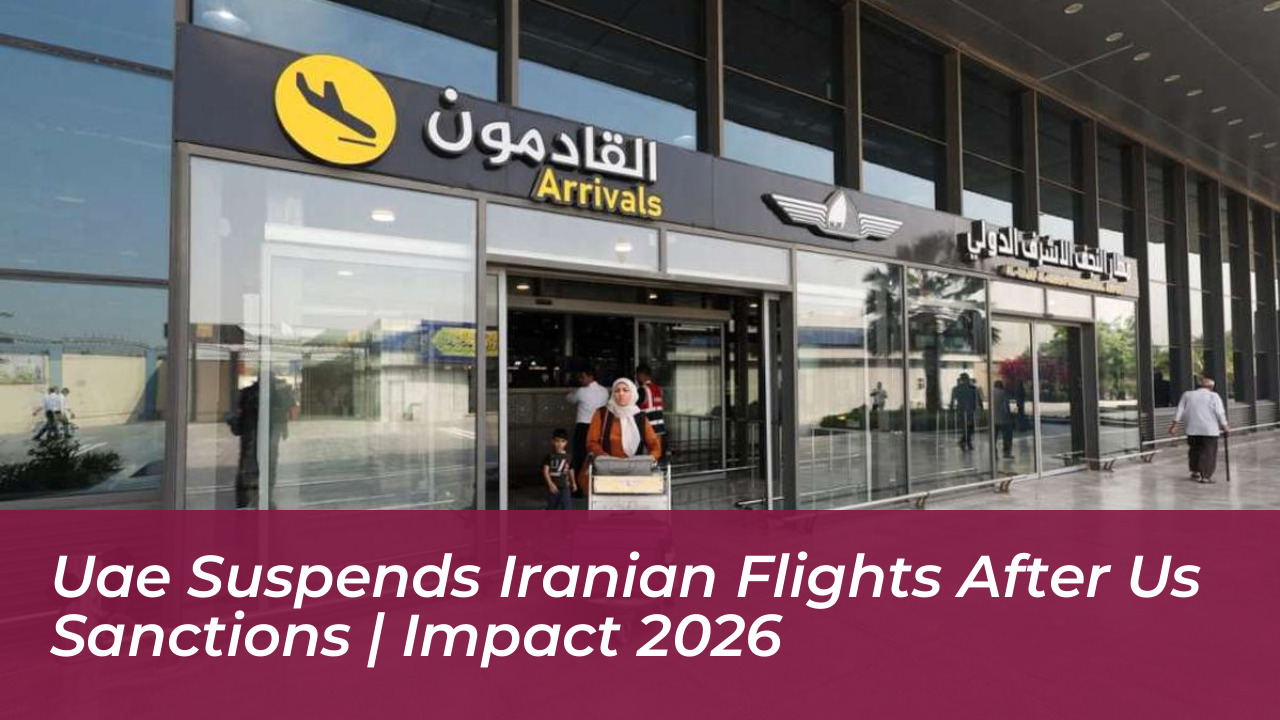
The United Arab Emirates General Civil Aviation Authority issued a decisive directive halting all commercial flights operated by Iranian airlines to and from the country. This regulatory action follows sweeping secondary sanctions enacted by the United States Department of the Treasury. These measures aim to isolate Tehran’s aviation network by penalizing international service providers that facilitate operations for Iranian carriers. The sudden suspension cuts off major operators like Iran Air, Mahan Air, and Kish Air from vital transit hubs in Dubai and Sharjah. As global regulatory pressure mounts, regional aviation channels, financial institutions, and international supply chains face unprecedented operational disruptions that threaten traditional Middle Eastern transit routes.
- Triggers and Mechanics of US Secondary Sanctions
- Expiration of the Wind-Down Period
- Supply Chain Penalties and Financial Leverage
- Scope of the UAE Aviation Ban and Regional Response
- The GCAA Directive and Regional Grounding
- Iran Retaliates with Airspace Restrictions
- Impact on Financial Institutions and Banking Channels
- Decline in International Flight Capacity
- Contraction of Iran Civil Aviation
- Loss of Overflight Revenue
- Logistical Bottlenecks for Civilian Travelers
- Overland Border Crossings and Price Surges
- Socioeconomic Toll on Families and Workers
- Consumer Rights and Travel Insurance Considerations
- Passenger Remedies and Refunds
- Strategic Outlook for Global Aviation
Triggers and Mechanics of US Secondary Sanctions
Expiration of the Wind-Down Period
The suspension of Iranian flights by the UAE follows the expiration of a critical wind-down period set by the US Department of the Treasury. This deadline accompanied an aggressive enforcement phase of US Treasury measures designed to target international entities engaging with Iran’s commercial and military transport sectors. US Treasury Secretary Scott Bessent characterized the enforcement date as an economic pressure point for international aviation. Rather than targeting aircraft directly, the regulatory framework penalizes every link in the aviation supply chain.
The policy forces foreign companies to choose between doing business with sanctioned Iranian entities or maintaining access to the Western financial system. This ultimatum creates a powerful deterrent for aviation service providers operating across the Middle East and beyond. Compliance departments in regional airports and logistics firms immediately evaluated their risk exposure ahead of the enforcement deadline.
Supply Chain Penalties and Financial Leverage
Airports hosting Iranian jets, fuel suppliers, ground handlers, and ticket agencies now face the risk of exclusion from the US dollar-based financial system. Losing access to the global dollar clearing system presents severe commercial consequences for international service providers. Consequently, airports and ground operators across the Middle East and parts of Europe terminated agreements with Iranian carriers rather than risk penalties from the Office of Foreign Assets Control.
The Office of Foreign Assets Control compliance pressures force regional operators to sever ties immediately. Without local ground handling, aircraft refueling, and passenger processing services, Iranian airlines cannot maintain regular flight schedules. This systemic squeeze effectively grounds targeted carriers by cutting off the foundational infrastructure required to support modern commercial aviation.
Scope of the UAE Aviation Ban and Regional Response
The GCAA Directive and Regional Grounding
The General Civil Aviation Authority of the UAE enacted the flight ban via an official statement distributed by the Emirates News Agency. The directive halts all arrivals and departures by Iranian-registered airlines until further notice. Because Dubai and Sharjah serve as primary international transit corridors for Iranian nationals, this closure severely restricts outbound human mobility and trade links.
The decision by the UAE mirrors similar actions across the region. Azerbaijan Airlines suspended Iranian routes, and Georgian aviation authorities instituted parallel bans. In Iraq, authorities closed Baghdad International Airport to Iranian carriers, though certain flights to Najaf maintained temporary exemptions to accommodate religious pilgrims traveling to Shia holy sites. Oman restricted Tehran-Muscat operations, and Turkish authorities curtailed specific schedules after requests from international regulators.
Conversely, certain jurisdictions maintained operations. Flight tracking data indicated that Mahan Air flights to Guangzhou, China, continued following the enforcement deadline, highlighting divergent international compliance strategies. While Western-aligned aviation networks rapidly closed their doors, select Asian partners attempted to navigate the shifting regulatory landscape under distinct risk parameters.
Iran Retaliates with Airspace Restrictions
In response to the regional grounding of its airline fleet, Iranian aviation authorities implemented retaliatory measures, banning UAE-operated carriers from utilizing Iranian airspace. This restriction forced immediate operational adjustments for Gulf carriers. Flydubai flights operating between Dubai and Baku in Azerbaijan required emergency route modifications to bypass restricted zones.
Flight-tracking data confirmed that regional carriers rerouted aircraft over alternative corridors in Iraq and Turkey, extending flight times and increasing operational fuel costs. Industry analysts note that ongoing airspace restrictions will drive up ticket prices across regional routes as carriers absorb longer journey durations. Passengers traveling between the Gulf and the Caucasus now experience extended transit times and altered flight paths.
Impact on Financial Institutions and Banking Channels
The aviation bans form part of a broader macroeconomic strategy initiated by Washington, including Operation Economic Outcast. This initiative targets the financial plumbing supporting Iranian entities abroad. Ahead of the aviation suspension, the UAE Central Bank ordered domestic branches of Bank Melli to halt all financial transactions connected to Iran, including trade finance and fund transfers.
These financial constraints compound difficulties for Iranian carriers trying to settle international liabilities. Without access to correspondent banking networks or local currency clearing facilities in key transit hubs, Iranian airlines cannot pay for routine maintenance, landing fees, or lease agreements. The total severance of these banking channels starves the aviation sector of the liquid capital needed to sustain cross-border operations.
Decline in International Flight Capacity
Contraction of Iran Civil Aviation
The September 2026 suspensions arrive during a period of acute distress for Iran’s civil aviation infrastructure. Data from aviation analytics firm Cirium indicates that international flight capacity originating from Iran dropped by 49 percent year-over-year by August 2026. This contraction followed a series of airspace closures, regional conflicts, and preliminary sanctions.
With major foreign carriers including Turkish Airlines, Qatar Airways, Emirates, and Lufthansa suspending services to Tehran over preceding months, domestic airlines relied heavily on regional flights to the UAE and Turkey to maintain international connectivity. The latest round of bans eliminates these remaining lifelines, leaving domestic carriers isolated within domestic airspace and select allied nations.
Loss of Overflight Revenue
Beyond passenger revenues, the suspension of overflight rights inflicts severe financial damage on Iran’s economy. Prior to the latest restrictions, Iran collected over $300 million annually in overflight fees from international carriers traversing its airspace. The cancellation of these authorizations strips Tehran of a critical foreign currency revenue stream.
As international airlines systematically reroute flights around Iranian territory to avoid regulatory and security complications, Tehran loses this vital passive income. The compounding loss of overflight fees and ticket sales creates a severe budgetary deficit for state-backed transport enterprises.
Logistical Bottlenecks for Civilian Travelers
Overland Border Crossings and Price Surges
With commercial air routes largely severed, civilian travelers face severe mobility restrictions. Overland border crossings have emerged as the primary exit route for Iranian citizens seeking to leave the country. Heavy congestion plagues the Bazargan and Razi land crossings into Turkey.
Road networks leading toward Yerevan, Armenia, report unprecedented traffic as travelers seek operational international airports. Black market bus tickets from Tehran to Turkey have reportedly quadrupled in price due to surging demand. Expats and students traveling abroad for mandatory international language examinations face complex, multi-day overland journeys.
Socioeconomic Toll on Families and Workers
Families separated by the sudden flight suspensions express deep concern over future visitation rights. , thousands of jobs within Iran’s domestic aviation, hospitality, and tourism sectors face immediate termination as operational revenues vanish. The inability to travel freely disrupts business operations, academic pursuits, and family reunions across the entire region.
Consumer Rights and Travel Insurance Considerations
Passenger Remedies and Refunds
Passengers holding tickets on Iranian carriers for UAE-originating flights face complex refund procedures. According to standard consumer protection frameworks, travelers whose flights are cancelled due to regulatory suspensions possess specific rights regarding compensation.
| Travel Scenario | Passenger Rights and Remedies | Regulatory Basis |
|---|---|---|
| US-Regulated Itineraries | Mandatory cash refunds upon request; travel vouchers are optional and not compulsory. | US Department of Transportation Regulations |
| UAE-Iran Suspended Routes | Subject to carrier policy and GCAA guidance; passengers should demand cash refunds over vouchers. | UAE General Civil Aviation Authority Directives |
| Standard Travel Insurance | Claims typically rejected; policies purchased after February 2026 exclude known events. | Global Travel Insurance Underwriting Exclusions |
Travelers dealing with cancelled itineraries should formally request cash refunds rather than accepting restrictive travel vouchers. Because many airlines facing insolvency or heavy sanctions struggle to issue timely reimbursements, regulatory intervention plays an essential role in securing consumer funds.
Strategic Outlook for Global Aviation
The enforcement of secondary sanctions transforms Middle Eastern transit geography and isolates Iran’s commercial aviation sector from Western-aligned airspace and financial markets. Regional hub operators must continuously monitor compliance directives to avoid severe penalties from international regulatory bodies. The long-term implications point toward a permanently altered global carrier network, where geopolitical compliance dictates flight paths just as much as commercial demand.