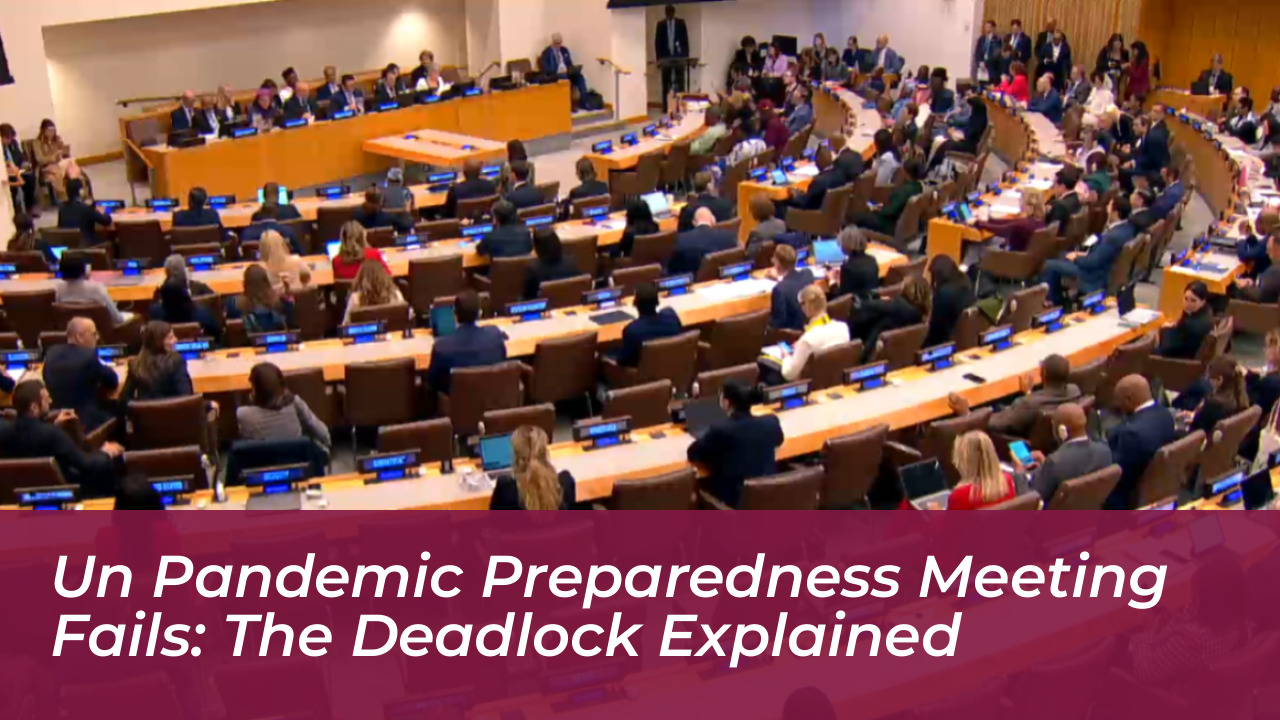
Global health governance hit a formidable brick wall at United Nations Headquarters in New York, leaving the international community scrambling for direction after a high-stakes meeting on pandemic preparedness collapsed. Member states gathered to address lingering biological risks, but hopes for a unified political declaration evaporated after hours of closed-door wrangling. This failure highlights deep ideological, financial, and structural divides that continue to threaten global security.
- The Collapse of Consensus Inside the United Nations High-Level Deadlock
- Opening Remarks and the Return of Global Amnesia
- Geopolitical Fault Lines and Negotiating Deadlocks
- Anatomy of a Diplomatic Failure Why Member States Walked Away
- Intellectual Property and Pathogen Access Disputes
- Sustainable Financing and Conditional Aid
- Sovereignty Versus Compliance in Global Health
- What Traditional Reporting Misses in Global Health Governance
- The Biosecurity and Dual-Use Research Dilemma
- Supply Chain Resilience Beyond Vaccines
- Contrasting Traditional Frameworks With Emerging Models
- Unique Strategic Paradigms for Future Biosecurity
- Decentralized Regional Manufacturing Hubs
- Open-Source Pathogen Governance
- The Shadow of Past Crises and Current Realities
- Six Years After COVID-19
- The Continuing Threat of Zoonotic Spillovers
- The Role of Emerging Technologies in Outbreak Control
- Actionable Steps for Resilient National Health Systems
- Moving Forward Beyond the Deadlock
The Collapse of Consensus Inside the United Nations High-Level Deadlock
Opening Remarks and the Return of Global Amnesia
General Assembly President Khalilur Rahman opened the proceedings by reminding exhausted delegates of the catastrophic tolls borne during the global coronavirus crisis. He challenged the room to confront the persistent threat of the ongoing Ebola outbreak in Congo and other menacing bio-threats. His opening remarks captured the surreal amnesia gripping international politics, noting that it often feels easier to pretend historical events never happened.
Institutional amnesia remains a dangerous hazard in modern diplomacy. As years pass since the peak of COVID-19, the temptation to ignore historical epidemiological data grows stronger among policymakers. This mindset ignores the reality that biological hazards evolve constantly, requiring continuous vigilance rather than temporary panic responses.
Geopolitical Fault Lines and Negotiating Deadlocks
Despite stark warnings from health experts, national delegations split along predictable geopolitical fault lines during the discussions. Wealthier nations resisted binding financial commitments and technology-transfer mandates, fearing economic exposure. Meanwhile, developing nations firmly rejected weak frameworks that failed to prevent future vaccine hoarding.
The breakdown of diplomatic trust occurred behind closed doors as negotiators failed to bridge these fundamental differences. Developing economies argued that non-binding resolutions serve only rich countries during a crisis. Without enforceable solidarity, the negotiations devolved into defensive posturing, ultimately sinking the entire declaration.
Anatomy of a Diplomatic Failure Why Member States Walked Away
Intellectual Property and Pathogen Access Disputes
The collapse of the pandemic preparedness declaration stems from chronic structural flaws within multilateral negotiation processes. Developing economies demanded absolute guarantees for open-source sharing of pathogen genetic sequence data and equitable distribution of countermeasures. They argued that public health emergencies require suspending strict commercial monopolies.
Major pharmaceutical hub nations pushed back hard against mandatory patent waivers and compulsory licensing requirements. Industry lobbyists and aligned governments insisted that intellectual property protections drive medical innovation. This clash over proprietary rights created an impassable barrier during the committee rooms.
Sustainable Financing and Conditional Aid
Low- and middle-income countries called for predictable, un-earmarked international funding to fortify fragile public health systems globally. Sustainable financing forms the bedrock of any real defense against fast-moving pathogens. Without reliable budgets, local clinics cannot maintain basic disease surveillance or staff retention.
Donor nations offered only voluntary contributions and conditional loans tied to strict bureaucratic oversight. This donor-driven model allows wealthy countries to dictate spending priorities while avoiding long-term financial obligations. Developing nations recognized this approach as inadequate for stopping transnational health threats.
Sovereignty Versus Compliance in Global Health
Several powerful member states balked at language empowering the World Health Organization to dispatch investigative teams or issue independent outbreak alerts. National sovereignty consistently overrode epidemiological logic during high-stakes committee debates. Governments proved unwilling to cede even minor oversight powers to international bodies.
Concerns over state autonomy paralyzed discussions on early warning compliance. When a novel pathogen emerges, speed dictates survival, yet bureaucratic delays rooted in sovereignty defenses guarantee slower responses. Member states chose political control over transparent, collective safety.
What Traditional Reporting Misses in Global Health Governance
The Biosecurity and Dual-Use Research Dilemma
Mainstream coverage of United Nations summits frequently glosses over the mechanics of diplomatic collapse and focuses solely on rhetoric. Standard reports miss the escalating threat of gain-of-function research oversight and the proliferation of high-containment biolabs in geopolitically volatile zones. Effective preparedness requires regulating synthetic biology, not just stocking basic personal protective equipment.
The rise of advanced laboratory capabilities demands rigorous international oversight to prevent accidental leaks or malicious misuse. Unfortunately, the failed UN talks completely sidelined discussions on dual-use research. Ignoring these high-risk scientific activities leaves a massive blind spot in global biosecurity architectures.
Supply Chain Resilience Beyond Vaccines
Previous panels focused heavily on final-product distribution while ignoring upstream material dependencies. Raw chemical precursors, single-use bioreactor bags, and specialized glass vials remain heavily monopolized by a handful of corporations. When demand spikes, these manufacturing bottlenecks instantly starve global supply chains.
The failed declaration offered no concrete solutions for diversifying the production of critical manufacturing inputs. Relying on isolated factories for essential chemical components ensures that future medical countermeasures will remain out of reach for most nations during a crisis.
Contrasting Traditional Frameworks With Emerging Models
A comparative look at how traditional diplomatic frameworks match up against decentralized public health models illustrates the shift needed in modern governance.
| Metric / Feature | Traditional UN Declarations | Proposed Decentralized Models |
|---|---|---|
| Decision-Making Speed | Months or years of bureaucratic deadlock | Agile, regional emergency task forces |
| Financing Structure | Voluntary pledges and conditional aid | Automated levies and pooled risk funds |
| Technology Transfer | Restricted by rigid IP laws | Open-source pools and mandatory licensing |
| Sovereignty Model | Absolute state veto over public health data | Conditional transparency for global safety |
Unique Strategic Paradigms for Future Biosecurity
Decentralized Regional Manufacturing Hubs
Relying on centralized pharmaceutical giants in North America and Europe guarantees inequity during an emergency. The future of pandemic defense relies on autonomous regional biomanufacturing networks in Africa, Latin America, and Southeast Asia. These hubs must produce vaccines and therapeutics locally, shortening transit times and neutralizing export bans.
Shifting production closer to vulnerable populations eliminates dependency on distant supply chains. Regional autonomy ensures that developing countries can protect their citizens without begging wealthy nations for surplus inventory.
Open-Source Pathogen Governance
Treating biological data as proprietary commercial assets incentivizes hoarding and compromises global safety. A decentralized, blockchain-verified ledger for genetic sequence sharing can ensure that scientists worldwide access data instantly. This model guarantees fair compensation to countries of origin without locking up vital information behind paywalls.
Open-source governance replaces competitive secrecy with collaborative transparency. By democratizing access to genetic blueprints, the global scientific community can develop diagnostics and treatments much faster.
The Shadow of Past Crises and Current Realities
Six Years After COVID-19
As the world marks more than half a decade since the initial global lockdowns, institutional memory fades fast amid economic shocks and regional wars. Health systems in many developing nations remain weaker today than they were prior to the pandemic. Burnout among frontline healthcare workers has depleted institutional capacity across public sectors.
Meanwhile, natural and zoonotic spillovers continue to accelerate due to environmental pressures and land-use changes. Ignoring these warning signs sets the stage for compounded failures when the next novel pathogen crosses the species barrier.
The Continuing Threat of Zoonotic Spillovers
The ongoing Ebola crisis in the Democratic Republic of Congo serves as an immediate test of global solidarity. When international actors bicker over non-binding declarations in New York, local health workers in Central Africa face underfunded clinics and violent insecurity. These frontline responders operate without adequate international backup.
Zoonotic threats do not wait for bureaucratic consensus. Treating local epidemics as isolated regional issues ignores the reality of interconnected global travel and trade.
The Role of Emerging Technologies in Outbreak Control
While diplomats argued over text in New York, technological advancements continued to transform the biosecurity landscape. Artificial intelligence models now track zoonotic spillover risks by analyzing climate data, deforestation rates, and livestock movements in real time. Machine learning algorithms also accelerate antibody discovery, shrinking development timelines from years to weeks.
However, these same technologies introduce severe risks that require urgent management. Automated DNA synthesis providers can easily be exploited by malicious actors to order genetic material for dangerous pathogens. The failure of the UN high-level meeting means that international guardrails for dual-use artificial intelligence and synthetic biology remain dangerously weak.
Actionable Steps for Resilient National Health Systems
- Audit National Stockpiles: Regularly rotate essential pharmaceuticals, personal protective equipment, and diagnostic kits to prevent critical domestic shortages during emergencies.
- Strengthen Wastewater Surveillance: Expand municipal testing programs for early, anonymized warnings of viral spread before clinical cases overwhelm hospitals.
- Invest in Workforce Surge Capacity: Establish trained reserves of retired medical personnel, public health students, and logistics experts to deploy during outbreaks.
- Combat Infodemics Proactively: Build rapid-response communication channels and trusted community partnerships to counter medical misinformation before it spreads.
Moving Forward Beyond the Deadlock
Accepting the sobering reality of geopolitical fragmentation and protectionism is the first step toward true preparedness. Bypassing paralyzed international forums allows nations to build resilient, decentralized, and equitable health networks from the ground up. True security relies on regional cooperation, transparent science, and localized manufacturing rather than empty diplomatic declarations.