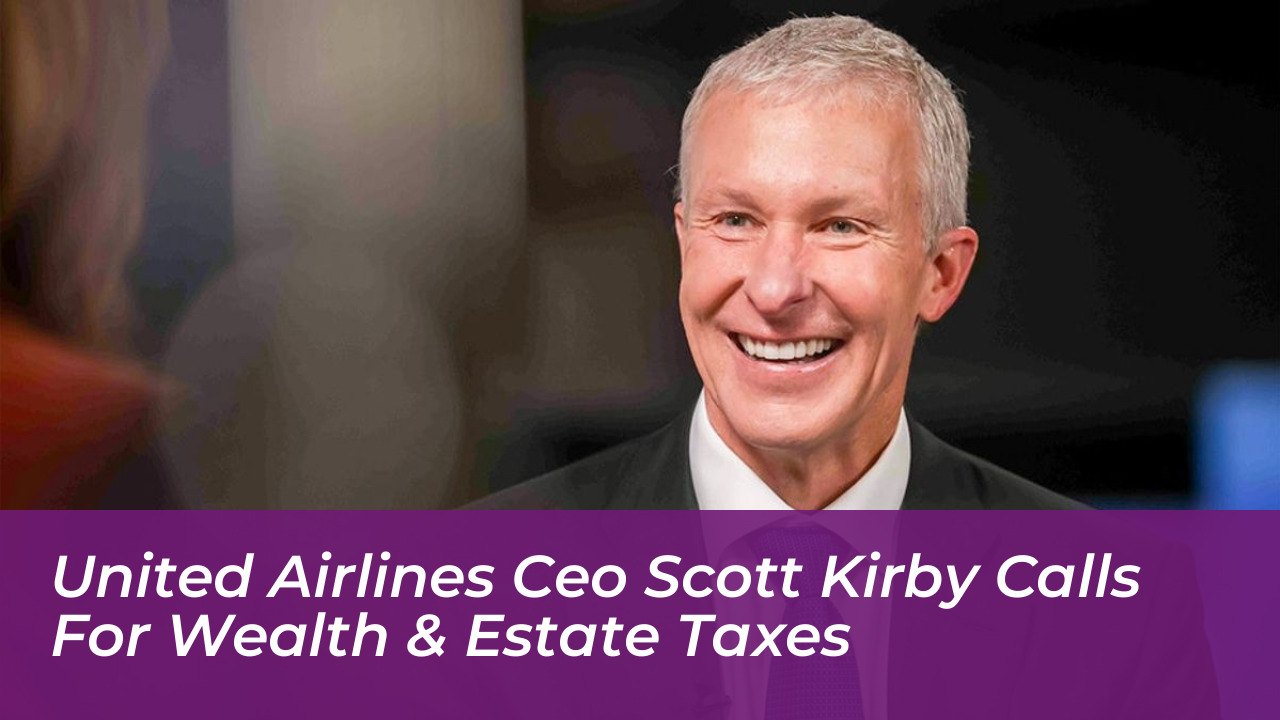

United Airlines CEO Scott Kirby has stepped into the national economic debate by advocating for a nationwide wealth tax and inheritance taxes approaching 100% for certain estates. In an interview with The New York Times, Kirby addressed declining public trust in corporate executives and argued that widening economic inequality poses a structural threat to American society.
Kirby received approximately $32.3 million in total compensation during fiscal year 2025. He emphasized that any meaningful wealth tax must be implemented at the federal level rather than by individual states. During the discussion, he noted that wealthy taxpayers can easily relocate to evade state-level levies, making a federal mandate essential.
“Wealth inequality has become a danger to our society, and we need to address that. We should have a national wealth tax – it won’t work by state because people will just move. And I think we should have inheritance taxes that get close to 100 percent at some level. I would pay them.” – Scott Kirby, United Airlines CEO
Tax Policy Context and Current Federal Rules
Kirby voiced support for aggressive tax restructuring. However, he did not specify the exact asset thresholds that would trigger his proposed inheritance tax, nor did he offer a specific percentage rate for a national wealth tax. His comments contrast sharply with existing federal tax structures.
Under current IRS guidelines, the federal estate tax imposes a top marginal rate of 40% on taxable estates that exceed applicable exemptions. For 2026, the basic estate tax exemption stands at $15 million per individual. Federal data indicates that only about 0.2% of estates are large enough to face the estate tax, which targets asset transfers at death rather than annual personal wealth holdings.
A national wealth tax would represent a fundamental shift. It would levy taxes on an individual’s accumulated assets annually rather than solely taxing income or posthumous estate transfers.
Broader Industry Context and Airline Pricing
Aside from his tax policy remarks, Kirby defended United Airlines’ commercial practices during the interview. When questioned about rising airfares and additional costs travelers face to secure preferred seating-such as avoiding middle seats without frequent-flier status-Kirby defended ancillary pricing strategies.
“There are some customers who want to sit in a window seat or a better seat, and that costs money to deliver,” Kirby explained to the publication. He maintained that charging customers separately for chosen services and products allows commercial airlines to effectively serve travelers with diverse preferences.
Despite raising concerns regarding wealth concentration and social equity, Kirby expressed strong optimism regarding the broader trajectory of the United States economy. He described the country’s economic future as “incredibly bright.”