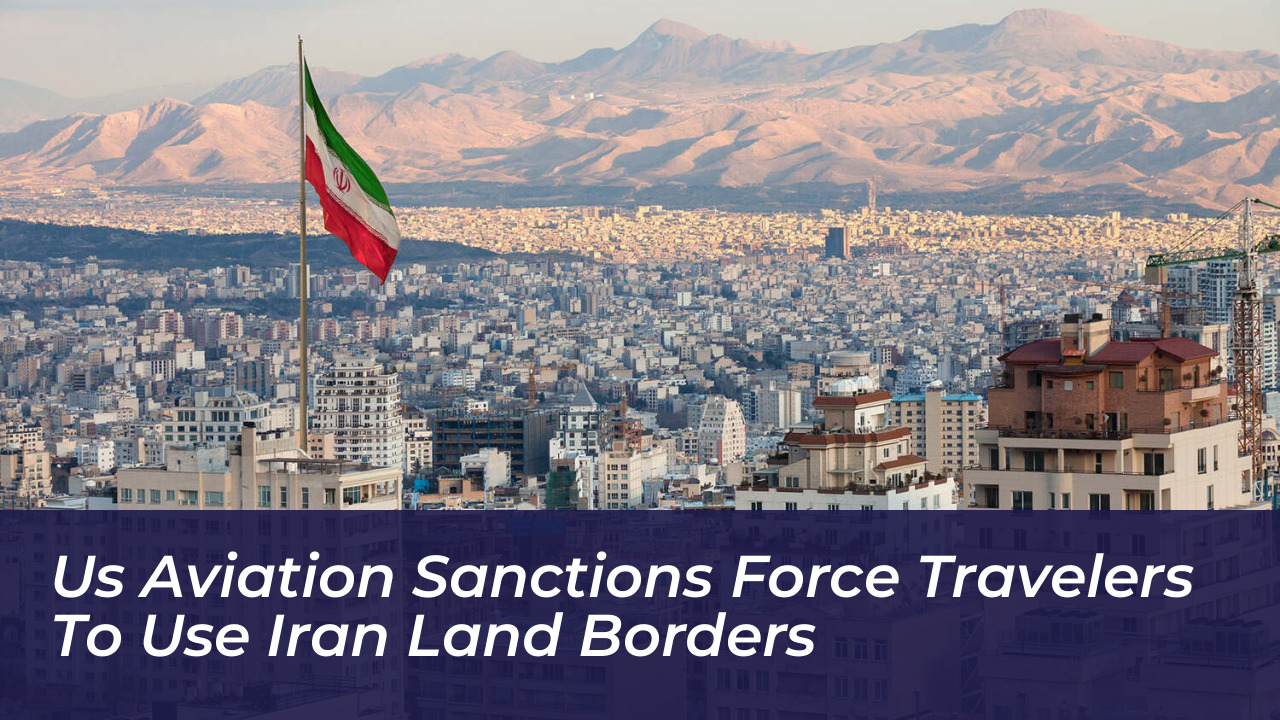
Heightened United States aviation sanctions are driving passengers toward crowded land crossings. Foreign airports are stopping service to Iranian commercial flights to avoid secondary penalties from Washington. This highlights severe structural disruptions across Middle East transit networks. The US Treasury Department’s targeted measures under operation economic outcast risk penalizing international ground handling, ticketing, and fueling companies that support Iranian airlines. This renders commercial flights increasingly unpredictable across regional routes, including Oman, Iraq, Azerbaijan, and Georgia.
Washington maintains that Iranian commercial airlines transport military personnel and assets alongside civilian passengers. Specifically, Mahan Air faces accusations of aiding the Islamic Revolutionary Guard Corps. This is supported by past statements from former Foreign Minister Mohammad Javad Zarif regarding military transport during the Syrian conflict. The expiry of a short wind-down period led to the cancellation of all but a handful of Iranian flights to Turkiye, the United Arab Emirates, and China, stranding thousands of everyday citizens and heavily straining neighboring transport links.
Regional Airports Cut Ties Under Secondary Sanction Threats
Aviation authorities in several neighboring countries announced they would no longer provide airspace and airport services to Iranian airlines. These countries include Oman, Azerbaijan, and Georgia. In Iraq, Baghdad Airport was declared off-limits to Iranian carriers. However, flights to Najaf Airport continued operating to accommodate pilgrims traveling to Shia holy sites. Meanwhile, international carriers such as Turkish Airlines suspended flights until at least March 2027. Qatar Airways, Emirates, and Lufthansa operations remain suspended due to ongoing airspace and conflict pressures.
Iran-based aviation and transit expert Mohammadreza Ebrahimpour noted that years of sanctions had already forced domestic airlines to rely on third countries and smaller firms for fuel, spare parts, and services. However, the decision by neighboring civil aviation authorities to formally refuse services to Iranian aircraft constitutes a new level of enforcement. Ebrahimpour explained that Washington has effectively prohibited international airlines from flying through Iranian airspace. It did this by suspending authorizations for US-origin aircraft and limiting lucrative overflight payments that previously earned Iran more than $300 million annually.
The Collapse of Air Links and Surging Overland Travel
With air connections severely curtailed, thousands of travelers have been pushed toward land crossings. These include routes along the Bazargan and Razi borders with Turkiye and routes leading toward the Armenian capital of Yerevan. Heavy congestion and skyrocketing prices have defined these bottlenecks:
- Bus tickets from Iran to Turkiye have reportedly sold for quadruple their normal price on the black market amid surging demand.
- Daily passenger travel overland into Azerbaijan remains restricted, with Baku citing internal security and health protocols.
- Shalamcheh and Chazabeh border crossings with Iraq experienced temporary closures before reopening to civilian traffic.
- Young Iranians frequently use these grueling overland journeys to reach international language testing centers located outside Iran that are required for studying or working abroad.
The travel restrictions also threaten broader commercial and medical logistics. Air freight is critical for urgent or sensitive goods, including specialized laboratory samples, industrial components, and pharmaceuticals. A domestic pharmaceutical executive reported that the cost of imported medical supplies arriving by air has surged up to 10-fold under the combined weight of sanctions, war damage, and logistical blockades.
Global Supply Chain and Economic Repercussions
The enforcement mechanism deployed under Operation Economic Outcast targets the entire commercial aviation support ecosystem. Treasury Secretary Scott Bessent emphasized that airports allowing Iranian aircraft to land, fuel providers filling their tanks, ground handlers loading baggage, and ticket agencies issuing boarding passes all risk being cut off from the dollar-based global financial system.
Despite these sweeping measures, exceptions remain. China has not complied with the blanket prohibitions, with Mahan Air flights continuing into airports like Guangzhou. Pakistan is similarly assessed as unlikely to sever transit links due to shared borders and deep trade ties. Nevertheless, for the vast majority of Iranian civilians, students, patients, and members of the diaspora, the closure of air hubs in Dubai, Sharjah, and regional capitals means direct connections have vanished, leaving long, expensive, and unpredictable land routes as the primary alternative.