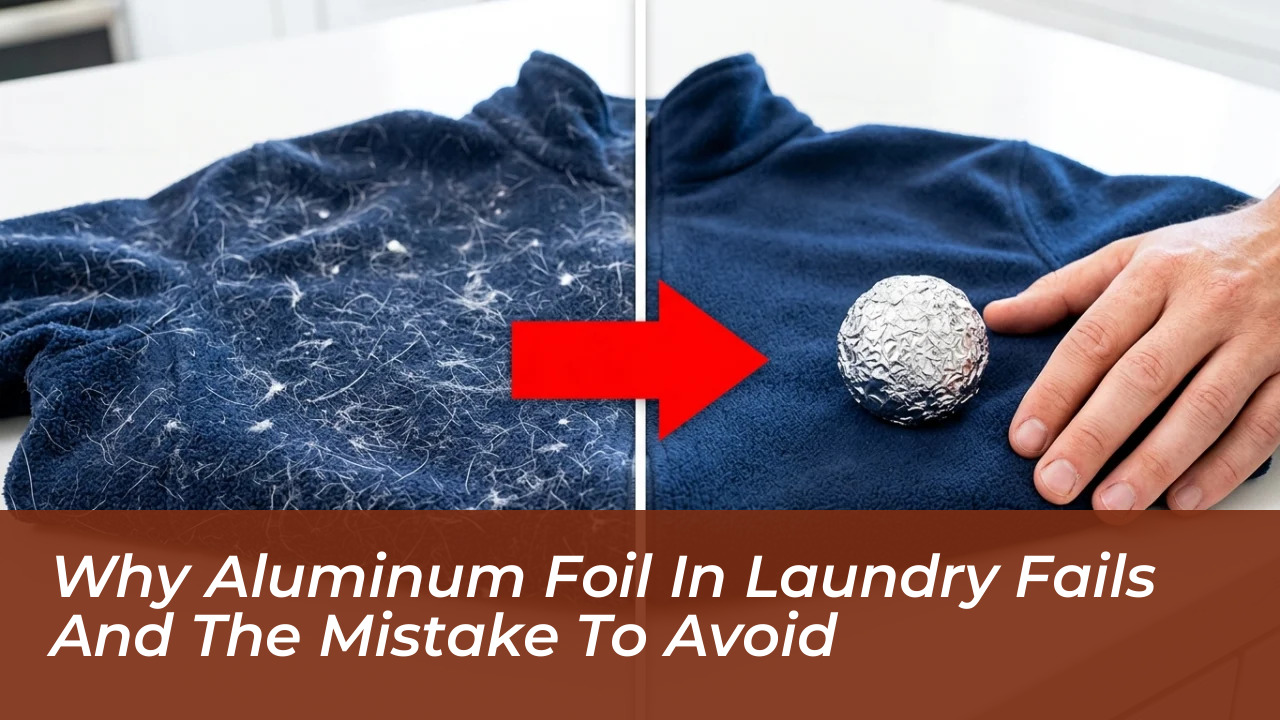

A crumpled ball of kitchen foil costing roughly five cents can neutralize the stubborn static cling that fabric softeners are designed to fix, but millions of viral social media clips instruct people to drop it into the wrong appliance. Tossing a tightly compressed metal sphere into a washing machine produces almost no anti-static benefit because electrical charges cannot build up while garments are thoroughly soaked in water. Instead, the real science of electrical dissipation proves that this five-cent hack works exclusively inside your heated tumble dryer.
Everyday laundry routines increasingly feature this viral ritual: tearing off an aluminum foil sheet, scrunching it into a firm ball around two inches wide, and tossing it directly alongside synthetic gym leggings and fleece pullovers. Those who test it frequently report fewer crackling sparks and significantly less clinging pet hair. However, understanding the boundary between simple physics and viral fiction determines whether you preserve your wardrobe or damage your drainage pump.
The Physics of Cling: How Everyday Friction Generates Static
Static cling is not caused by dirt, grease, or laundry detergent residue. It stems entirely from microscopic electrical imbalances created when separate fabrics rub against one another in motion. During tumbling, touching materials swap tiny quantities of electric charge, leaving one textile slightly positive and the adjacent one slightly negative so that they snap together like weak magnets.
Most things around us are neutral and quiet. When two materials rub, they swap a little charge, and in dry air that charge has nowhere to go. Ivana Dimitrova, a physics professor at Northeastern University, emphasizes that dry environmental air prevents these accumulated charges from naturally escaping. Leading home appliance manufacturer Whirlpool confirms this mechanism in its laundry guidance, pointing out that static in garments results directly from fabrics trading electrical charge during movement, a process severely exacerbated by arid conditions.
Because aluminum is a superior electrical conductor, a smooth metal sphere bouncing against clothing pulls localized surface charges off the fabrics and distributes them across its metallic body. This principle mirrors traditional household fixes, such as brushing a metal wire hanger down clingy dresses or touching a metal doorknob before receiving an electric zap. But the medium surrounding the metal dictates whether this transfer occurs at all.
The Washing Machine Myth: Why Moisture Nullifies the Hack
The primary flaw across viral social media tutorials is insisting that the foil ball belongs inside the wash cycle. Whirlpool technical documentation highlights that static cling primarily forms during drying cycles or while wearing clothes, not when laundry sits fully submerged in water. Moisture acts as a continuous conductor, instantly carrying away stray charges before they can ever gather on cloth fibers.
Michelle Feng, an appliance specialist at Hisense, clarified to Tom’s Guide that putting a foil ball into a washing machine offers virtually no proven anti-static performance during the wash cycle. , unsecured or poorly rolled foil risks breaking apart into small metallic debris that can lodge in machine drain filters and mechanical lines. The actual environment where static thrives is the hot, tumbling chamber of a mechanical dryer filled with synthetic fibers.
Laundry Cycle Foil Ball Effectiveness
- Washing Machine: Ineffective. Surrounding water continuously dissipates charges before static cling can form.
- Tumble Dryer: Highly effective. Conductive aluminum absorbs charges created by hot synthetic friction.
A Step-by-Step Guide to Safe Tumble Drying
To safely eliminate clinging without chemical sheets or liquid softeners, apply the method correctly inside your dryer:
- Tear off a full 10-to-12-inch sheet of household aluminum foil and scrunch it tightly into a sphere measuring roughly 2.5 inches across, comparable to the diameter of a tennis ball.
- Firmly press and roll the metal ball against a hard, clean countertop until all outward edges and seams are completely flush and smooth to protect tumbling fabrics.
- Place one to two prepared balls inside the dryer drum alongside synthetic loads, such as polyester sportswear, fleece, and everyday blends.
- Inspect the metal spheres before every load and replace them immediately whenever the foil shows visible flaking or fraying.
- Avoid using foil balls when drying delicate items, sheer materials, lace, or heavily embroidered clothing.
Try shifting your aluminum foil balls from the wash drum straight to the dryer to eliminate cling without chemical additives. Have you noticed a dramatic difference when drying synthetic sportswear with metal balls? Share your experiences and laundry tricks in the comments below.
Frequently Asked Questions
Does putting aluminum foil in the washing machine reduce static?
No. Static electricity cannot build up while clothes are soaked in water during a wash cycle. Moisture naturally conducts and dissipates stray electrical charges.
Can aluminum foil damage my washing machine?
Yes. If the foil ball breaks apart during a wash or spin cycle, loose metal fragments can travel into the pump, hoses, or drainage filter, causing clogs and potential mechanical failure.
Where should I actually put the aluminum foil ball?
You should place the tightly rolled foil ball inside your tumble dryer. The hot, dry tumbling environment with synthetic fabrics is where static electricity actually accumulates.
Are there alternatives to using aluminum foil for static?
Yes. Reusable wool dryer balls, traditional fabric softener sheets, lowering dryer heat settings, and separating synthetic items from heavy cottons are safer, manufacturer-approved alternatives.
How often should I replace a homemade foil dryer ball?
Inspect your foil balls before every single load. Replace them immediately if you notice any tearing, flaking, or rough edges that could snag clothing or damage your dryer drum.