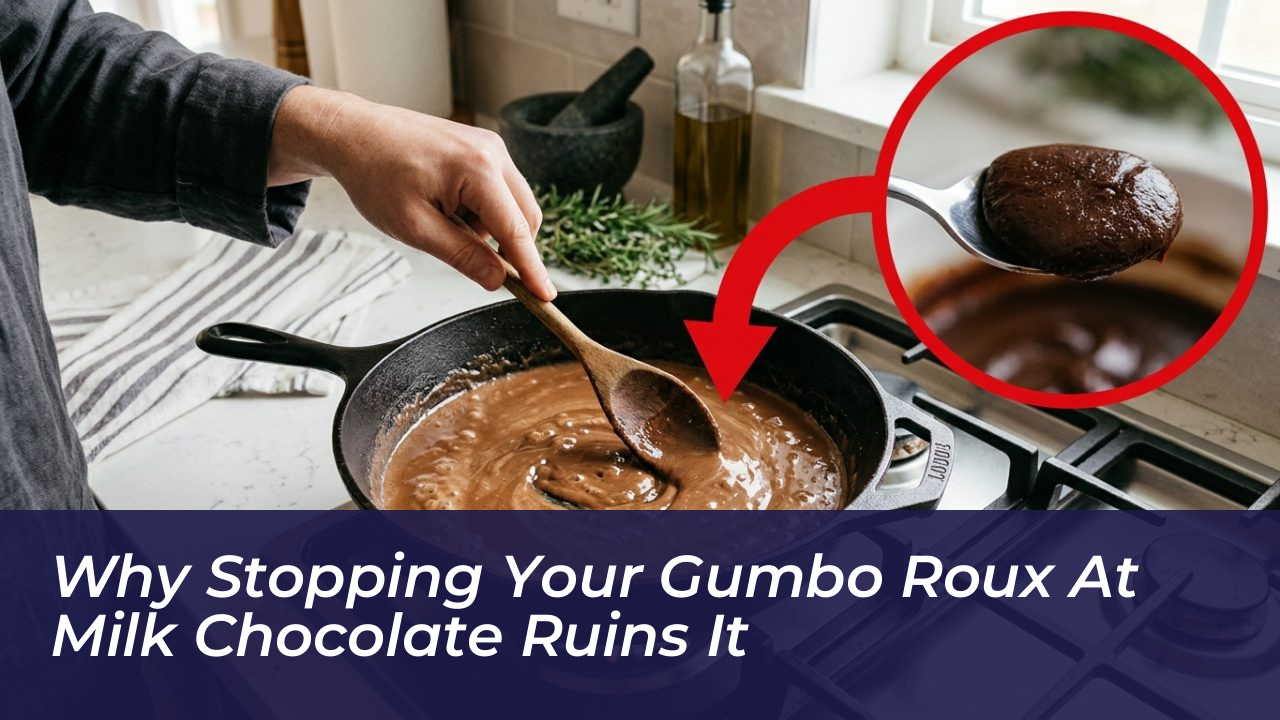

Pulling your gumbo roux off the stove when it reaches a milk chocolate color leaves the final pot noticeably pale, weak in body, and lacking the deep, toasty backbone that defines authentic Louisiana stew. Many home cooks lose patience and cut the cooking short at this rich-looking brown hue. Doing so prevents the flour from developing the bold, smoky foundation gumbo requires. This visual checkpoint mistake caught national attention when Louisiana-raised chef Adriánna Guillory-Bellow took to TikTok under the handle @louisianacreoleinla to address home cooks across the country. She racked up nearly 20 million views and 1.4 million likes by challenging the traditional reliance on kitchen timers in favor of strict visual cues.
A roux consists of flour cooked slowly in fat. It serves as the essential base that gives gumbo both its thickening power and distinct flavor profile. Most published recipes cite a cooking window anywhere between 45 minutes and a full hour, but stove heat variations make rigid clock-watching unreliable. Guillory-Bellow guides the process through precise color milestones instead of setting a timer.
Decoding Color Stages on the Stove
The earliest threshold in the browning process is a light tan shade reminiscent of peanut butter or pecan candy. While suitable for thickening seafood étouffée made with crawfish or shrimp, this shade remains far too immature for a proper gumbo pot. The danger zone occurs right at the milk chocolate stage, where cooks routinely abandon the skillet out of fear of burning the mixture. Halting here undercuts the dish entirely, resulting in a thin, underdeveloped broth.
- Peanut butter or pecan candy: Suitable for crawfish or shrimp étouffée.
- Milk chocolate: A premature stop that leaves your gumbo pale and weak in body.
- Deep, dark brown: The target finish for traditional Louisiana gumbo.
The true target is a deeper, darker brown that pushes well beyond milk chocolate. Because heavy cookware retains significant heat, the mixture will continue to cook and darken slightly even after you move the pan off the direct flame.
The Physics of Continuous Stirring in Heavy Cookware
Achieving this depth of color without scorching requires strict proportion control and physical stamina. Guillory-Bellow builds her base using a ratio of two parts flour to one part oil, specifically combining 4 cups of flour with 2 cups of oil. A dark roux for gumbo can take up to an hour of constant stirring.
The preparation begins cold in a heavy-bottomed vessel, such as a cast-iron skillet. Blending the oil and flour completely before turning on the burner ensures uniform texture from the very beginning. Mastering the heat and motion requires careful execution:
- Combine before heating: Whisk the 4 cups of flour and 2 cups of oil together until fully smooth before lighting the burner.
- Maintain medium heat: Keep the flame steady and stir without interruption to prevent hot spots.
- Scrape the perimeter: Use a spatula along the sides and corners of the skillet where flour particles settle fastest.
- Manage arm fatigue: Alternate hands during prolonged stirring or tag in a partner to prevent stopping mid-cook.
The browning progression develops gradually over medium heat. Yet, the shift from deeply toasted flour to burnt, bitter carbon happens within seconds. Your spatula must continuously sweep the bottom and sides to maintain even heat exposure throughout the entire volume.
What to Do Once the Roux Reaches Peak Darkness
When the mixture hits its target shade of deep brown, take the skillet off the heat immediately. However, the work does not end there. Residual thermal energy stored in the cast iron will keep the fat and flour sizzling, making constant stirring mandatory during the initial cooling phase.
As the mixture cools down to room temperature, excess oil separates and rises to the top of the skillet. Guillory-Bellow pours off that separated surface layer, then places a clean paper towel directly on top of the roux to blot away any remaining grease film. You can ladle the finished paste directly into a mason jar for convenient batch storage. Stored this way, it stays fresh for a couple of months in the refrigerator and remains stable for considerably longer in the freezer.
Mastering the color transition is the single biggest step between an average soup and an authentic, deeply flavorful pot of gumbo. Keep a watchful eye on that transition from milk chocolate to deep brown, letting the skillet’s residual heat finish the job safely.