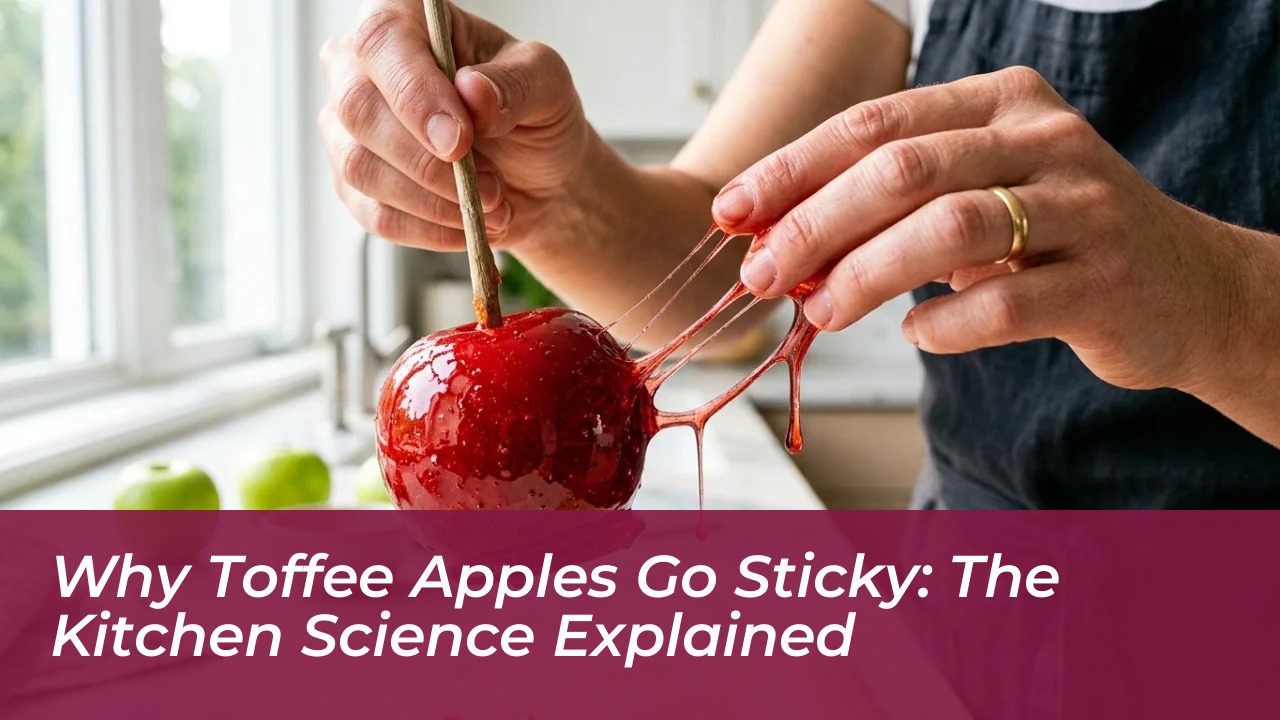

For autumn gatherings across the UK, from Halloween parties to Bonfire Night fairs, the glossy red shell of a traditional toffee apple represents the quintessential seasonal treat. Yet within just a few hours of cooling, that satisfying crunch frequently deteriorates into a gummy, teeth-clinging mess. This transformation is not a culinary accident, but an unavoidable chemical chain reaction governed by environmental moisture and the fascinating properties of sugar.
The Science of Hygroscopy and Sugar Glass
To achieve a brittle, glass-like shell, confectioners boil sugar syrup until it reaches the hard crack stage, specifically between 149°C and 154°C (300°F to 310°F). At this precise thermal threshold, almost all water evaporates, leaving behind a supersaturated syrup with less than 2% water content. When poured over fruit and cooled, the molecules lock into an amorphous solid rather than an organized crystal structure.
However, this solid state is inherently unstable at standard British autumn room temperatures. Pure sucrose molecules feature numerous hydroxyl groups that form rapid hydrogen bonds with atmospheric water vapor. Because sugar is naturally hygroscopic, it actively pulls moisture out of the surrounding air. The moment ambient humidity exceeds roughly 30%, the outer shell begins to pull microscopic water droplets from the air, slowly reverting the brittle candy shell back into liquid syrup.
The primary enemy of a hard sugar coating is water absorption from both the atmosphere and the moisture trapped inside the fruit itself. This dual moisture attack creates a compounding issue. While the exterior battles damp autumn air, the interior faces an equally aggressive water source: the apple itself. As the fruit breathes, natural moisture moves outward, dissolving the inner wall of the coating and loosening the bond between fruit and shell.
Natural Fruit Wax and Punctures: The Hidden Moisture Trap
Supermarket apples across the UK, including standard varieties like Bramley or Granny Smith, naturally develop a protective outer layer of wax, while commercial orchards often add a thin food-grade coating to retain freshness. This waxy barrier repels molten sugar syrup during the dipping process. When sugar fails to adhere directly to the skin, pockets of trapped air and ambient moisture form underneath the crust.
Inserting the wooden skewer creates another structural vulnerability. Puncturing the core ruptures cellular walls, releasing acidic juices that travel along the stick and seep under the sugar base. Because sucrose breaks down into glucose and fructose when exposed to water-a process known as sugar inversion-the syrup fails to re-harden, accelerating the sticky transformation across the entire bottom half.
Common Candy Coating Faults
Understanding how different environmental factors alter the candy shell helps isolate why a batch softens prematurely:
- High Room Humidity: Pulls moisture into the exterior shell, creating surface stickiness within hours.
- Residual Peel Wax: Prevents syrup adhesion, creating moisture pockets that loosen the coating.
- Under-Boiled Syrup: Leaves excess water in the mix, preventing the shell from ever reaching hard-crack solidity.
- Stem Puncture Seepage: Releases internal fruit juices that dissolve the sugar matrix from within.
Steps to Prevent Sticky Toffee Apples
Preventing premature softening requires removing natural oils and blocking moisture migration at every stage of preparation. To give homemade batches the best chance of remaining crisp, follow these structural kitchen steps:
- Strip the Wax: Dip the fresh apples in boiling water for approximately five to ten seconds, then scrub them vigorously with a clean kitchen towel to dissolve and remove all surface waxes.
- Dry Completely: Allow the fruit to come to room temperature and ensure the skin is bone dry before dipping, as any surface droplet will ruin the sugar’s glass matrix.
- Use a Reliable Thermometer: Never guess the setting point; always use a calibrated sugar thermometer to ensure the mixture reaches the exact hard crack window.
- Seal the Insertion Point: When inserting the wooden skewer into the stem end, avoid piercing entirely through the base to prevent juices from draining onto the tray.
- Store Airtight: Never refrigerate finished toffee apples, as fridge condensation dissolves sugar instantly; instead, seal them individually with moisture-absorbing food-safe packets in a cool, dry cupboard.
Have you experienced your toffee apples turning into a sticky mess this autumn? What methods have worked best in your kitchen to preserve that classic, glossy snap? Leave your thoughts in the comments below and share your favourite seasonal confection techniques!