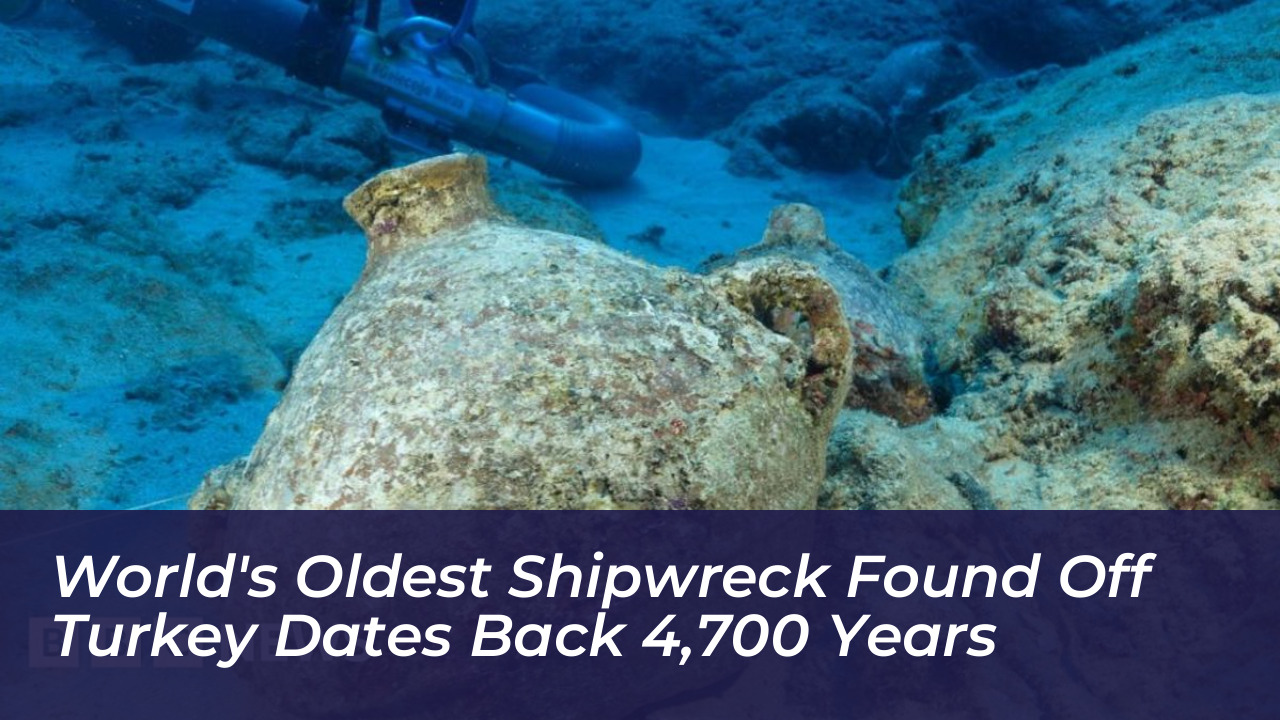

Archaeologists have identified what they believe is the world’s oldest known shipwreck, located off the coast of Kekova Island in Antalya, Turkey. Dating back between 4,400 and 4,700 years to the Early Bronze Age, the vessel provides unprecedented insights into ancient maritime commerce and Mediterranean shipping networks during the time the Great Pyramid of Giza was being constructed.
Led by Prof. Hakan Öniz of Akdeniz University and the Mediterranean Archaeology Association, the expedition discovered the wreck resting on an underwater slope approximately 30 meters beneath the surface. Although marine erosion and centuries of decay completely dissolved the ship’s wooden hull, the durable ceramic cargo it transported survived intact on the seabed.
Unlocking Antiquity Through Ceramic Amphorae
Because no organic timber remained from the ship, standard dating methods like radiocarbon analysis could not be applied. Instead, researchers relied on typological dating by examining the shape, construction, and decorative motifs of the recovered pottery. The team retrieved three large stone anchors-standard equipment for long voyages-alongside more than 30 ceramic storage vessels known as amphorae.
Dr. Karin Sowada, an archaeologist from Macquarie University in Australia who examined the recovered artifacts, noted that several vessels possessed distinctive double handles, central ridges, and flat bases. By matching these specific stylistic traits to identical pottery discovered in secure archaeological contexts in Egypt and the Middle East, the researchers confirmed the Early Bronze Age origin of the vessel.
- Location: Kekova Island, Antalya, Turkey
- Depth: 30 meters underwater
- Estimated Age: 4,400 to 4,700 years old (Early Bronze Age)
- Key Artifacts: 3 stone anchors, 30+ ceramic amphorae
Preserved Organic Residue and Ancient Supply Chains
One of the most astonishing aspects of the discovery was the presence of intact organic matter inside the storage jars. Upon inspecting the vessels, Dr. Sowada reported finding a thick, glossy, viscous residue still clinging to the interior walls. Scientists are currently analyzing these traces to determine whether the jars originally carried olive oil, wine, or valuable tree resins.
“I looked inside and nearly fainted. I could not believe how much residue was visible. It wasn’t just like spots…. a lot of this material was still remaining,” Dr. Sowada said.
Experts suggest that these large jars were valuable commodities reused across multiple commercial voyages rather than single-use containers. The ship likely embarked from the eastern Mediterranean coastline, carrying goods intended for the ancient city of Troy in northwestern Turkey or the Minoan civilization in Crete.
Surpassing Previous Archaeological Records
The Kekova Island discovery now stands as the oldest known shipwreck in the world, eclipsing the previous record holder found off the coast of Dokos Island in southern Greece, which dates back roughly 4,200 years. While older preserved wooden shipwrecks exist-such as a 2,400-year-old vessel discovered in the Black Sea off Bulgaria-none match the extreme antiquity of the Kekova Bronze Age cargo site.
Reflecting on the excavation, Prof. Öniz emphasized the human element behind the discovery, noting that the team was privileged to touch objects untouched by humans for nearly five millennia. The findings continue to reshape our understanding of early maritime logistics, proving that complex trade routes and economic networks spanned the ancient Mediterranean long before the rise of classical empires.