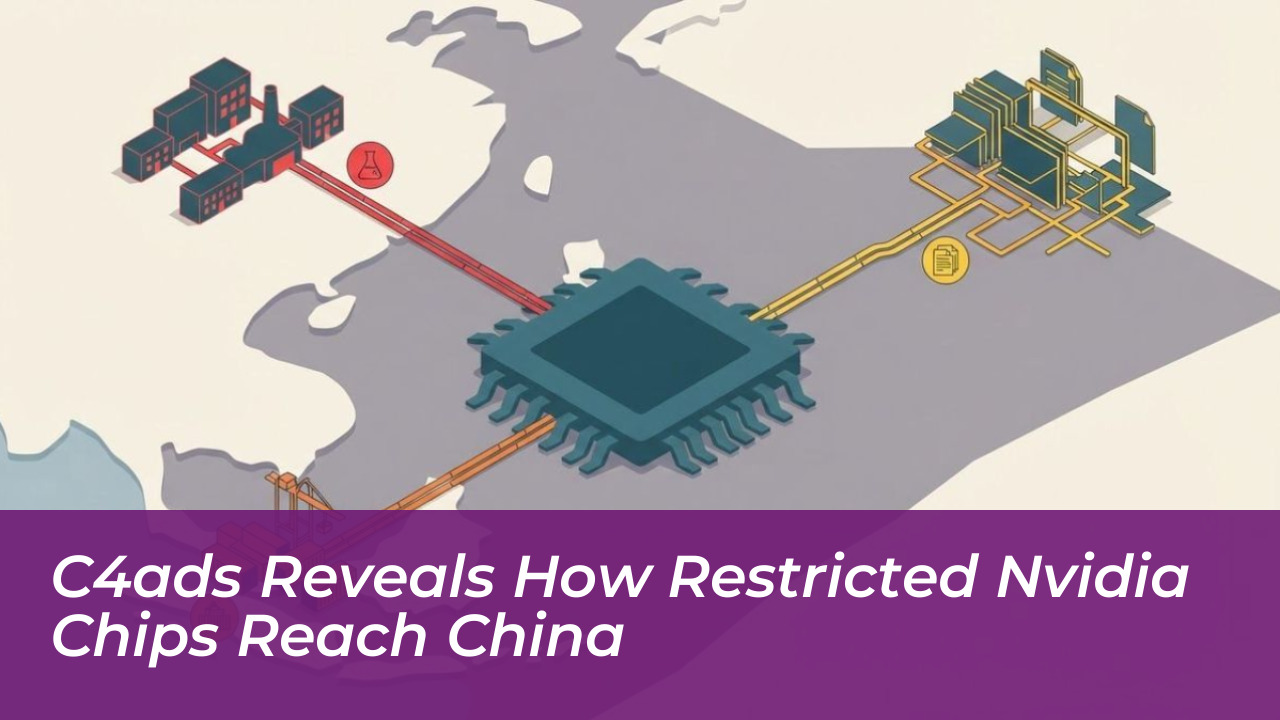
Despite strict export regulations imposed by Western nations, advanced American artificial intelligence hardware continues to find its way into China. A comprehensive investigation published on September 9, 2026, by the non-profit research organization C4ADS has mapped out the primary logistical channels that bypass international trade controls.
The U.S. Department of Commerce’s Bureau of Industry and Security has restricted access to powerful semiconductors to maintain a technological edge. However, the new findings demonstrate that a combination of institutional loopholes, regional trade diversion, and complex corporate structures successfully keeps the supply lines open.
Three Primary Pathways for Chip Diversion
The C4ADS investigation reviewed Chinese government records, corporate databases, and Southeast Asian trade data to identify three distinct routes utilized to move restricted graphics processing units (GPUs) into China:
- Institutional Procurement: Chinese universities and research entities directly acquire hardware through multi-vendor contracts.
- Regional Transshipment: Shipments are routed through intermediary nations in Southeast Asia before reaching Hong Kong and mainland China.
- Opaque Corporate Networks: Layered shell companies obscure the ultimate beneficial ownership of massive hardware imports.
University and Research Acquisitions
According to the report, higher education and research institutions in China procured at least 56 restricted Nvidia microchips valued at $1.7 million between July 2025 and January 2026. These advanced components were typically bundled inside large, multi-vendor procurement contracts managed by regional integrators. Many of the purchasing entities maintain documented ties to the Chinese government and its defense industrial base.
Southeast Asian Logistics Networks
The second channel exploits routine semiconductor logistics. Chips manufactured and packaged by TSMC in Taiwan frequently move through various testing and assembly facilities before reaching final destinations. C4ADS identified 50 export shipments worth approximately $13.4 million of restricted Nvidia GPUs moving through Vietnam, India, and Malaysia to Hong Kong and China between 2023 and 2025.
Vietnam’s growing chip testing infrastructure provided a functional cover for these movements, with some shipments displaying questionable import documentation, such as declared values listed as zero.
Opaque Corporate Ownership and Megaspeed
By far the largest volume of hardware was moved through complex corporate veils. The investigation tracked $4.6 billion in Nvidia hardware imports handled between 2022 and 2025 by Megaspeed International Pte. Ltd., a Singapore-headquartered entity operating across Indonesia and Malaysia.
Megaspeed’s ownership shifted multiple times, transitioning from Chinese gaming firm 7Road Holdings to Swiftdata, another Singaporean firm, while featuring Chinese businesswoman Huang Le as a major shareholder and chairwoman. Because of these fluid ownership structures, the ultimate beneficiaries remain difficult to trace, allowing even advanced Blackwell-family chips to reach restricted markets.
Recommendations for Closing Enforcement Gaps
C4ADS emphasized that its public data review likely understates the true scale of the gray market, as the findings only account for explicitly named transactions within a limited timeframe.
To combat these illicit supply pathways, the organization has issued key recommendations for both policymakers and private industry:
- Government Oversight: Allocate additional staffing and resources to the U.S. Bureau of Industry and Security to enhance post-shipment verification and end-user tracking.
- Enhanced Corporate Compliance: Semiconductor manufacturers and distributors should implement strict due diligence that goes beyond basic restricted-party list screening, including ownership tracing and on-the-ground verification.
- Geopolitical Risk Integration: Private firms must assess whether direct or downstream customers risk supplying foreign military or intelligence sectors.
As global demand for artificial intelligence infrastructure continues to surge, the findings underscore the ongoing challenge of aligning export policy intentions with practical enforcement realities on the ground.