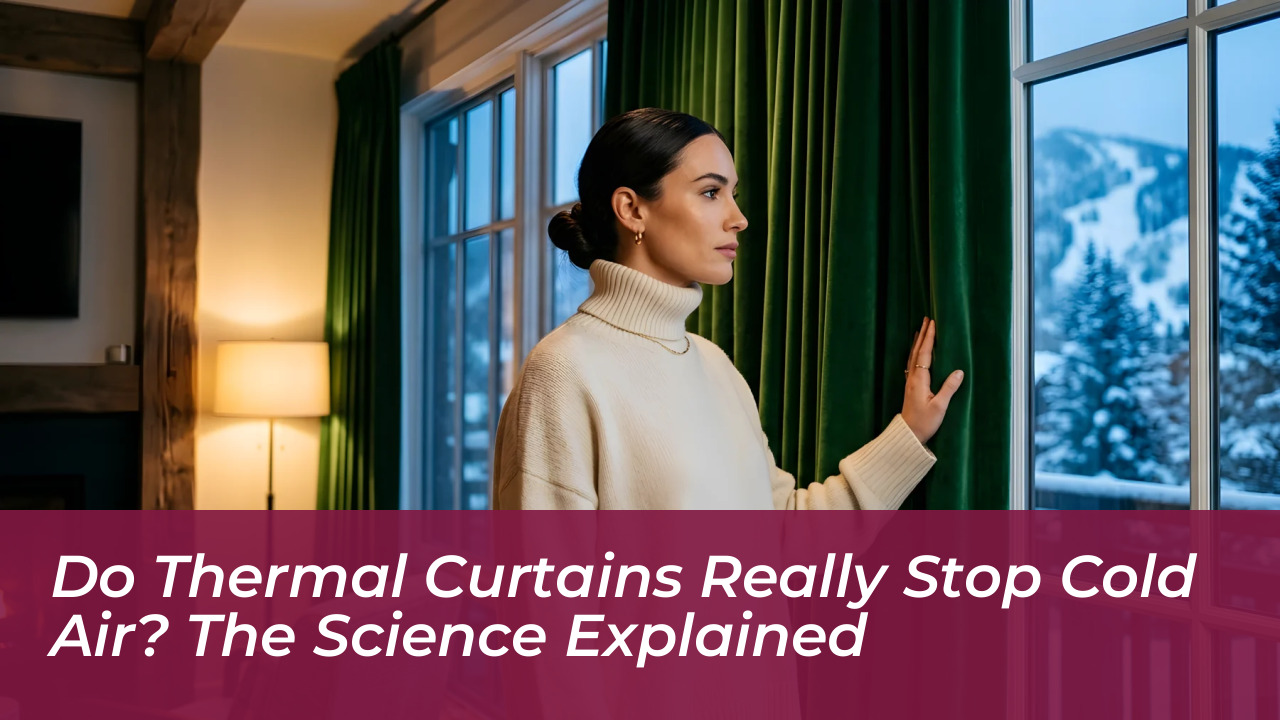
Yes, thermal curtains genuinely keep cold air out. However, their primary power lies in stopping indoor heat from escaping rather than merely blocking outside breezes. By establishing a physical barrier against cold window glass, properly installed insulated drapes arrest conductive heat loss and dismantle room-chilling convection cycles before drafts spread across your floor. Windows represent the weakest thermal link in any home envelope. Even when modern window seals remain completely airtight, single- and double-pane glass conducts indoor warmth outward at a rapid pace. Understanding how heavy drapery counteracts that thermal transfer is the key to cutting home energy waste without undergoing costly renovations.
Due to high traffic on this story, please verify you are not a bot to instantly unlock the remaining content. Takes only 5 seconds!
Verify & Continue ReadingThe Physics of Window Chill: Conduction vs. Convection
Glass conducts heat far more aggressively than an insulated wall. When indoor heating warms a room, that thermal energy naturally migrates toward colder exterior surfaces through direct conduction. The moment indoor air touches an uninsulated windowpane, it loses its thermal energy instantly. This rapid heat loss triggers an invisible movement pattern known as a convection loop.
Air cooled by the cold glass increases in density and sinks rapidly toward the floor. As that dense cold air drops, it creates a vacuum that pulls fresh warm air off the ceiling and down against the pane. Homeowners frequently mistake this sinking cascade of indoor air for an exterior draft leaking through broken weatherstripping. In reality, your windows are acting as a passive refrigeration engine, converting warm room air into an internal chill. Hanging drapery that ends above the windowsill is a common mistake that inadvertently accelerates the convection cycle and funnels cold air straight into the living area.
Busting the Window Draft Myth
A widespread misconception is that thermal curtains only provide value if your window frames are drafty or failing. Scientific reality shows otherwise: completely airtight, brand-new double-pane windows still suffer from radiative and conductive heat loss. Heavy drapery acts as a supplementary layer of wall-grade insulation over the glass, regardless of window age.
What Makes a Curtain Truly Thermal?
A standard decorative curtain offers negligible resistance against cold air. Effective window insulation relies entirely on fabric density, pile depth, and dedicated lining layers engineered to trap still air-one of nature’s best insulators. Dense fabrics like velvet provide exceptional natural performance because their raised surface pile physically traps air molecules within the weave. When manufacturers bond or back this dense outer textile with specialized thermal or blackout linings, the curtain forms a robust dead-air chamber between the room and the exterior glass.
| Curtain Specification | Thermal Impact |
|---|---|
| Dense Pile (e.g., Velvet) | Traps standing air molecules to reduce surface conduction |
| Layered Thermal Lining | Prevents warm room air from permeating toward the glass |
| Floor-Length Drop | Physically interrupts the falling indoor convection current |
| Flush Wall Return | Seals the perimeter to trap cold pockets behind the fabric |
How to Hang Thermal Drapes for Maximum Cold Defense
A premium thermal drape hung incorrectly will fail to stop drafts. If air can circulate freely behind the fabric, the cooling cycle continues uninterrupted. Achieving genuine temperature stabilization requires proper installation geometry:
- Mount wide and high: Position your drapery hardware 4 to 6 inches above the window molding and extend brackets several inches past the frame on both sides to prevent lateral air leakage.
- Break or touch the floor: Ensure the bottom hem skims or pools slightly on the floorboards, cutting off the escape path for falling cold air.
- Return the edges to the wall: Wrap the outermost curtain rings or pleats back against the drywall using wraparound rods or hook fasteners to seal off perimeter airflow.
- Overlap the center panels: Close the curtains with an overlapping middle seam so moving air cannot bypass the center junction.
When sealed correctly at the top, sides, and bottom, thermal curtains isolate the window pocket completely. The enclosed air stabilizes near the temperature of the glass, preserving your home’s central heat and lowering thermostat demand. Check your current drapery fit around drafty windows to confirm the fabric touches the floor and seals against adjacent walls. Test your window temperature with an infrared thermometer before and after closing heavy lined curtains to track performance.
Frequently Asked Questions About Thermal Curtains
Do thermal curtains really work in winter?
Yes, thermal curtains reduce heat loss through windows in winter by adding R-0.5 to R-1.5 of insulation. This can cut window heat loss by 25% to 40%. However, because standard curtains do not seal at the edges, warm air still circulates behind the fabric unless properly mounted.
What R-value do thermal curtains provide?
Most thermal curtains offer an R-value between R-0.5 and R-1.5, depending on fabric weight, backing material, and the number of layers. For comparison, a standard double-pane window is approximately R-2.
Are insulated curtains worth the money?
For mild climates or renters unable to install permanent updates, thermal curtains are a cost-effective way to reduce minor drafts and improve comfort. For extreme cold climates, higher R-value window treatments or sealed-track shades provide vastly superior energy savings.
How do cellular shades compare to thermal curtains?
Cellular or honeycomb shades significantly outperform thermal curtains, typically ranging from R-2 to R-5. The trapped air pockets inside cellular structures function similarly to double-pane glass.
Do blackout curtains help with insulation?
Blackout curtains featuring a thermal foam backing provide marginal insulation, typically ranging from R-1.0 to R-1.5. While the coating adds value, edge gaps limit their overall thermal efficiency.