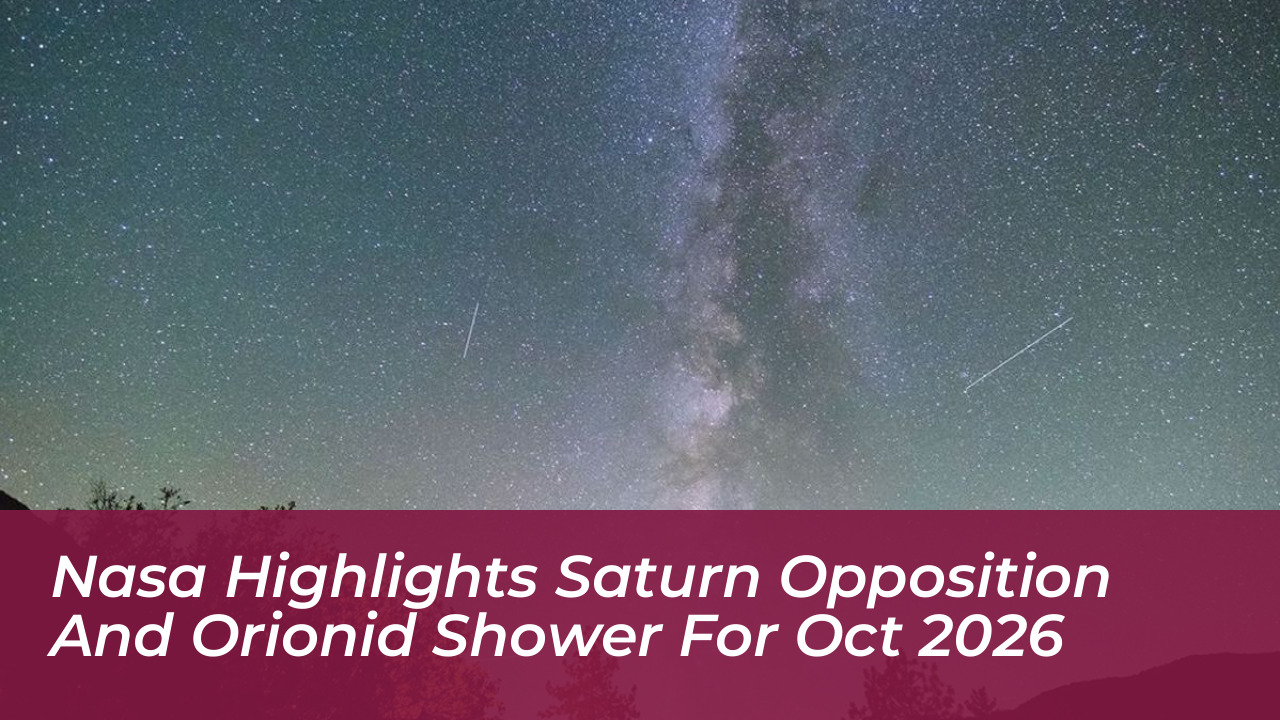
NASA has released its skywatching guide for October 2026, offering stargazers a roadmap to the month’s celestial events. Headlining the calendar are Saturn reaching opposition, the peak of the Orionid meteor shower, and several striking lunar conjunctions with bright planetary and stellar neighbors.
The month begins with planetary action as Saturn officially moves into opposition on October 4, 2026. This alignment places Earth directly between the Sun and the ringed gas giant, positioning Saturn opposite the Sun in our sky. For observers on Earth, this configuration means the planet rises near sunset and remains visible for most of the night, making it a premier viewing opportunity of the year.
Recent scientific insights have added interest to Saturn’s opposition window. While astronomers have long studied the 20,000-mile-wide hexagonal jet stream churning across Saturn’s north pole, observations from NASA’s Hubble Space Telescope have uncovered a ten-sided atmospheric wave encircling the planet’s south pole. This southern feature provides researchers with insight into the atmospheric dynamics of our solar system’s gas giants.
Additional October 2026 Skywatching Highlights
Beyond Saturn’s performance, the October 2026 calendar features several other astronomical alignments:
- October 6: A thin crescent Moon appears near bright Jupiter just before sunrise, creating an early-morning photo opportunity.
- October 21-22: The annual Orionid meteor shower reaches its peak. Formed by debris from Halley’s Comet, these meteors appear to radiate outward from the constellation Orion, though they can streak across any region of the night sky.
- October 27-28: The Moon passes close to the Pleiades star cluster, also known as the Seven Sisters, climbing high into the eastern evening sky.
Tips for Viewing the Orionid Meteor Shower and Pleiades
Stargazers hoping to catch the Orionid meteor shower will need to navigate some lunar interference this year. A bright waxing gibbous Moon will wash out fainter meteors during the early evening hours of October 21. NASA experts recommend waiting until the Moon sets during the hours before dawn on October 22 to secure dark skies.
For optimal viewing, find a dark-sky location away from urban light pollution, allow your eyes 20 to 30 minutes to adapt to the dark, and look upward. Later in the month, the Pleiades star cluster will appear as a fuzzy grouping of six to seven naked-eye stars in the east, though utilizing binoculars or a small telescope will reveal finer stellar detail.
Frequently Asked Questions About October 2026 Stargazing
What does Saturn at opposition mean?
Opposition occurs when Earth passes directly between the Sun and an outer planet like Saturn. During this time, the planet is opposite the Sun in our sky, rising around sunset and remaining visible all night long.
When does the Orionid meteor shower peak in October 2026?
The Orionid meteor shower peaks on the night of October 21 into the morning of October 22, 2026. The best viewing window is in the pre-dawn hours after the Moon has set.
What comet creates the Orionid meteors?
The Orionid meteor shower is created by particles of cosmic debris left behind in space by Halley’s Comet as it orbits the Sun.
How can I find the Pleiades star cluster?
On the night of October 27-28, 2026, look toward the eastern sky in the evening as the Moon passes close to the cluster. The Seven Sisters appear as a compact, fuzzy cluster of stars visible to the naked eye.
Where can I get more monthly skywatching tips from NASA?
You can follow NASA’s “What’s Up” video series and access educational resources through the official NASA Science website and the Night Sky Network.