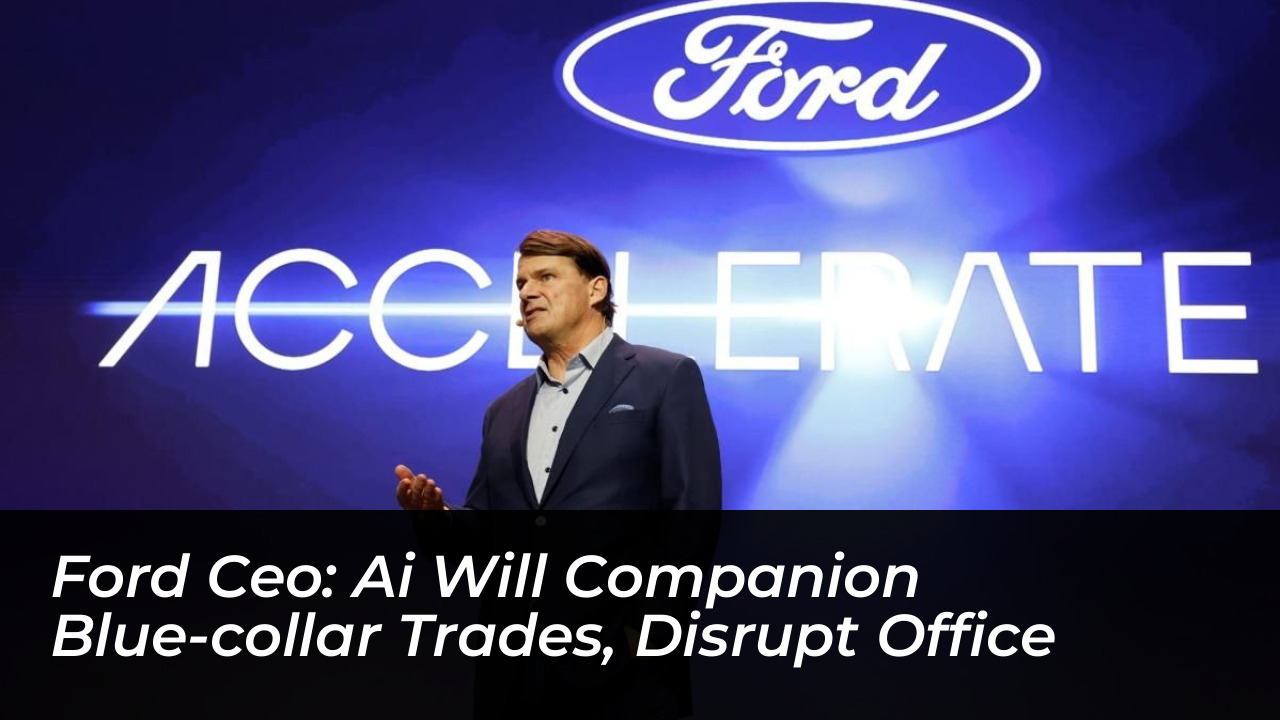
Artificial intelligence will act as a vital companion to blue-collar workers while blurring the boundaries between skilled trades and traditional engineering, according to Ford Chief Executive Officer Jim Farley. Speaking at a media roundtable during the Ford Pro Accelerate event in Detroit, Farley explained that routine screen-based and knowledge roles face immediate disruption, whereas physical trade jobs remain protected by human judgment requirements.
Due to high traffic on this story, please verify you are not a bot to instantly unlock the remaining content. Takes only 5 seconds!
Verify & Continue ReadingThe shift directly impacts major manufacturing operations, including Ford facilities where the company employs more than 10,000 skilled-trades workers. These individuals represent roughly 20 percent of its 56,000 United Auto Workers (UAW) workforce. Modern factory maintenance is shifting away from traditional conveyor belt repairs toward managing automated equipment, fiber optic systems, and complex battery manufacturing robotics that closely mirror semiconductor fabrication plants.
Blue-Collar Trades as a Protected Workforce
During the roundtable discussion-which featured industry leaders such as Linda Hubbard, president and CEO of Carhartt, and Chris Nelson, CEO of Stanley Black & Decker-Farley drew a sharp distinction between manual labor and routine office tasks. He stated that while jobs involving spreadsheets, call centers, and entry-level programming are vulnerable to the initial wave of artificial intelligence, physical trades require practical judgment and safety protocols that software cannot easily replicate.
“I think most of these jobs will be both using AI and also protected from it,” said Jim Farley. He emphasized that AI is likely to disrupt routine knowledge work much faster than it can replace electricians, technicians, mechanics, and factory skilled-trades workers.
The Blurring Lines Between Engineering and Trades
Inside newer automotive manufacturing operations, the visible line separating skilled trades from engineering is becoming increasingly difficult to trace. Farley noted that skilled-trades workers are increasingly tasked with maintaining large robotic casting systems, configuring digital manufacturing processes, and troubleshooting specialized machinery used in electric vehicle battery production.
Ford is actively deploying artificial intelligence and augmented reality to support technicians repairing complex vehicle components. For example, engine removals in Ford Super Duty trucks can take up to two days and require extensive disassembly. Ford Pro is leveraging AI guidance systems to help dealership mechanics complete these intricate procedures safely and efficiently.
Addressing Labor Shortages and Backlogs
Industry leaders at the conference highlighted that acute labor shortages across construction, infrastructure, and manufacturing make technological adoption an operational necessity rather than a threat. Chris Nelson of Stanley Black & Decker described AI and robotics as a labor-force multiplier that helps companies clear massive project backlogs.
“They see a backlog of future revenue that they cannot access because they can’t get through what they need to do right now,” Nelson said, referring to industrial tradespeople. He cited autonomous downward-drilling robots developed for data-center construction as a prime example of technology handling repetitive tasks while skilled workers focus on complex setups.
Worker Trust and Technological Adoption
A central theme of the discussions was the necessity of building and maintaining workforce trust. Ford already utilizes AI-powered vision systems in the background to monitor operations, such as checking panel dimensional control and door alignment. Farley warned that if workers suspect monitoring data will be used punitively for surveillance or work intensification, adoption will stall.
Comparing current technological anxieties to historical efficiency studies, Farley noted that the tension between industrial management and labor security remains a longstanding challenge. Future generations of trade workers will require greater familiarity with data, software, and automation, transforming how vocational training and technical education are delivered.
Frequently Asked Questions
What did Ford CEO Jim Farley say about AI and blue-collar jobs?
Jim Farley stated that artificial intelligence will act as a companion to blue-collar skilled tradespeople rather than replacing them, helping them handle complex physical tasks while protecting their jobs due to the need for human judgment.
Which jobs are most at risk during the first wave of AI integration?
According to Ford’s leadership, routine screen-based and knowledge roles-such as finance spreadsheet management, call center operations, and entry-level programming-face immediate disruption and elimination.
How is Ford currently using AI in its manufacturing and repair operations?
Ford utilizes AI and augmented reality to guide technicians through complex vehicle repairs like engine removals, while deploying automated vision systems in factories to inspect parts and monitor robotic assembly lines.
What percentage of Ford’s UAW workforce consists of skilled-trades workers?
Ford employs more than 10,000 skilled-trades workers, representing approximately 20 percent of its 56,000 UAW workforce.
Why do manufacturing and construction industries welcome AI tools?
Industry executives note that an acute shortage of technical labor has created massive project backlogs. AI and robotics help existing workers complete tasks faster, safer, and more efficiently to access untapped revenue.
Why is worker trust essential for implementing AI in factories?
If employees believe that AI vision systems or data-tracking tools are being used for negative surveillance or work intensification rather than assistance, they will resist the technology and refuse to use it.