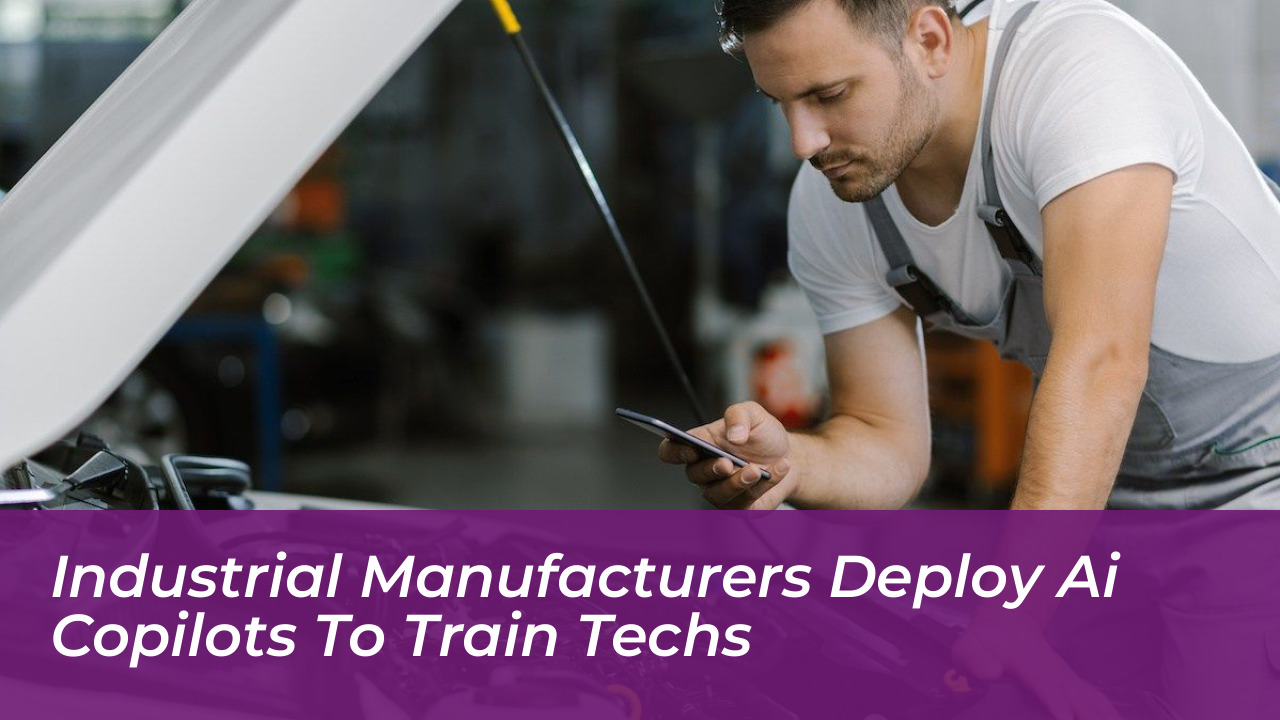
Industrial manufacturers are deploying artificial intelligence tools to accelerate worker training, bridge talent gaps, and reduce equipment downtime. According to corporate statements and industry insights, major industrial enterprises are introducing specialized generative AI systems into factory service bays and assembly plants to guide less-experienced personnel through maintenance procedures.
Due to high traffic on this story, please verify you are not a bot to instantly unlock the remaining content. Takes only 5 seconds!
Verify & Continue ReadingThis push comes as the sector faces a generational skills shortage and pressure to maintain operational efficiency. By pairing veteran expertise with machine learning frameworks, manufacturing firms are fast-tracking rookie technicians and transforming how human labor interacts with industrial machinery.
Fast-Tracking Rookie Mechanics at Ford
At Ford Motor Company, the automotive dealer network uses AI systems to guide inexperienced mechanics through engine maintenance procedures in commercial service bays. Speaking during a media roundtable at the Ford Pro Accelerate event in Detroit, Ford Chief Executive Officer Jim Farley explained that the technology provides step-by-step instructions while human workers perform the physical labor.
“They’re good mechanics, they just don’t know,” Farley stated during the media briefing.
The system helps technicians complete intensive maintenance tasks, such as removing Super Duty pickup truck engines. This task normally takes two days of labor and requires years of specialized technical experience. Farley previously highlighted that mastering diesel engine removal takes approximately five years, while Ford faced roughly 5,000 open technician positions.
Industry analyses show that such tools act as a second set of eyes in the service bay, ensuring high precision while preserving human oversight.
Rockwell Automation Cuts Training Timelines
Other industrial leaders are reporting similar breakthroughs. At Rockwell Automation’s manufacturing plant in Singapore, new technicians learn to troubleshoot hundreds of complex machines in three months instead of the traditional nine-month timeline. Bob Buttermore, chief supply chain officer at Rockwell, highlighted the shift in a recent interview.
Microsoft attributed the efficiency gain to the generative AI-powered Maintenance Copilot, an internal assistant deployed by Rockwell. When a machine triggers an error code, the copilot organizes diagnostic data by problem, cause, and reaction, placing likely solutions directly in front of the worker.
The system relies on a database built by Rockwell engineers with 20 to 30 years of shop-floor experience, combined with equipment manuals and manufacturing software data running on Microsoft’s Azure platform. According to plant director Li Wang, machine downtime at the Singapore facility dropped by 33%, while servicing and spare-parts costs fell by approximately 25%.
Siemens Industrial Copilot and the Broader Industry Landscape
Siemens has scaled its Industrial Copilot initiative-developed in partnership with Microsoft-to over 120,000 engineers globally. Operating on the Siemens Xcelerator open digital business platform, the tool assists automation engineers in writing and debugging complex code. It also supports shop-floor operators with real-time troubleshooting via natural language chat interfaces.
Boston Consulting Group (BCG) estimates that artificial intelligence could lift field-service productivity by 20% to 30% and raise technician profitability by up to 80%. Analysts emphasize that roughly 70% of this value stems from effective change management and bridging knowledge silos rather than raw code generation alone.
Core Benefits of Industrial AI Copilots
- Accelerated Onboarding: New operators achieve full proficiency up to three times faster with real-time procedural guidance.
- Reduced Downtime: Intelligent diagnostics minimize unplanned machine stoppages and lower Mean-Time-to-Repair (MTTR).
- Preservation of Tribal Knowledge: AI models capture decades of insights from retiring veteran workers, making them searchable for future generations.
- Enhanced Safety: Systems monitor actions against standard operating procedures (SOPs), providing hazard alerts directly at the point of work.
As manufacturers across automotive, electronics, and heavy industry scale these technologies, industrial AI copilots are shifting from experimental concepts to foundational infrastructure for the modern factory floor.