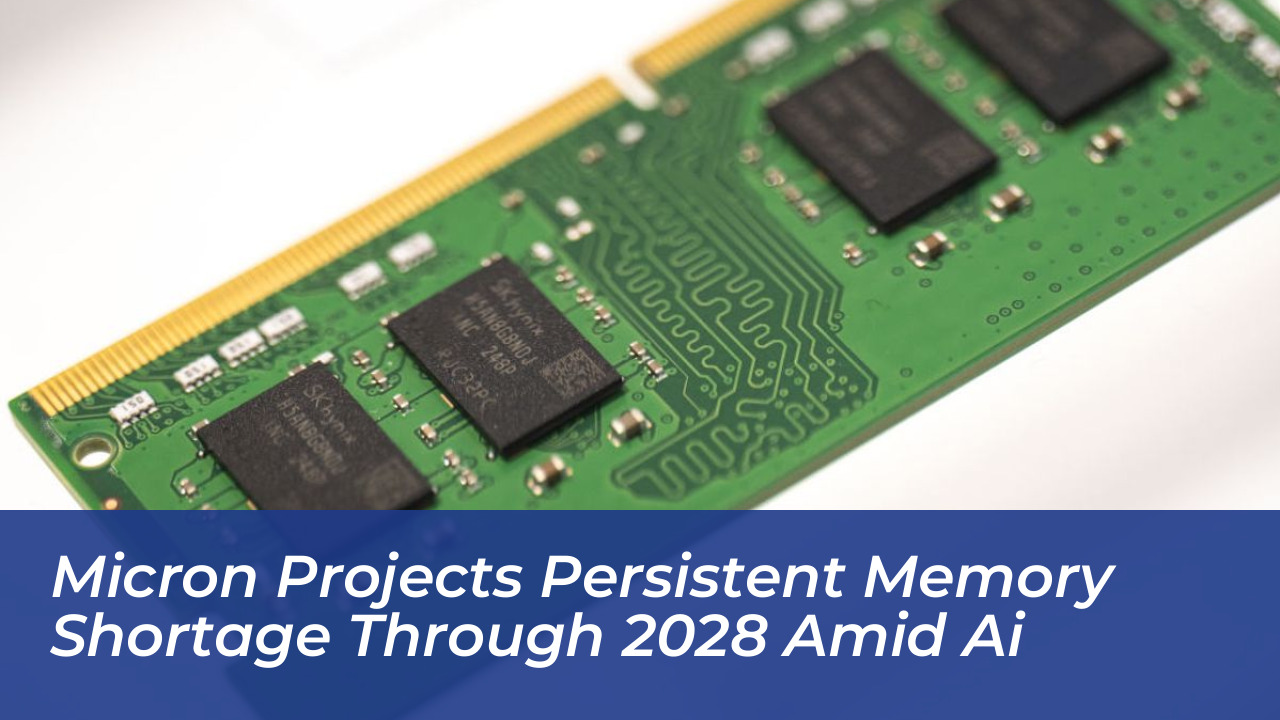
Micron Technology executives have announced that global memory chip shortages will extend through at least 2028. Surging demand for artificial intelligence data centers is rapidly outpacing manufacturing capacity. This structural imbalance is driving record quarterly financial performance for semiconductor producers while squeezing supply allocations for traditional consumer electronics.
During the company’s fourth-quarter earnings report on October 2, 2026, Micron reported stellar financial growth that outpaced major technology firms. The memory manufacturer recorded earnings per share of $33.42, marking a 1,002 percent jump from $3.03 during the same period in 2025. Quarterly revenue expanded by 379 percent to $54.23 billion, up from $11.31 billion a year prior, allowing Micron to briefly out-earn all “Magnificent Seven” technology corporations in operating income for the quarter.
Chief Executive Officer Sanjay Mehrotra addressed investors regarding the prolonged supply pipeline during the earnings briefing, emphasizing the severity of the market conditions. “Overall, supply-demand environment is only getting tighter,” said Sanjay Mehrotra, CEO of Micron. He added that the company lacks a clear line of sight regarding when market supply and demand will ultimately return to balance.
Prioritizing High-Bandwidth Memory for AI Infrastructure
To cope with relentless infrastructure demands, manufacturing facilities worldwide are actively prioritizing high-bandwidth memory (HBM) and server-grade DRAM over conventional consumer components. Industry reports indicate that roughly 75 percent of Micron’s projected 2027 memory output has already been sold out under long-term customer agreements.
Competitors are echoing similar strategic shifts. Samsung Executive Vice President Kim Taewoo noted that HBM will account for nearly 30 percent of total DRAM manufacturer wafer capacity in 2027, up from 20 percent previously. This massive reallocation leaves less production capacity available for standard PCs, smartphones, and consumer gadgets, driving up input costs and retail prices globally.
Manufacturing Complexities and Expansion Timelines
Addressing why memory producers cannot instantly build their way out of the shortage, executives noted that advanced semiconductor fabrication is exceptionally slow and capital-intensive. A single cutting-edge silicon wafer can require around 2,000 intricate process steps.
Micron is pouring billions into expanding production lines across the United States, Taiwan, Japan, and Singapore, including a planned $250 billion U.S. investment framework. However, new clean room facilities scheduled to open in 2028 will bring on additional output only gradually. Node transitions and complex HBM manufacturing stacks yield fewer usable productivity gains per wafer during early production ramps, ensuring that supply constraints will persist well into the decade.
Frequently Asked Questions
Why does Micron expect memory shortages to continue through 2028?
Micron CEO Sanjay Mehrotra stated that AI-driven data center demand is growing faster than the semiconductor industry can add manufacturing capacity, creating a structural supply deficit that double-digit bit-shipment growth cannot solve immediately.
What percentage of Micron’s 2027 output is already committed?
Approximately 75 percent of Micron’s memory output for 2027 is already accounted for and sold out under multiyear agreements with major strategic technology partners.
How is the memory shortage affecting consumer electronics?
Because chipmakers are prioritizing high-bandwidth memory (HBM) and server DRAM for AI workloads, consumer devices face tighter supplies. This has resulted in higher costs, smaller default RAM configurations in prebuilt PCs, and rising prices for smartphones and gaming hardware.
Does Micron still sell memory modules directly to consumers?
No. In December 2025, Micron announced that its Crucial brand was exiting consumer RAM sales to redirect constrained wafer capacity toward faster-growing enterprise and data-center customers.
When will memory supply and demand return to a normal balance?
Micron executives have stated they currently do not have a line of sight on when supply will catch up with demand, noting that new clean rooms opening in 2028 will ramp up production only gradually.