
The United States has officially loosened federal fuel economy requirements for new vehicles. This grants automakers greater flexibility to manufacture gasoline-powered trucks and larger-engine models while reducing regulatory pressure to invest in alternative fuel technologies. Announced by the National Highway Traffic Safety Administration (NHTSA), the updated policy lowers the target for the national light-duty vehicle fleet to 34.9 miles per gallon (mpg) by model year 2031, which is a significant departure from the previous 50.4 mpg target established in 2024.
The regulatory shift forms part of a broader deregulatory agenda under the second Trump administration. Alongside Transportation Secretary Sean Duffy and NHTSA Administrator Jonathan Morrison, federal officials framed the rule-officially titled the Safer Affordable Fuel Efficient Vehicles Rule III-as a vital correction. They stated it would restore vehicle affordability for American families and eliminate what the administration terms an illegal electric vehicle mandate.
Restructuring Corporate Average Fuel Economy (CAFE) Standards
The newly finalized rule reaches back to reset the model year 2022 baseline fuel economy standards and prescribes modest annual efficiency increases of roughly 1 percent through 2031. Under the revised framework, passenger cars are assigned a 2022 baseline of 37.4 mpg, while light trucks carry a 29.4 mpg baseline.
These updated baselines exclude the high fuel economy values previously attributed to electric vehicles (EVs) in fleet-wide calculations. According to NHTSA, the Energy Policy and Conservation Act (EPCA) of 1975 prohibits federal regulators from considering dedicated alternative fuel vehicle performance when setting maximum feasible standards.
Automotive analysts note that the changes align closely with legislative actions taken by Congress, which eliminated civil penalties for automakers failing to meet CAFE compliance requirements. According to Itay Michaeli, an automotive analyst at TD Cowen, the combination of zeroed-out penalties and lowered standards will significantly reduce compliance expenses for traditional manufacturers, potentially improving short-term corporate earnings.
Impact on Pickups, Crossovers, and V8 Engines
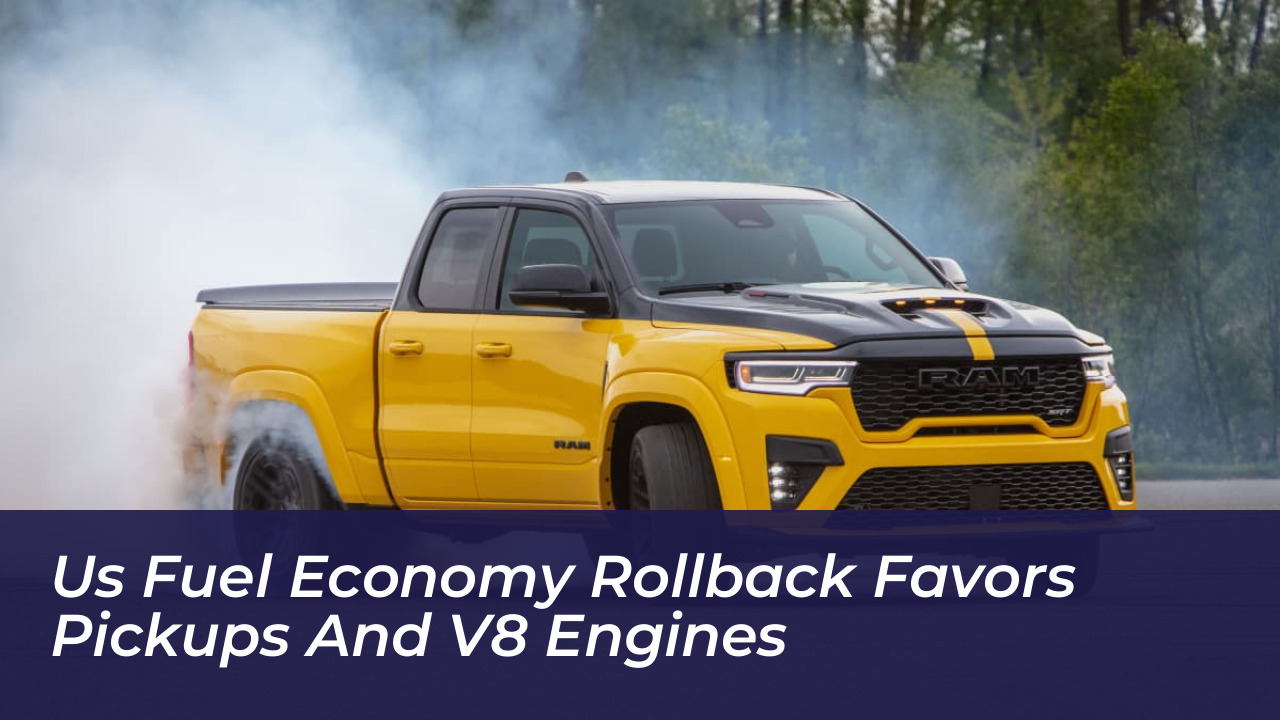
The rollback provides immediate relief to traditional manufacturers producing internal combustion engine vehicles. This is especially true for full-size pickup trucks, large SUVs, and V8-powered models that represent a major share of domestic automotive sales. However, the rule also introduces strict reclassification criteria effective in model year 2030, which federal estimates suggest will shift many lighter crossover utility vehicles from the light truck category into the passenger car fleet.
This reclassification means that many popular crossovers will face more stringent efficiency expectations than they would have under prior definitions. Nevertheless, traditional automakers gain wide latitude to optimize their production portfolios around consumer demand for gasoline and conventional hybrid powertrains.
In addition to adjusting fleet targets, the administration’s final rule eliminates the CAFE credit trading program beginning in model year 2028. Regulators argued that the multi-billion-dollar credit market created an artificial subsidy for EV-exclusive manufacturers at the expense of traditional internal combustion engine producers.
Industry Reactions and Economic Debate
The policy change has elicited sharply contrasting responses from industry leaders, consumer advocates, and environmental organizations.
Major domestic manufacturers, including the Alliance for Automotive Innovation representing Ford, General Motors, and Stellantis, welcomed the alignment between federal regulations and prevailing market conditions. Industry representatives praised the administration for easing pressures that pushed manufacturers toward mandatory EV adoption rates ahead of consumer demand.
Conversely, environmental groups and clean-transportation advocates condemned the rollback. Critics argue that lower fuel economy standards will increase national gasoline consumption, elevate household fuel expenses during periods of high oil prices, and slow down American competitiveness in the rapidly evolving global electric vehicle market. Legal challenges from environmental coalitions are widely expected to target both the retroactive baseline adjustments and the exclusion of EV performance metrics from future standard-setting procedures.