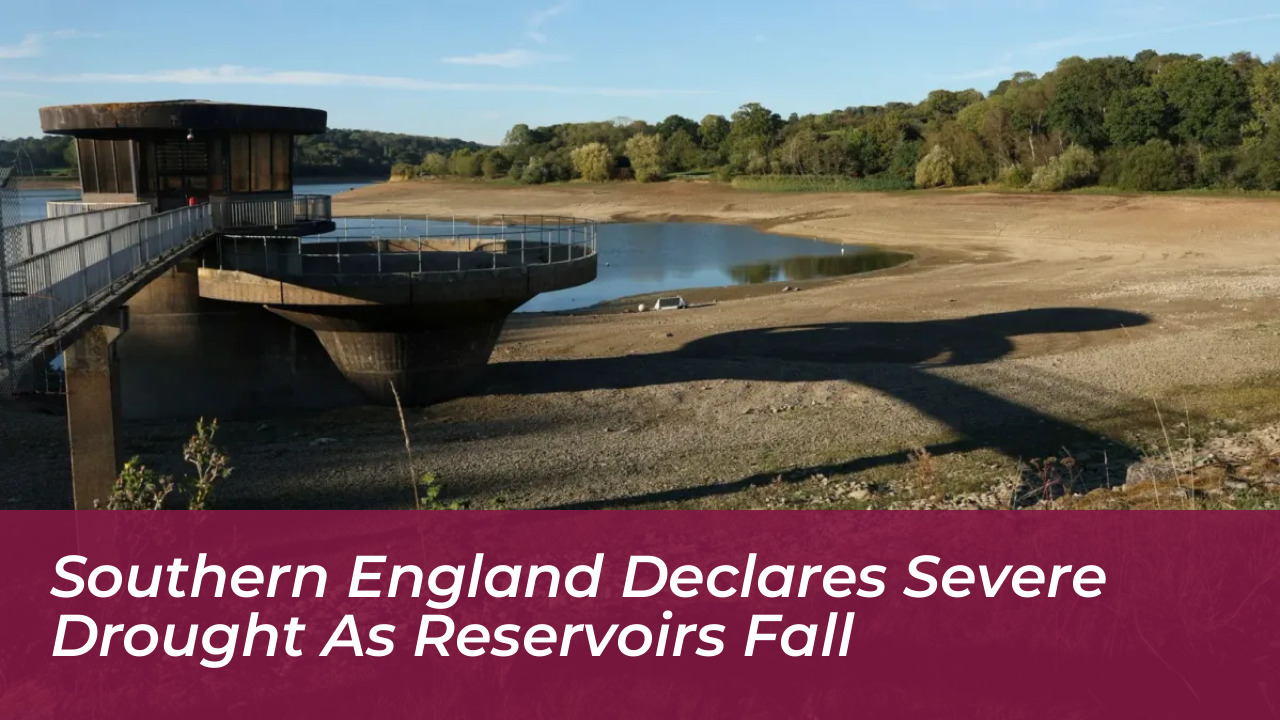

A severe drought has been officially declared across parts of southern England following months of acute rainfall shortages and record-breaking summer temperatures. Announced by the Environment Agency after a review by the National Drought Group, the emergency status impacts regions including Cornwall, Devon, Dorset, Somerset, East Suss*x, and West Suss*x. The decision aims to safeguard public water supplies and protect the local environment as critical water storage facilities continue to plummet.
Critical Declines Across Major Reservoirs
The escalation to a severe drought was triggered by alarming water deficits at several major regional reservoirs. Officials reported that normal reservoir storage levels at this time of year should hover around 75%. However, active tracking reveals a starkly different reality:
- Wimbleball Reservoir (Somerset): Standing at 14.9% to 16% capacity, serving roughly 300,000 properties across east and north Devon, Somerset, west Dorset, and West Somerset.
- Ardingly Reservoir (West Suss*x): At 19.4% capacity, supplying approximately 95,000 to 280,000 customers across East and West Suss*x, including Haywards Heath and Uckfield.
- Stithians Reservoir (Cornwall): Plunged to 21.9% capacity, heavily impacting local households near Falmouth.
- Colliford Reservoir (Cornwall): Operating at 35% capacity, categorized alongside Wimbleball as possessing exceptionally low water levels.
- Roadford Reservoir (Devon): Down to 36.8% capacity.
- Burrator Reservoir (Devon): Standing at 33.6% capacity.
The South East and South West regions experienced their driest April to September period in more than a century, fueled by prolonged heatwaves and intense consumer demand.
Government Actions and Regulatory Measures
Environment Secretary Dame Angela Eagle stated that this level of drought is an emergency not experienced for decades. While customer taps are expected to remain running without immediate interruption, the government has stepped up regulatory oversight and enacted proactive measures:
- Daily Monitoring: Water companies are instructed to conduct daily tracking of reservoir and river levels alongside heightened water quality checks.
- Abstraction Checks: The Environment Agency has increased compliance inspections on businesses that withdraw water from natural sources to ensure they adhere strictly to permitted limits.
- Drought Permits: Authorities have granted drought orders to South East and South West Water, permitting them to reduce the volume of water released from reservoirs into natural rivers by millions of litres per day.
Water Company Response and Public Appeal
Water providers across the affected counties have mobilized enhanced leak-detection crews and implemented localized restrictions. Hosepipe bans, which first came into force across Devon, Cornwall, the Isles of Scilly, and parts of Dorset and Somerset in August, remain active with no definite end date. Southern Water has additionally applied for usage restrictions covering Hampshire and the Isle of Wight.
“Record-breaking summer heat and severe drought have put our water resources under immense pressure. Recovery depends on both rainfall and how much water we use. We cannot change the weather, but water companies can act now,” said Environment Agency Chief Executive Philip Duffy.
Water utility firms such as South West Water and South East Water are urging households and commercial entities to exercise extreme water prudence. Minimizing non-essential usage preserves critical river flows, safeguards vulnerable local wildlife, and ensures public supplies endure through the winter months.
Frequently Asked Questions
Which areas are affected by the severe drought declaration?
The severe drought covers parts of Cornwall, Devon, Dorset, Somerset, East Suss*x, and West Suss*x following recommendations from the National Drought Group.
Why did the Environment Agency declare a severe drought?
The declaration was prompted by exceptionally low water levels at major regional reservoirs-such as Ardingly and Wimbleball-following the driest April-to-September period in over a century.
Are public tap water supplies at immediate risk?
Government officials have assured that customer taps will remain uninterrupted, though proactive monitoring and mandatory conservation orders have been put into effect to prevent future supply disruptions.
What restrictions are currently in place?
Hosepipe bans remain active across Devon, Cornwall, the Isles of Scilly, and parts of Dorset and Somerset, while water companies evaluate further non-essential use limitations for commercial properties.
How can individuals help mitigate the drought?
Residents are strongly encouraged to reduce daily water consumption inside and outside their homes to leave more water in local rivers and protect regional ecosystems.