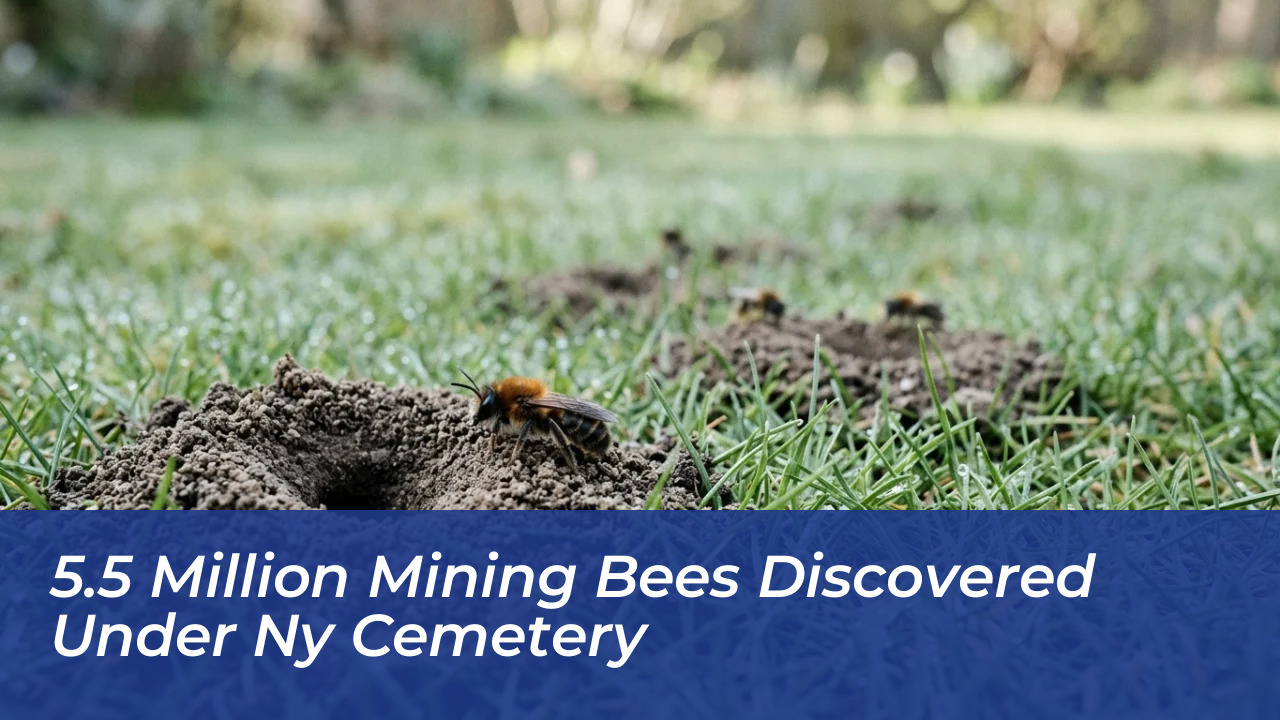

An estimated 5.5 million solitary ground-nesting bees emerge each spring beneath East Lawn Cemetery in Ithaca, New York. This establishes one of the largest recorded wild pollinator aggregations on Earth. The massive underground population thrives across just 1.5 acres of undisturbed turf, containing more than three times the human population of Manhattan beneath the grass.
Discovered by researchers from Cornell University, the colony reveals how historical urban landscapes can shelter vast networks of native wildlife in plain sight. The discovery began when laboratory technician Rachel Fordyce noticed the cemetery surface bustling with insect activity while walking to work. After gathering samples in a jar for entomologist Bryan Danforth, researchers confirmed the insects were Andrena regularis, commonly known as the regular mining bee.
Records show the species has inhabited the 1878-founded burial ground since at least the early 1900s, quietly maintaining subterranean chambers for generations.
Measuring Millions in the Soil
To quantify the subterranean population, Cornell undergraduate Steven Hoge coordinated field monitoring across the cemetery grounds. Between March 30 and May 16, 2023, the team deployed 10 emergence traps across the site. Each trap covered roughly 11 square feet (1 square meter) to capture emerging insects. The collectors trapped 3,251 individual insects representing 16 species of bees, flies, and beetles, with Andrena regularis overwhelmingly dominating the counts.
When researchers scaled the data across approximately 65,000 square feet (6,000 square meters) of active nesting terrain, mathematical models estimated a population between 3 million and 8 million bees, centering on a baseline of 5.5 million. “In terms of what is in the literature, this is one of the largest,” said Hoge.
Sean Brady, an entomologist with the Smithsonian Institution who reviewed the findings, noted that documented aggregations in the hundreds of thousands are rare. Meanwhile, verified sites numbering in the millions are almost unprecedented in modern entomology.
Key Colony Metrics at East Lawn Cemetery
- Primary Species: Andrena regularis (Regular mining bee)
- Estimated Total Population: 5.5 million bees (range: 3 million to 8 million)
- Active Nesting Area: 1.5 acres (approx. 65,000 square feet)
- Survey Trapping Window: March 30 – May 16, 2023
- Equivalent Hive Capacity: Exceeds 200 managed honeybee hives
- Winter Survival Strategy: Underground hibernation as mature adults
The Biology Behind the Underground Boom
A widespread misconception assumes that most bees inhabit social colonies housed in wooden hives or hollow trees. In reality, data from the Xerces Society confirms that roughly 70 percent of North America’s native bee species nest directly in the dirt as solitary insects. Rather than serving a queen, female mining bees excavate independent shafts where they nurture their own offspring.
The survival strategy of A. regularis hinges on precise environmental timing. Unlike typical wild species that spend the cold months in larval stages, these mining bees overwinter fully grown beneath the frost line.
Apple Blooms and Underground Parasites
Emergence occurs every April once daytime ground temperatures consistently reach 70°F (21°C). This biological alarm clock synchronizes with flowering fruit trees at Cornell Orchards, located just one-third of a mile (0.5 kilometers) away, providing the colony with a massive source of nectar and pollen.
“This species overwinters as adults, which is relatively rare, and that’s part of the reason why they come up out of the ground so early in the spring, timed to the apple bloom,” said Steve Hoge, lead author of the study published in the journal Apidologie.
Key biological factors driving the colony include:
- Protandry in action: Male bees emerge days ahead of females during spring warm spells to establish territory and secure mating opportunities.
- Floral dependence: Foraging flights concentrate around local orchards and spring-blooming flora to fuel nest provisioning.
- Natural balance: Traps also revealed Nomada imbricata, a cuckoo bee that invades nests, deposits eggs, and consumes the host’s pollen stores.
Why Historical Cemeteries Protect Native Pollinators
Modern suburban expansion, chemical lawn treatments, and intensive urban development have eliminated critical bare ground habitats across the United States. East Lawn Cemetery provides an accidental refuge because its sandy soil remains largely undisturbed, pesticide-free, and structurally stable.
“The peacefulness, the lack of pesticides and the fact that, overall, the ground is rarely disturbed, all make cemeteries good habitat for bees,” said Danforth.
Cemetery superintendent Keven Morse has adjusted operations around heavy concentration areas, remaining mindful of mowing schedules while the insects dig their nests. Because heavy machinery and paving can destroy subterranean nesting sites instantaneously, the Cornell research team published their study and established a citizen-science tracking initiative to locate similar nesting fields across the country.
How to Identify and Protect Ground-Nesting Bees
- Identify natural nest sites: Small mounds of loose, excavated soil on patchy spring lawns often indicate active native mining bees rather than pests.
- Protect bare turf: Avoid heavy chemical treatments and allow sunny, well-draining patches of earth to remain exposed to help ground pollinators complete their nesting cycle.
- Report sightings: Participate in citizen science tracking initiatives to help researchers map large wild bee aggregations worldwide.