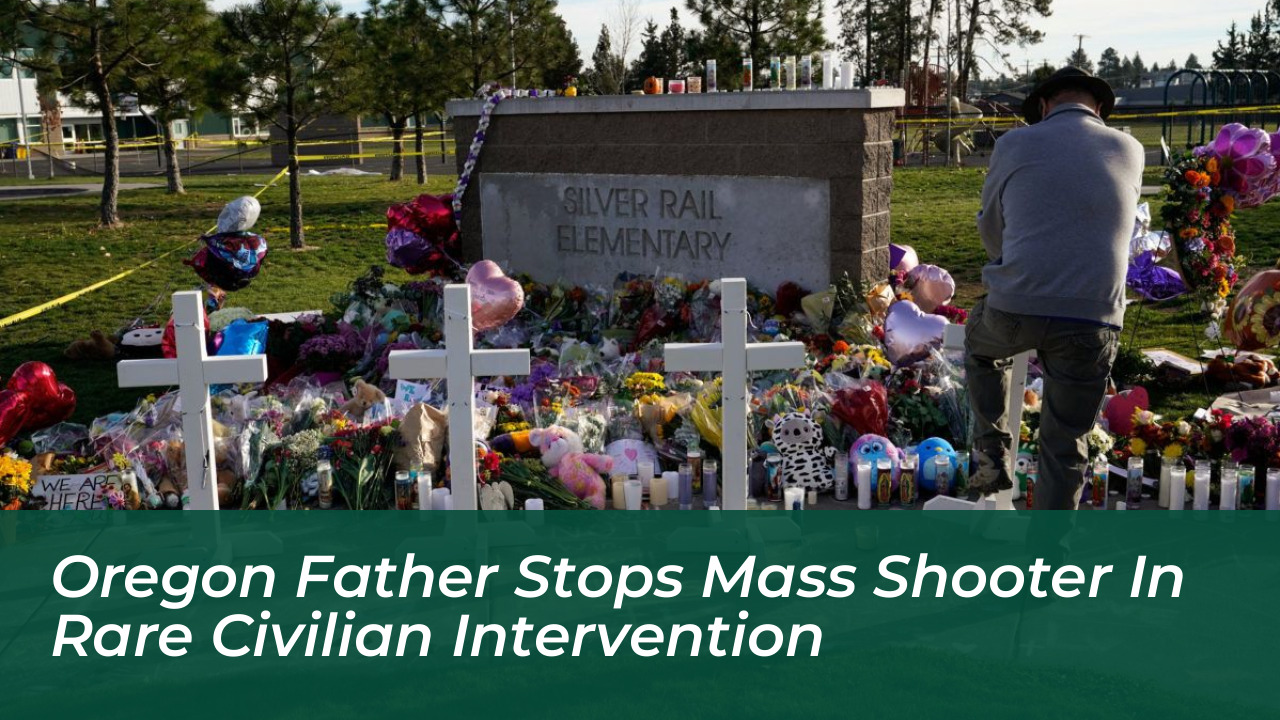

Armed civilian intervention remains a rare occurrence during active-shooter incidents in the United States, according to extensive data compiled by Texas State University’s Advanced Law Enforcement Rapid Response Training Center (ALERRT). This reality gained renewed national attention following a tragic shooting at Silver Rail Elementary School in Bend, Oregon, where a 36-year-old father of two intervened to stop a teenage gunman.
Kaylub Giamanco, a carpenter and father whose children attend the school, was in the neighborhood when he heard gunfire and rushed inside. Bend Police Chief Mike Krantz reported that Giamanco fired his legally owned .40-caliber pistol when he saw a teacher struggling with the armed attacker. The intervention occurred during an assault that ultimately claimed the lives of three students and a teacher, drawing praise from public officials, including President Donald Trump.
Data and Statistics on Active-Attack Interventions
To understand the broader context of civilian responses, the ALERRT Center examined 634 active-attack incidents involving firearms, blades, or vehicles between 2000 and 2025. Researchers found that 374 of these attacks ended before law enforcement officers arrived on the scene.
Among those incidents stopped prior to police arrival:
- Armed civilians shot and stopped the attackers in 29 cases.
- Civilians halted another 31 incidents through other means, such as physically restraining the attacker or disarming them.
- The vast majority of pre-police interventions were executed by unarmed individuals, including teachers, custodians, coaches, and students, often acting when the shooter’s weapon jammed or during reloading.
James Densley, a professor at Metro State University in St. Paul, Minnesota, and co-founder of the Violence Prevention Project, tracks K-12 school homicides nationwide. According to Densley’s research looking at roughly 400 school shooting incidents since 2000, armed civilian intervention to stop a shooter has virtually no historical precedent in K-12 settings, making the Bend intervention an extraordinary exception.
Expert Guidance on Active Shooter Survival
Despite the outcome in Bend, law enforcement training organizations strongly advise against civilians attempting to confront active shooters with firearms.
James Keith of the ALERRT Center emphasizes standard survival protocols for the public:
What we’re teaching people is get away, don’t stop. When you hear that and you think it’s a gun, run.
If evacuation is impossible, experts recommend secondary safety measures: blocking access to rooms, hiding in windowless spaces, and creating physical barriers. Direct physical confrontation or fighting back is framed strictly as a last resort when all other options fail.
The Ongoing Gun Policy Debate
The incident in Bend has once again ignited political debates surrounding the Second Amendment and personal protection. Following the shooting, the National Rifle Association (NRA) released a statement asserting that the tragic event highlights the importance of law-abiding gun owners, reaffirming the long-standing philosophy that “the only thing that stops a bad guy with a gun is a good guy with a gun.”
Conversely, sociologists and gun policy researchers point out that this narrative oversimplifies complex societal anxieties. Jennifer Carlson, an Arizona State University sociologist who studies gun politics in America, notes that while personal protection drives gun ownership across diverse demographics, framing incidents purely around a “good guy versus bad guy” binary fails to address broader concerns regarding public safety and institutional protection.
Frequently Asked Questions
How often do armed civilians stop mass shootings?
According to ALERRT data tracking 634 active attacks between 2000 and 2025, armed civilians shot and stopped attackers in only 29 of the 374 cases that ended before police arrived.
What happened during the Silver Rail Elementary School shooting?
A teenage gunman opened fire at Silver Rail Elementary School in Bend, Oregon, killing three students and a teacher. Kaylub Giamanco, a local carpenter and father, entered the school and fired his legally owned .40-caliber pistol after seeing a teacher struggling with the shooter.
What do safety experts recommend doing during an active shooter event?
The ALERRT Center recommends running away immediately upon hearing gunshots. If evacuation is not possible, individuals should hide in windowless rooms, block doors, and prepare to defend themselves only as an absolute last resort.
How do most active-shooter incidents end without police intervention?
When attacks end before law enforcement arrives, they are most frequently stopped by unarmed individuals-such as teachers, school staff, or students-often acting when the perpetrator’s weapon jams or while they are reloading.
What is the stance of gun rights groups regarding civilian intervention?
Organizations like the NRA view armed civilian interventions as validation of the importance of civilian gun ownership for self-defense and deterrence against active threats.