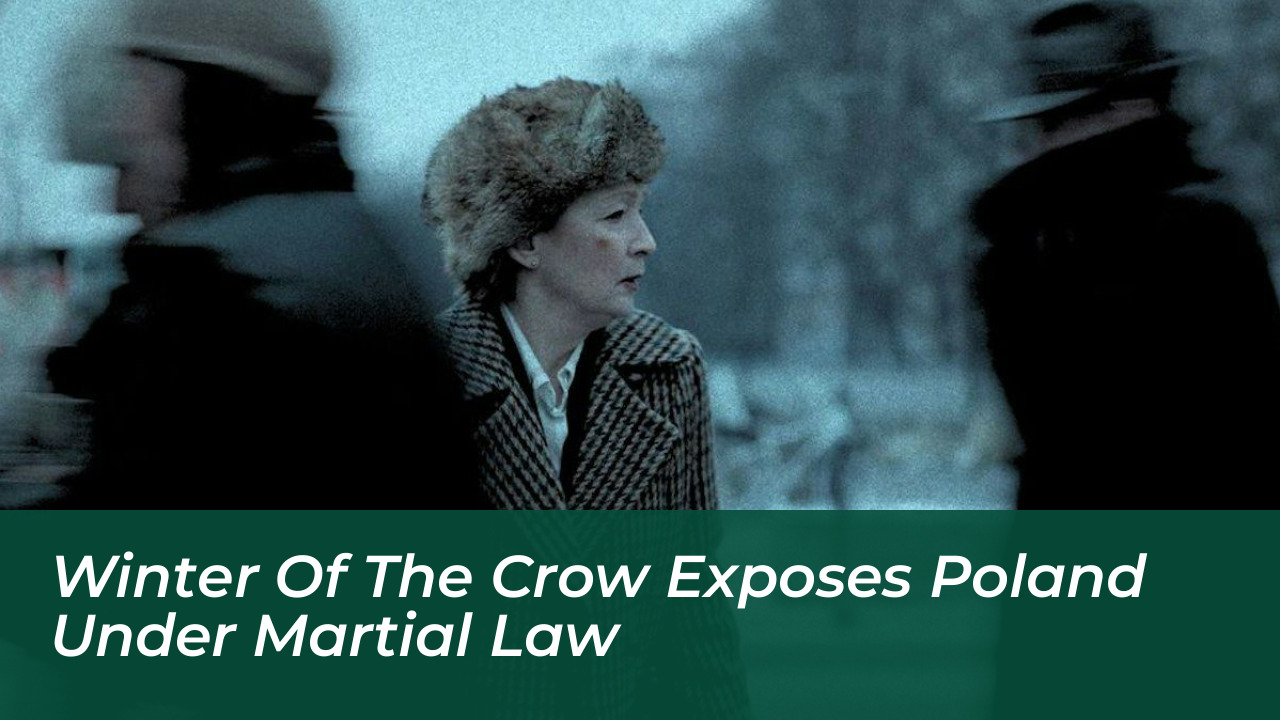

Directed by Kasia Adamik and based on a short story by Nobel Prize-winning author Olga Tokarczuk, Winter of the Crow transports audiences back to Warsaw in December 1981. The historical thriller explores the tense, sudden, and violent realities of communist Poland under martial law through the eyes of a visiting British academic.
The film stars Academy Award nominee Lesley Manville as Professor Joan Andrews, a blunt British psychiatrist invited across the Iron Curtain to deliver a university lecture. Initially, Joan operates inside a familiar bubble of academic privilege, viewing her host country through a detached lens. However, her perspective shifts dramatically overnight when the Polish government, reacting to severe economic recession and mounting social unrest, declares martial law.
The Swift Onset of Martial Law in December 1981
Following the government crackdown, telephone lines are immediately severed, international borders are locked, and heavily armed soldiers populate the snowy streets of Warsaw. Joan finds herself trapped in an unfamiliar and austere landscape defined by concrete tower blocs, blizzards, and leaden skies.
Her detachment evaporates after she arrives at a local university lecture hall accompanied by Alina, a young Polish doctoral student played by Zofia Wichłacz. Student protesters aggressively disrupt Joan’s presentation to draw public attention to their plight. Shortly after, Joan witnesses the brutal, heavy-handed arrest of a young mother and watches in horror as Alina’s idealistic brother, Marek-portrayed by Jakub Guszkowski-is murdered by secret police agents colloquially known as “crows.”
A Taut Escape Thriller Set Against the Cold War
Armed with little more than a Polaroid camera, Joan becomes the target of shadowy state security agents. What begins as a routine academic visit transforms into a high-stakes escape thriller. Her primary objective is reaching the safety of the British Embassy to secure a flight home.
Director Kasia Adamik weaves distinct parallels throughout the narrative. The film contrasts the clean, colourful democratic West-characterized by red buses and warm sandstone-with the oppressive, grey monotone of Soviet-era Warsaw. Additionally, the narrative subtly links Joan’s professional expertise in psychiatry with the paranoid architecture of a totalitarian police state, suggesting that total authoritarianism functions similarly to a hope-suffocating asylum.
Joan’s background as an internationally renowned psychiatrist makes her uniquely qualified to navigate landscapes of fear and paranoia. Having survived the Machiavellian rivalries and political intrigue of British academia, she proves surprisingly capable of outwitting professional intelligence operatives.
Release, Production, and Historical Context
Produced as a British, Polish, and Luxembourgish co-production with a screenplay by Sandra Buchta, Winter of the Crow features an international cast that also includes Tom Burke and Andrzej Konopka, with Agnieszka Holland serving as executive producer. The film premiered in the Platform program at the Toronto International Film Festival before moving to wider theatrical releases.
For many international viewers, particularly within the Polish diaspora, the events depicted on screen represent lived history. December 1981 marked a profound turning point that triggered mass waves of emigration to the United States and other Western nations.
Ultimately, Winter of the Crow delivers a timeless message about totalitarian oppression. As Professor Joan Andrews learns firsthand during the freezing winter of 1981, when basic human rights and freedom are suppressed, no one can remain a bystander.
Frequently Asked Questions
What is Winter of the Crow about?
Winter of the Crow is a historical thriller following Professor Joan Andrews, a British psychiatrist visiting Warsaw in December 1981, who must fight to escape when the Polish government declares martial law.
Who directed Winter of the Crow?
The film is directed by Polish filmmaker Kasia Adamik and features an executive-producing role by her mother, acclaimed director Agnieszka Holland.
Is the film based on a book or story?
Yes, the screenplay by Sandra Buchta is directly adapted from a short story written by Nobel Prize-winning Polish author Olga Tokarczuk.
Who stars in the movie?
The film stars Lesley Manville as Professor Joan Andrews, alongside Zofia Wichłacz as Alina, Jakub Guszkowski as Marek, and Tom Burke.
When was martial law declared in Poland?
Martial law was officially declared in communist Poland on December 13, 1981, suspending civil liberties, cutting communications, and closing national borders to crush the Solidarity movement.