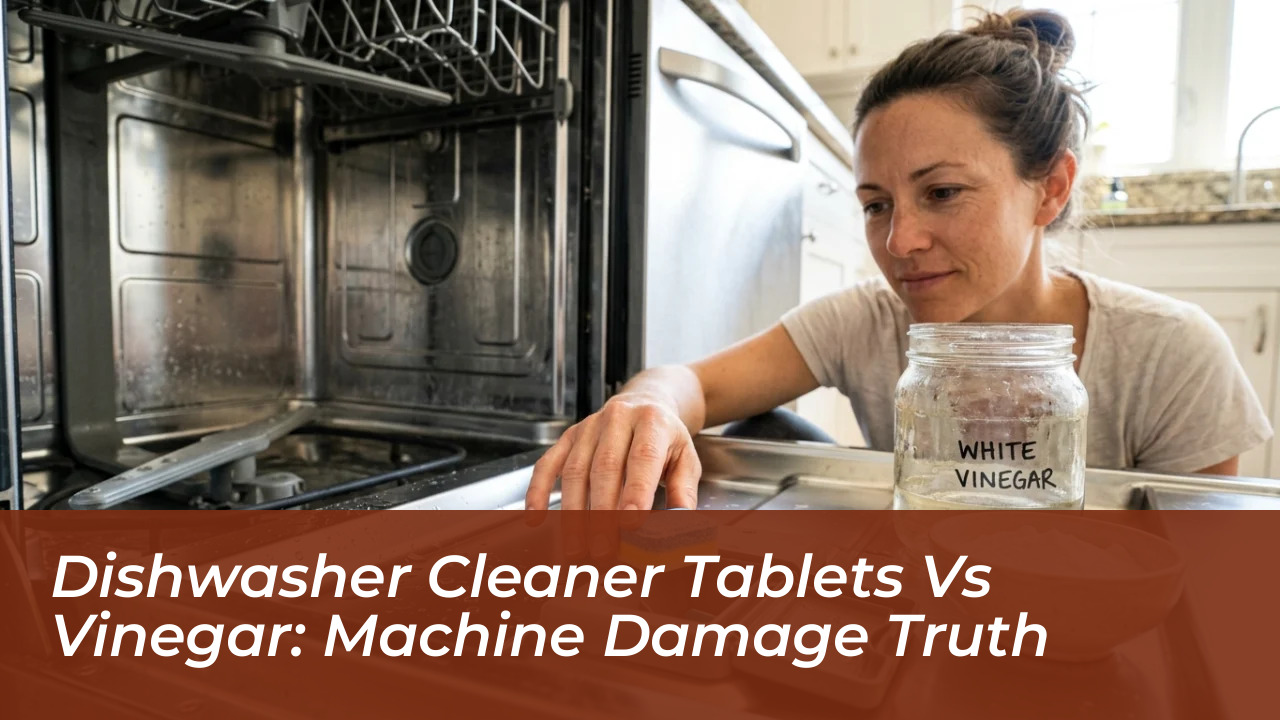

When staring into a dishwasher basin plagued by a lingering funk or mineral buildup, many homeowners reach straight for the pantry. White vinegar and bicarbonate of soda have long been championed across social media as the ultimate natural fix for household cleaning. However, relying on DIY kitchen hacks instead of purpose-formulated commercial products can carry unintended consequences for your appliance’s internal hardware.
Hard water affects more than 60 percent of homes across England and Wales, leaving thick calcium carbonate deposits inside internal pipework that standard wash cycles cannot dislodge. When limescale crusts over heating elements and micro-filters, energy consumption climbs and wash performance plummets. Deciding between a commercial product and a cheap DIY remedy comes down to machine chemistry and long-term component preservation.
The Hidden Chemistry Behind the Vinegar and Baking Soda Myth
The viral cleaning hack of combining distilled white vinegar with bicarbonate of soda creates an immediate, satisfying fizz. That violent bubbling is simply carbon dioxide gas escaping as an reacts with an alkali, leaving behind mostly water and a trace amount of sodium acetate.
Combining an and a base in equal measure largely cancels out the cleaning benefits of both compounds, resulting in salty water with little degreasing capability. When mixed directly in the appliance base, the two substances quickly neutralise each other. Vinegar requires a sustained acidic environment to dissolve stubborn limescale, whilst bicarbonate of soda relies on mild abrasiveness and alkalinity to cut through grease. Neutralising them before they circulate through the wash arms destroys the exact properties required to clean internal conduits.
What White Vinegar Does to Internal Rubber Seals
Running an empty cycle with a bowl of neat white vinegar on the top rack does expose the machine to dilute acetic , which dissolves mineral crusts effectively. However, appliance manufacturers warn that repeated exposure to acetic can dry out, swell, or perish the ethylene propylene diene monomer (EPDM) rubber used in door gaskets, motor seals, and internal drainage hoses.
Once an internal seal becomes brittle or warped, water slowly bypasses the barrier, leading to hidden leaks beneath the machine basin that can trigger flood protection switches or short-circuit electrical components.
How Purpose-Built Dishwasher Cleaner Tablets Work
Formulated dishwasher cleaner tablets rely on a balanced matrix of oxygen-based bleaching agents, non-ionic surfactants, and citric or sulfamic acids. Unlike harsh acetic , citric targets limescale deposits aggressively without compromising synthetic elastomers or internal plastic liners.
These commercial tablets work across distinct temperature bands within an intensive cycle. Surfactants dissolve hardened animal fats and starch films clinging to internal pipe walls, whilst targeted sequestering agents bind to free minerals in the water to prevent redeposition onto heating coils.
Comparison of Dishwasher Cleaning Agents
- Commercial Cleaner Tablets: Dissolves limescale via buffered citric and breaks down congealed fat without damaging rubber gaskets.
- Vinegar and Baking Soda: Neutralises active cleaning agents when mixed; prolonged neat vinegar use risks eroding internal seals.
- Pure Sodium Carbonate: Cuts heavy oil buildup effectively but offers zero decalcifying power against limescale.
- Citric Crystals: Safely strips mineral buildup from heating coils without degrading rubber components.
Because commercial formulations dissolve progressively or release agents at specific wash phases, they tackle both fatty blockages and mineral crusting simultaneously in an empty cycle.
The Correct Routine for Machine Maintenance
Keeping an appliance running at peak efficiency requires consistent mechanical cleaning alongside chemical decalcification. A chemical treatment cannot shift debris trapped inside the mechanical drainage barrier.
- Twist and remove the cylindrical micro-filter at the bottom of the tub, washing it under hot running water with a soft brush to remove trapped food particles.
- Inspect the lower and upper spray arm nozzles, poking clear any trapped seeds or mineral grains using a wooden c**ktail stick.
- Wipe down the outer door perimeter and rubber perimeter seals manually using a damp cloth and mild washing-up liquid, avoiding harsh acids.
- Place a dedicated dishwasher cleaner tablet dose into the dry detergent dispenser, or follow the manufacturer packaging instructions for empty-tub placement.
- Select the hottest available cycle-typically an intensive or hygiene setting operating at 65°C to 70°C-to ensure complete thermal activation of surfactants.
Homes in soft water districts benefit from running this routine every three to four months, whereas appliances in severe hard water regions require monthly maintenance to prevent heating coil degradation. Always check your appliance manual to confirm whether the manufacturer explicitly prohibits -based domestic home remedies under warranty terms.
Frequently Asked Questions
Can I safely use vinegar and baking soda together in my dishwasher?
No. Mixing vinegar and baking soda causes an immediate chemical neutralization reaction, turning the mixture into mostly water and salt while eliminating their individual cleaning capabilities.
Does white vinegar ruin dishwasher rubber seals?
Repeated, long-term exposure to neat or highly concentrated acetic can dry out, warp, and degrade EPDM rubber gaskets, leading to potential water leaks.
How often should I use commercial dishwasher cleaner tablets?
In hard water regions, run a dedicated cleaning tablet monthly. For soft water homes, every three to four months is generally sufficient to maintain optimal performance.
Are citric crystals safer than vinegar for descaling?
Yes. Citric powder dissolves mineral buildup effectively on heating coils while being significantly less aggressive toward internal synthetic rubber components than concentrated vinegar.
Do commercial cleaner tablets remove grease as well as limescale?
Yes. Purpose-built tablets combine active surfactants to liquefy congealed fats with sequestering acids to break down calcium deposits in a single wash cycle.