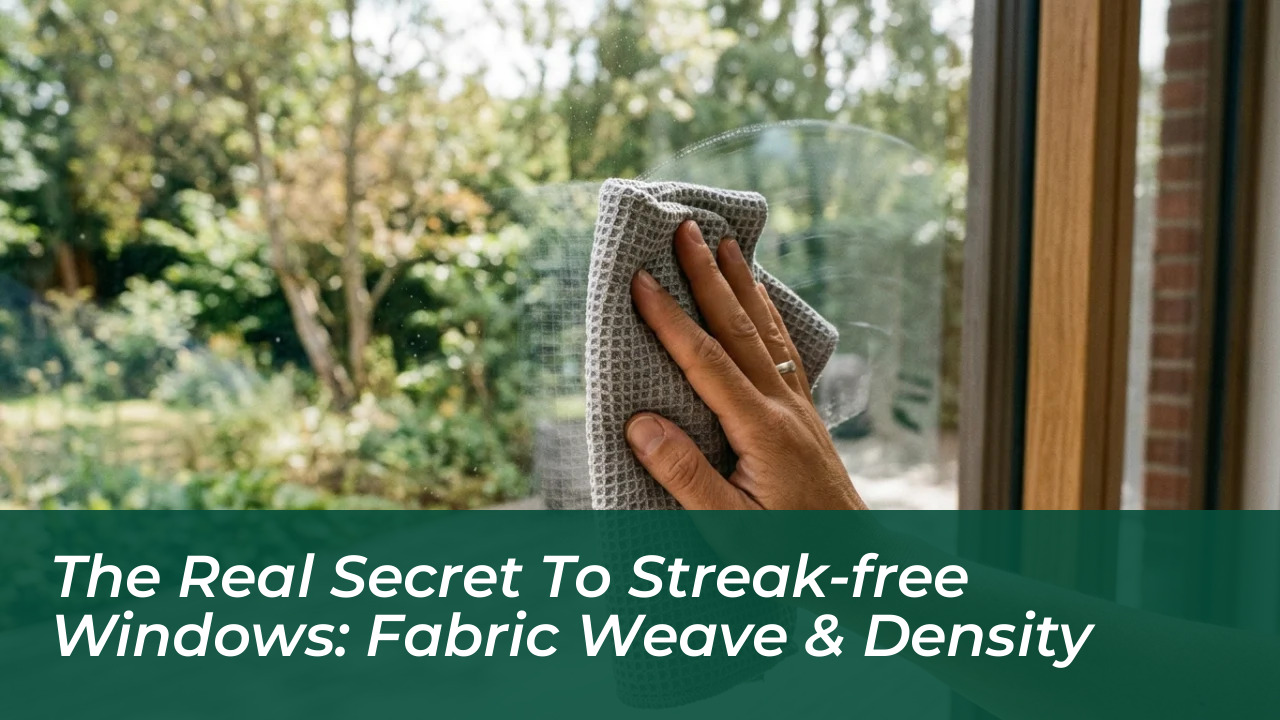

Achieving a crystal-clear view through your home windows often feels difficult. You spend hours spraying, wiping, and polishing, only to find a web of haze and smudges when sunlight hits the glass. The secret to streak-free windows does not lie in expensive commercial sprays. Instead, success comes down to matching the correct fabric weave and density of your microfiber cloths to the exact task.
While ordinary plush towels simply redistribute dirt and oils, a dedicated flat-weave or waffle-weave cloth lifts oily films and evaporates moisture instantly. Understanding how different microfiber structures interact with glass transforms an exhausting chore into a quick routine.
Why Traditional Household Cloths Fail on Glass Surfaces
Standard household dusting cloths feature high-pile loops designed to trap dust. When applied to wet window panes, these looped fibers bend under pressure, depositing trapped dust back onto the glass while shedding lint strands.
Traditional cotton tea towels present another issue. Cotton fibers are round and hollow, causing them to absorb water quickly while pushing oils across the pane. Split microfiber is engineered with synthetic polyester and polyamide strands cleaved at a microscopic scale, creating channels that grab mineral deposits and skin oils directly from the glass.
The most common error when cleaning interior glass is using the same plush towel to remove dirt and buff the surface, which spreads grime across the pane. Professional window cleaners split the process into two distinct phases using specialized fabrics.
Choosing the Best Microfiber Cloths: Weave and GSM
Microfiber quality is measured primarily by weight in grams per square meter (GSM) alongside the specific weave profile. Using the wrong GSM on glass leads to waterlogged material.
1. Waffle Weave for Heavy Cleaning
Waffle-weave cloths feature a distinct square indentation pattern across the surface. These recessed pockets hold excess moisture and dislodge stubborn external grime without grinding grit against the glass. They excel at the initial wash stage on exterior glass or kitchen splashbacks.
2. Flat or Diamond Weave for the Final Polish
Often referred to as glass cloths, flat-weave microfiber possesses no visible pile. Because the fabric sits completely flat against the window, it exerts uniform friction across the surface, scraping away moisture droplets before they form water spots.
| Fabric Characteristic | Optimal Window Application |
|---|---|
| Waffle Weave (300-400 GSM) | Initial washing and absorbing heavy moisture without dripping. |
| Flat Glass Weave (200-280 GSM) | Final dry buffing to remove smudges, haze, and lint. |
| Plush Terry Microfiber | Frame and sill wiping only; unsuitable for glass polishing. |
| Fish-Scale Weave | Fast interior mirror polishing and light maintenance cleaning. |
The Two-Cloth Technique for Effortless Clarity
Technique matters just as much as your cleaning solution. Applying a two-cloth method prevents cross-contamination and ensures the glass dries before streaks form.
- Dampen the first cloth with plain warm water: Use a medium-weight waffle weave wrung out until nearly dry to lift particulate matter and dissolve grease.
- Wipe in an overlapping pattern: Move from top to bottom in an S-shape to capture dirt without pushing it back into cleaned sections.
- Buff immediately with the dry flat weave: Before the thin water film evaporates naturally, take a dry glass-polishing cloth and buff briskly in broad circular motions.
This process eliminates the need for vinegar or chemical glass sprays on regular household dust. Water acts as the release agent, while the microfiber strands provide the mechanical cleaning action.
Dispelling the Fabric Softener Myth
A widespread misconception suggests that washing cleaning cloths with fabric conditioners keeps them soft and absorbent. In reality, fabric conditioners ruin microfiber permanently for glass applications.
Conditioners deposit a waxy silicone coating over fabrics. When a microfiber cloth absorbs this coating, its microscopic channels become clogged. The next time you wipe a window, that wax layer dissolves onto the glass, producing oily streaks.
To maintain non-absorbent microfiber, wash the cloths separately at 40°C to 60°C with a simple liquid detergent containing no optical brighteners. Never use fabric softeners or tumble-dryer sheets. Air-drying microfiber cloths on an indoor drying rack ensures the synthetic threads retain their electrostatic charge and structural integrity. Checking your cloth edges for laser-cut or soft-bound borders also prevents delicate window coatings from scratching.