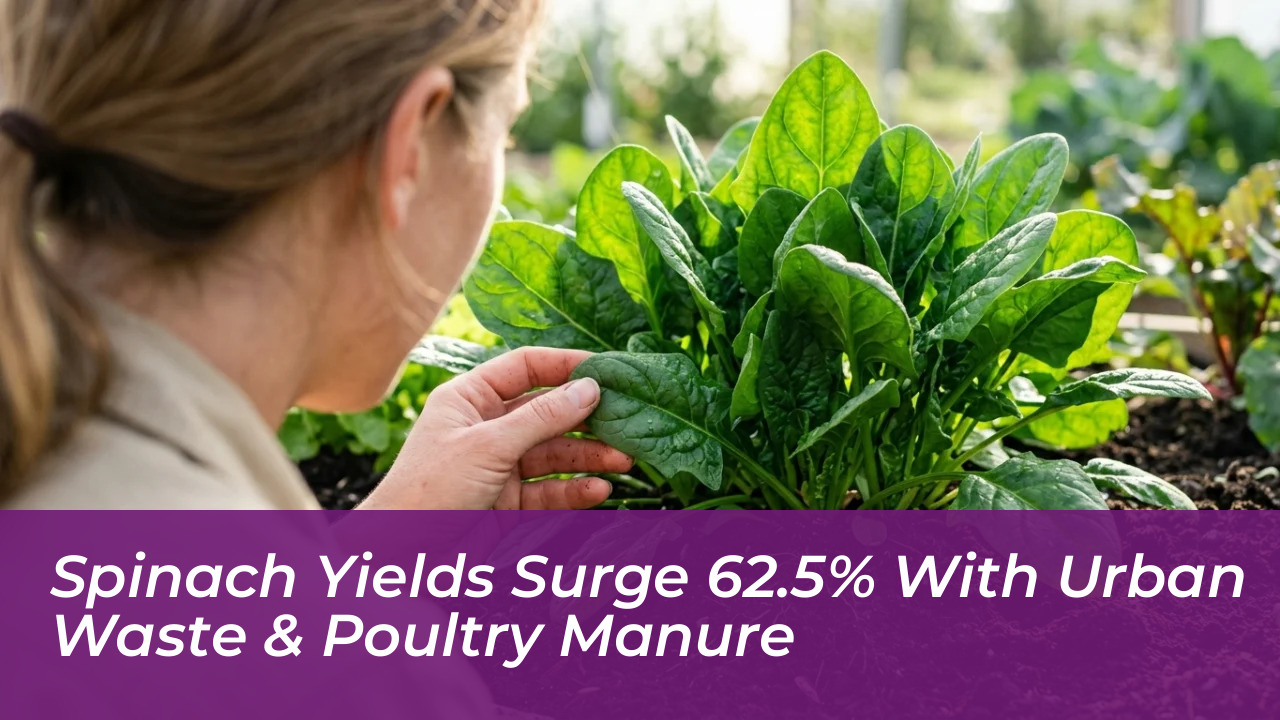

Combining municipal solid waste compost with poultry manure boosts spinach yields by up to 62.5 percent while significantly restoring degraded soil carbon and essential minerals. In a controlled trial published in Discover Soil by researchers at Banaras Hindu University, this precise organic mixture produced 17.49 tonnes of spinach per hectare compared with just 10.76 tonnes in unamended control soil. The data confirms that urban organic refuse, which routinely clogs municipal landfills, can serve as a potent substitute for synthetic chemical inputs.
Urban centres generate approximately 170,000 tonnes of municipal solid waste daily across India, yet barely half undergoes processing before entering open dumps. According to the country’s Central Pollution Control Board, roughly 51.3 percent of this discarded material consists of biodegradable matter. Diverting this biodegradable stream straight into crop nutrition tackles mounting landfill emissions while reversing the severe depletion of organic matter typical of intensive agricultural soils.
The Chemistry Behind the Waste Combination
City waste compost and poultry manure function as distinct nutritional counterparts. Laboratory characterisation revealed that municipal compost supplies a sustained 1.00 percent nitrogen reserve-double the 0.50 percent concentration found in poultry manure. However, the manure compensates by providing 2.26 percent phosphorus against the compost’s 0.71 percent, and 1.13 percent sulphur versus 0.27 percent.
Poultry manure also carries elevated baseline levels of essential trace minerals, particularly zinc, iron, and manganese. When applied together, the compost acts as a slow-release nitrogen baseline, whereas poultry manure releases immediate phosphorus and micronutrients to hungry root systems during early growth stages. This combination creates a dual mechanism of short-term and long-term fertility benefits.
Researchers evaluated these interactions on an Inceptisol-a dominant soil order across the Indo-Gangetic alluvial plains-using the fast-maturing spinach variety Kashi Baramasi. Topsoil sieved to two millimetres was distributed into 21 earthen pots before testing seven randomised regimes: a zero-amendment control, standalone compost doses at 20, 30, and 40 tonnes per hectare, and identical compost applications supplemented with poultry manure at 5 tonnes per hectare.
Vegetative Growth and Biological Activity
The physical transformation of the crop was apparent well before harvest at 50 days. Spinach receiving the top-tier treatment-40 tonnes per hectare of compost alongside 5 tonnes per hectare of poultry manure-reached an average height of 29.48 centimetres, marking a 30.8 percent increase over the control’s 22.55 centimetres. Leaf area index expanded by 51.2 percent, total leaf count rose by 35.6 percent, and chlorophyll levels recorded via SPAD meter rose by 10.9 percent due to enhanced nitrogen synthesis.
Agricultural Metrics and Soil Transformations
- Fresh Shoot Weight: Increased from 48.03 g to 78.10 g per pot.
- Dry Biomass Yield: 69.3% increase, rising from 3.52 g to 5.96 g per pot.
- Total Nitrogen Uptake: 426% surge over unamended soil.
- Leaf Potassium Content: Rose to 4.23%, with total uptake climbing 190% to 25.20 g.
- Soil Organic Carbon: Elevated significantly from 0.76% to 2.79%.
- Available Soil Phosphorus: Rose from 25.59 to 43.99 mg/kg.
Biological soil vitality experienced an equally sharp revival under these organic amendments. Dehydrogenase activity-the standard biochemical marker for soil microbial respiration-climbed steadily with every added increment, peaking under the maximum combined regime alongside available zinc gains from 1.09 to 3.57 milligrams per kilogram.
The Heavy Metal Dilemma and Practical Application
A widespread assumption among conventional growers is that higher organic matter inputs are universally beneficial and risk-free. However, the trial’s laboratory data exposes a critical threshold where continuous urban waste recycling can elevate heavy metal risks. While DTPA-extractable cadmium, chromium, and nickel remained modest under lower application rates, applying 40 tonnes per hectare triggered notable accumulations.
Lead levels climbed to 3.80 milligrams per kilogram compared to 1.26 milligrams per kilogram in the control, alongside a nearly threefold rise in nickel and cadmium. Every measured parameter remained strictly within statutory safety thresholds established by the Food and Agriculture Organization (FAO), the World Health Organization (WHO), and European Commission soil directives. Tissue analysis also confirmed that accumulation within edible spinach shoots stayed well beneath phytotoxic limits. Nonetheless, unchecked accumulation over several consecutive seasons could pose risks to food safety.
Crucially, the study showed that applying 30 tonnes per hectare of compost supplemented with 5 tonnes of poultry manure yielded statistical parity with the 40-tonne compost regime. This allows growers to achieve peak biomass while avoiding excessive compost loading and reducing trace metal accumulation.
Transitioning from Experimental Pots to Field Rows
To safely replicate the agronomic benefits of integrated waste amendments while managing soil health, researchers highlight several practical management steps for agricultural producers:
- Conduct baseline soil testing: Verify current background levels of heavy metals (cadmium, lead, and nickel) and organic carbon prior to treatment.
- Procure pre-screened compost: Ensure municipal organic waste is fully stabilised, showing neutral pH and low electrical conductivity.
- Adopt balanced application ratios: Cap city waste compost at moderate rates (roughly 30 tonnes per hectare) and combine with 5 tonnes per hectare of nitrogen- and phosphorus-dense poultry manure.
- Monitor long-term accumulation: Conduct post-harvest plant tissue and soil assays across multi-season cycles to ensure trace elements remain within international safety guidelines.
Transforming city food scraps and commercial poultry droppings into high-grade crop nutrition provides a clear framework for circular agriculture. Long-term field trials across varying climate zones will be essential to establish lasting safety profiles for continuous vegetable production.
Frequently Asked Questions
What crop was tested in the Banaras Hindu University study?
The study evaluated the fast-maturing spinach variety known as Kashi Baramasi (Spinacea oleracea L.).
How much did the spinach yields increase by?
Spinach yields surged by up to 62.5 percent, producing 17.49 tonnes per hectare under optimal treatment compared to 10.76 tonnes in unamended control soil.
Why are municipal compost and poultry manure combined?
They act as nutritional counterparts. Municipal compost provides a slow-release nitrogen baseline, while poultry manure delivers immediately available phosphorus, sulphur, and essential micronutrients like zinc and iron.
Does using urban waste pose heavy metal risks?
While high application rates (40 tonnes per hectare) increase trace metal concentrations like lead and cadmium, all values remain safely within FAO, WHO, and European Commission safety thresholds. Moderate application rates (30 tonnes per hectare) achieve identical crop yields while minimizing trace metal risks.
What soil order was used in the research trial?
The experiment was conducted on an Inceptisol, which is a dominant soil order across the Indo-Gangetic alluvial plains.