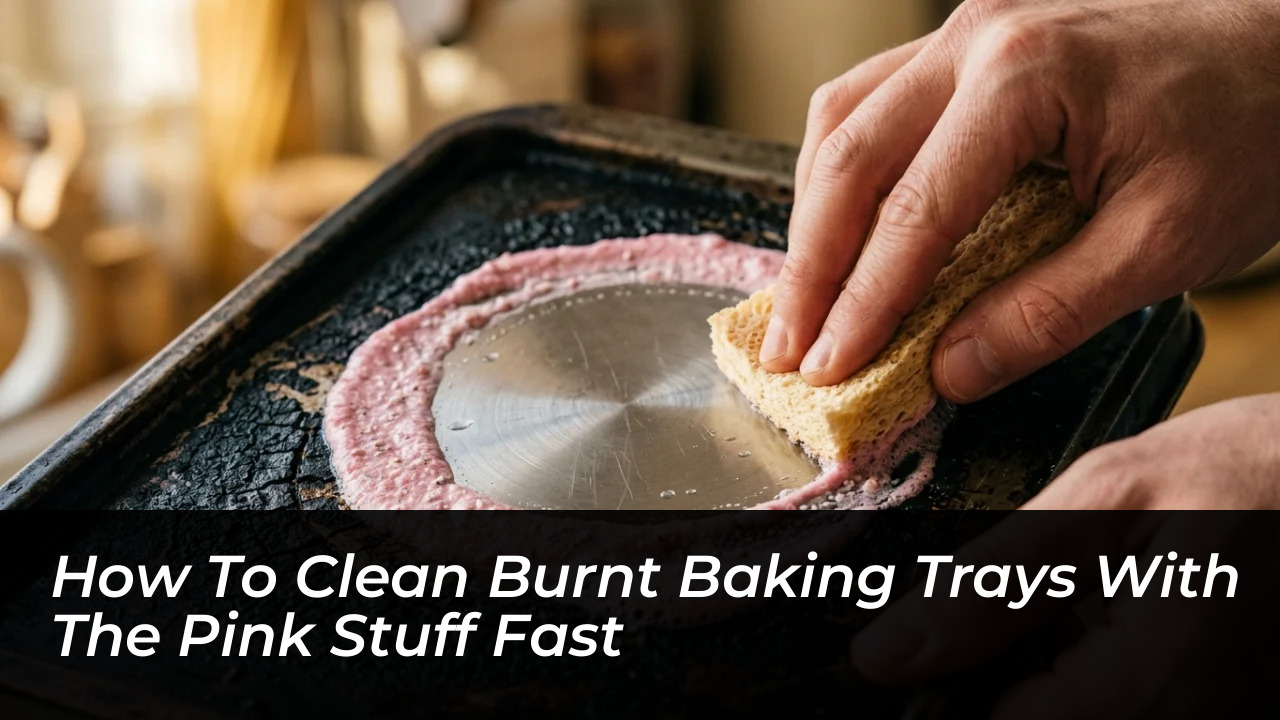

You can remove rock-hard, blackened grease and restore a ruined oven sheet in under twenty minutes when you clean a burnt baking tray with The Pink Stuff using a mildly abrasive paste technique. The cleaning compound relies on natural quartz particles, vegetable soap, and sodium silicate to break down stubborn polymerised cooking oils without requiring toxic oven cleaners or aggressive wire wool.
Baked-on grime forms through a process called oil polymerisation, where fats cross-link under high oven temperatures to create a varnish-like shell. Standard washing-up liquids lack the mechanical friction and chemical composition to penetrate this barrier. Knowing which metals tolerate abrasive pastes ensures you avoid scratching delicate finishes while stripping stubborn carbonisation down to bare metal.
The Science Behind Why The Pink Stuff Tackles Carbonised Grease
The Pink Stuff Miracle Cleaning Paste functions primarily as an abrasive suspension. The microscopic quartz mineral particles provide controlled friction, cutting into carbon layers without creating the deep gouges associated with heavy steel scourers. Combined with sodium silicate and soap, the formulation softens lipid bonds.
This dual mechanical and surfactant action lifts baked residues away from the substrate so they can be rinsed clean. Applying uniform circular pressure allows the quartz granules to wear away carbon deposits evenly across the sheet rather than scouring a single patch down to bare substrate prematurely. While the paste is highly effective, surface compatibility determines whether your tray emerges spotless or ruined.
Surface Compatibility: When to Use the Paste
Before scrubbing, identify the material of your baking sheet. Modern British kitchens feature a mix of uncoated aluminium, stainless steel, enamel, and synthetic non-stick coatings. Using any micro-abrasive paste on traditional non-stick sheets will scratch and peel the fluoropolymer coating, rendering the pan food-unsafe. Keep abrasive pastes reserved for untreated metals and commercial-grade baking trays.
Tray Material Suitability & Risk Level
- Stainless Steel: High suitability; highly resilient against quartz friction.
- Enamel Coated: Moderate suitability; gentle pressure needed to prevent dulling.
- Uncoated Aluminium: Moderate suitability; works well but may alter surface shine.
- PTFE Non-Stick: Not recommended; abrasives strip the coating completely.
- Cast Iron: Use caution; strips away established seasoning layers.
Step-by-Step Guide to Restoring a Burnt Baking Tray
Achieving the best finish requires minimal moisture during the initial scrub, as excess water dilutes the paste and reduces mechanical friction. Follow these steps for a rapid metal restoration:
- Dry wipe the tray: Scrape off loose food debris using a wooden spatula and wipe the surface dry with a kitchen towel.
- Apply the paste: Scoop a generous tablespoon of The Pink Stuff directly onto the burnt patches.
- Allow contact time: Let the paste sit undisturbed for 10 to 15 minutes to allow the soap agents to penetrate grease layers.
- Work in small circles: Take a damp, non-scratch microfibre sponge or a dual-sided cleaning pad and buff the burnt areas in tight, circular motions.
- Rinse thoroughly: Wash away the emulsified residue using warm water and standard dish soap to remove all mineral dust.
- Dry immediately: Hand-dry the sheet thoroughly with a clean tea towel to prevent water spots or surface oxidation.
For decades-old carbon buildup, repeat the application once more on stubborn edge corners.
Myth vs Reality: Do You Need Extreme Pressure?
A widespread misconception suggests that removing baked grease requires heavy, exhausting physical exertion. In reality, applying excessive force flattens the cleaning pad and creates uneven scratches on softer aluminium.
Letting the quartz particles perform the cutting action through patient, circular buffing produces a far cleaner surface with minimal fatigue. Controlled friction consistently outperforms aggressive force.
Preventing Future Burnt Grease Buildup
Once your baking tray is restored, adopting proactive kitchen habits will save you from having to repeat deep cleaning sessions every month. Lining sheets with reusable silicone baking mats or unbleached baking parchment creates an impenetrable barrier against high-temperature caramelisation.
Additionally, washing trays immediately after they cool prevents residual fats from polymerising during subsequent oven preheats. A restored baking tray distributes oven heat more evenly, preventing hot spots that burn delicate pastries. Always perform a quick spot check on the underside of vintage trays before treating the entire cooking surface.
Frequently Asked Questions
Can you use The Pink Stuff on non-stick baking trays?
No. The Pink Stuff contains mild quartz abrasives that will scratch, dull, and eventually peel PTFE non-stick coatings, making the baking sheet unsafe for food contact.
How long should I let The Pink Stuff sit on burnt grease?
Leaving the paste on for 10 to 15 minutes is usually sufficient to allow the soap agents and sodium silicate to soften hardened, carbonised cooking oils.
Do I need to scrub aggressively to remove burnt carbon?
No. Excessive physical force can warp or scratch softer metals like aluminium. Let the quartz particles do the work through gentle, circular buffing motions.
Is it safe to use The Pink Stuff on aluminium baking sheets?
Yes, but use light pressure and do not leave the paste sitting for extended periods, as prolonged contact with alkaline cleaning agents can alter the surface shine of raw aluminium.
How can I prevent my baking trays from burning in the future?
Line your baking sheets with parchment paper or silicone mats, wash them thoroughly after every use to prevent oil polymerisation, and avoid cooking at excessively high temperatures with sugary glazes.