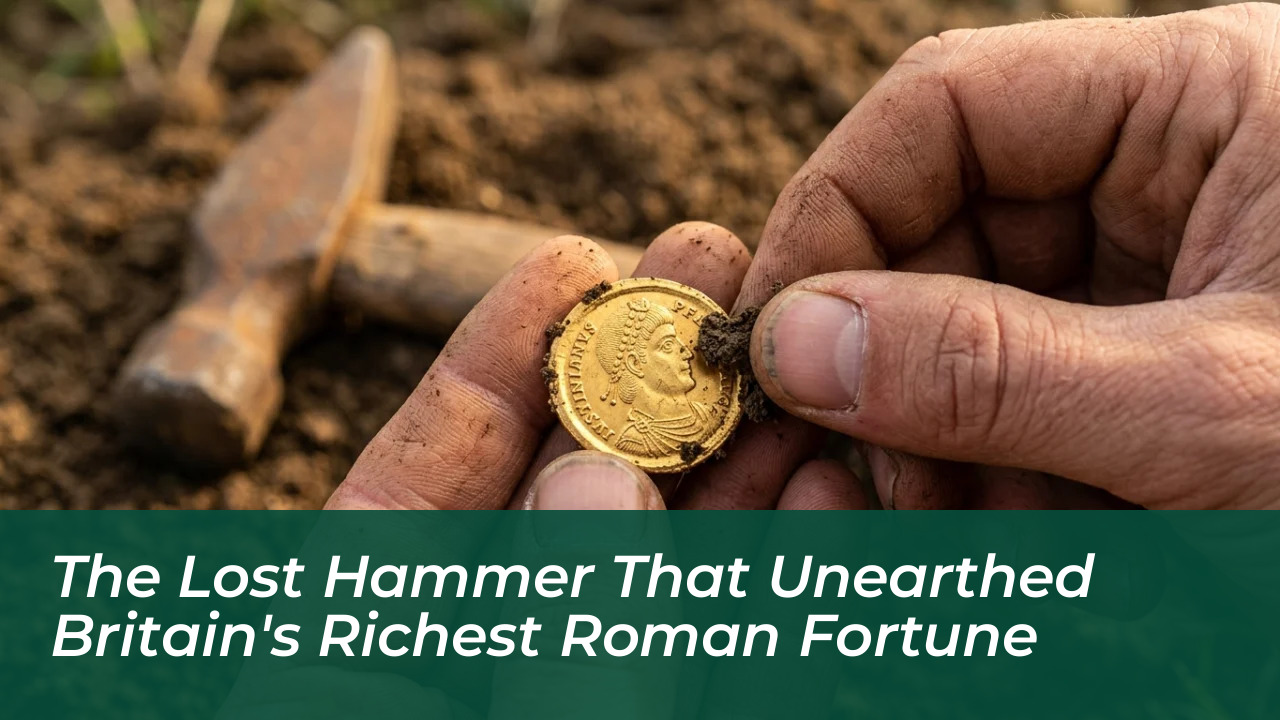

On 16 November 1992, retired gardener Eric Lawes stepped into a damp field in Hoxne, Suffolk. He carried a metal detector given to him as a retirement gift. He was not searching for history, but for a lost iron hammer belonging to tenant farmer Peter Whatling, who had misplaced the tool in the pasture. Within minutes of sweeping the ground, the metal detector triggered a powerful, unmistakable signal just beneath the topsoil. Rather than hitting iron, Lawes unearthed silver spoons and Roman gold coins. This accidental discovery revealed the Hoxne Hoard, the richest collection of late Roman treasure ever recovered in Britain.
Why Halting the Dig Saved British Archaeology
Lawes made an immediate decision that defined the archaeological fate of the find: he stopped digging. Instead of turning over the remaining soil or taking valuables with him, he alerted local authorities and the Suffolk Archaeological Unit. By the morning of 17 November, professional archaeologists were on-site to execute an emergency controlled excavation.
Because the earth remained undisturbed, researchers lifted the objects in large blocks of soil. They transported them to the British Museum for laboratory disassembly. This careful approach preserved vital organic materials, including the remnants of an oak chest, smaller inner wooden boxes, tiny silver padlocks, and traces of wheat straw and linen wrappings. In an ironic stroke of luck, the archaeologists’ systematic sweep of the 30-metre radius also solved the day’s original problem. They found Peter Whatling’s missing hammer intact in the field.
The Anatomy of the Hoxne Hoard
The scale of the cache stunned researchers. It represented the portable wealth of an elite family rather than a merchant’s bulk stock or a military payroll. Official records confirmed an extraordinary assembly of precious bullion and domestic luxury items. This included over 3.5 kilograms of gold and 23.75 kilograms of silver.
- Gold Coinage: 569 gold solidi, close to their theoretical 4.48-gram weight and nearly pure gold.
- Silver Coinage: 14,272 silver coins, primarily 14,212 siliquae and 60 miliarenses, many with clipped edges to stretch dwindling supplies.
- Bronze Coinage: 24 bronze nummi.
- Jewellery: An intricate gold body chain set with amethysts and garnets, necklaces, finger rings, and 19 gold bracelets.
- Tableware & Luxury Items: Nearly 100 silver spoons and ladles, bowls, a tigress-handled vessel, and four silver-gilt pepper pots.
The Female Pepper Pot and Domestic Splendour
Among the most famous artifacts is a hollow, silver-gilt pepper pot (*piperatorium*). Sculpted in the likeness of an aristocratic Roman woman, people once popularly dubbed it an “empress.” Black pepper was an imported luxury item brought from India. This indicated that the owner maintained high-status banqueting standards even during severe regional instability. Several spoons discovered in the hoard bear the name Aurelius Ursicinus. Meanwhile, a gold bracelet features the inscription VTERE FELIX DOMINA IVLIANE (“Use this happily, Lady Juliane”), offering a fleeting personal connection to the individuals who once owned the wealth.
Myth vs. Fact: Unpacking the Fourth-Century Panic
A frequent misconception is that hoards represent hidden plunder buried haphazardly by invaders during chaotic raids. Archaeological evidence from Suffolk disproves that assumption entirely.
“The objects were packed deliberately inside fitted containers, wrapped in fabrics, and stacked with care, pointing to a conscious effort to safeguard valuable assets during a period of acute regional turbulence.”
The latest coins in the collection date to the reign of Constantine III, around AD 407-408. This aligns directly with the timeline when formal Roman administration in Britain faltered and troops were withdrawn. Whether the owners fled overseas, fell victim to conflict, or simply lost the precise spot in the changing landscape remains an unsolved historical mystery.
Legal Protocols and the Treasure Act 1996
The discovery served as a model benchmark for modern treasure regulations across England and Wales. Under previous archaic treasure trove rules, finders received rewards while landowners and tenants often got nothing. This incentivized illicit digging. The responsible reporting of the Hoxne Hoard directly influenced the drafting of the Treasure Act 1996, which established clearer definitions, legal reporting timeframes, and shared financial rewards for finders and landowners.
Key Guidelines for Modern Metal Detectorists
- Stop digging immediately once potential historical deposits, clusters of coins, or precious metals appear.
- Record the precise location using coordinates and preserve the surrounding soil layers without washing the objects.
- Report the discovery to the local Finds Liaison Officer or county archaeological service within 14 days under the Treasure Act 1996.
Today, the permanent collection of the British Museum in Room 49 houses the key artifacts of the Hoxne Hoard, alongside Peter Whatling’s recovered iron hammer. The accidental find remains a to how responsible stewardship and a sudden beep in a quiet field can illuminate the complex final days of Roman Britain.